






Bilateral merchandise trade stood at nearly USD 1.16 billion in 2025-26 and is projected to reach USD 3 billion by 2030.
Prime Minister Narendra Modi’s historic visit to New Zealand has elevated bilateral relations to a Strategic Partnership, laying the groundwork for stronger economic cooperation, enhanced security collaboration, and a shared vision for a free, open, and prosperous Indo-Pacific Region
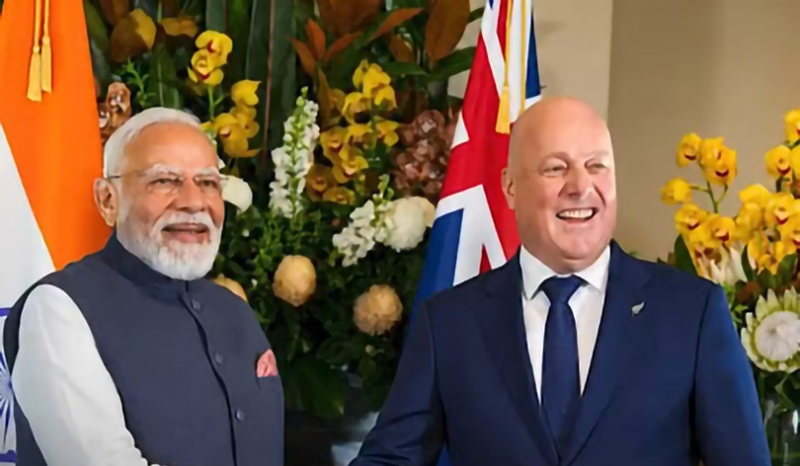
Prime Minister Narendra Modi’s recent visit to New Zealand marks a defining moment in India–New Zealand relations. Held after a four-decade gap since the last visit by an Indian Prime Minister, the visit transformed bilateral ties into a comprehensive Strategic Partnership. Hosted by New Zealand’s Prime Minister Christopher Luxon, the visit culminated in the adoption of the India–New Zealand Strategic Partnership: Roadmap to 2030, the conclusion of the long-awaited India–New Zealand Free Trade Agreement (FTA), the signing of ten bilateral agreements, and the announcement of eight additional initiatives spanning trade, defence, agriculture, education, culture, and people-to-people exchanges. Together, these outcomes establish a robust institutional framework for long-term cooperation between two democratic nations with complementary economies and shared strategic interests.
The conclusion of the India–New Zealand Free Trade Agreement marks the visit’s most significant economic achievement. The India-New Zealand FTA will improve market access, facilitate investment, strengthen services trade, encourage technology collaboration and promote talent mobility. Both governments have set an ambitious target to double bilateral trade in goods and services to NZ$7 billion by 2030. In addition, the implementation of the Authorised Economic Operators Mutual Recognition Arrangement under the Customs Cooperation framework will simplify customs procedures, reduce transaction costs and facilitate trusted trade between the two countries.
Prime Minister Modi, addressing business leaders in Auckland, highlighted India’s expanding opportunities across infrastructure, civil aviation, logistics, clean energy, urban mobility, water and waste management, and the digital economy. He invited New Zealand businesses to actively participate in India’s growth journey and emphasised collaboration in fintech, innovation, and emerging technologies.
Although bilateral merchandise trade remains modest, recent trends point to substantial untapped potential. India’s exports to New Zealand rose from USD 486.25 million in FY2020-21 to USD 566.51 million in FY2025-26. In FY2025-26, India’s imports from New Zealand stood at USD 589.10 million, bringing total bilateral merchandise trade to nearly USD 1.16 billion. Bilateral trade is expected to double to USD 3 billion by 2030. The Free Trade Agreement provides a comprehensive institutional framework to accelerate this growth by improving market access, promoting investment and strengthening business partnerships.
Agriculture has emerged as another major pillar of bilateral cooperation. New Zealand’s expertise in dairy science, horticulture, forestry, food safety, sustainability and post-harvest management complements India’s expanding food processing sector and large agricultural market. Both countries have established an Agricultural Productivity Partnership under the FTA, with action plans for kiwifruit, apples and honey. The initiative also supports the establishment of Centres of Excellence for kiwifruit cultivation in Nagaland and Uttarakhand. A Memorandum of Cooperation on Animal Husbandry and Dairying, along with continued collaboration in horticulture and forestry, reflects a shift from traditional agricultural trade towards technology transfer, productivity enhancement and sustainable value-chain development.
The visit also significantly strengthened defence and maritime cooperation. Building on the Defence Cooperation Memorandum signed in 2025, both governments agreed to deepen engagement between their defence ministries and armed forces. The signing of the Maritime Cooperation Arrangement, the Implementing Arrangement on Hydrography and Nautical Cartography, and the Mutual Logistics Support Arrangement between the Indian Navy and the New Zealand Defence Force will strengthen maritime cooperation and facilitate future bilateral naval exercises. India also appreciated New Zealand’s leadership in the Indo-Pacific Oceans Initiative, particularly its focus on combating Illegal, Unreported and Unregulated Fishing. The establishment of an annual Maritime Security Dialogue further institutionalises cooperation to safeguard regional maritime interests.
Security cooperation has also taken on a stronger operational dimension. Recognising evolving regional security challenges, both countries agreed to establish a Joint Working Group on Counter-Terrorism to enable regular consultations and coordinated action. They reaffirmed their commitment to combating transnational organised crime, drug trafficking, financial crimes, cyber-enabled offences, terrorism, and human trafficking. Both sides also agreed to continue the India–New Zealand Cyber Dialogue. These initiatives broaden bilateral cooperation beyond diplomacy and trade, making security a defining pillar of the Strategic Partnership.
Education and scientific collaboration remain important bridges between the two nations. Building on the 2025 Education Cooperation Arrangement, both governments agreed to enhance student mobility, institutional partnerships and academic exchanges. Scientific cooperation received further impetus through a Memorandum of Understanding between India’s National Centre for Polar and Ocean Research and the University of Canterbury for Antarctic research. Collaboration between the National Institute of Food Technology, Entrepreneurship and Management (NIFTEM-K) and Massey University will also promote research partnerships and student exchanges in food technology. These initiatives strengthen innovation, research and knowledge sharing while building long-term institutional linkages.
The visit further expanded cooperation in tourism, disaster management and climate resilience. A Memorandum of Arrangement on Tourism aims to promote greater visitor exchanges, and both governments encouraged airlines to explore direct, non-stop connectivity under the updated Air Services Agreement. Enhanced air connectivity is expected to boost tourism, business travel and people-to-people interactions.
Another significant outcome was the Memorandum of Cooperation between India’s National Disaster Management Authority and New Zealand’s National Emergency Management Agency, covering earthquake resilience, tsunami preparedness, coastal hazard mitigation and capacity building. Both countries also reaffirmed their cooperation through the International Solar Alliance, the Coalition for Disaster Resilient Infrastructure and the Global Biofuels Alliance, underscoring their collective commitment to tackling global climate challenges.
People-to-people ties remain the strongest foundation of India–New Zealand relations. As part of the 100 Years of Unity Through Sport celebrations in 2026, both Prime Ministers welcomed the India–New Zealand Joint Action Plan on Sport, which covers coaching, sports science, high-performance training, and institutional exchanges. Cultural cooperation was strengthened through agreements between the two Ministries of Culture and through collaboration between the National Maritime Heritage Complex at Lothal and the New Zealand Maritime Museum.
Traditional medicine exchanges further deepened cultural engagement. A particularly memorable moment of the visit was Prime Minister Modi’s interaction with over 10,000 members of the Indian diaspora at Auckland’s “Kia Ora Modi” event. He described the Indian community as a vital bridge between the two countries and acknowledged its significant contribution to New Zealand’s economy, society and cultural diversity.
Beyond bilateral cooperation, both leaders reaffirmed their commitment to a free, open and rules-based Indo-Pacific, grounded in respect for sovereignty, territorial integrity and international law, including UNCLOS. They reiterated support for ASEAN-led regional architecture and recognised the need to strengthen multilateral institutions to address emerging global challenges. New Zealand reaffirmed its support for India’s permanent membership of a reformed United Nations Security Council and acknowledged the importance of India’s participation in the Nuclear Suppliers Group. Both countries also expressed concern about geopolitical developments affecting global supply chains and reaffirmed their commitment to combating terrorism through cooperation with the United Nations, the Financial Action Task Force and the UNSC sanctions framework.
In conclusion, Prime Minister Modi’s historic visit has fundamentally transformed India–New Zealand relations, shifting them from a largely friendly bilateral engagement to an institutionalised Strategic Partnership. The Roadmap to 2030, the landmark Free Trade Agreement and multiple sector-specific agreements provide a robust framework for expanding cooperation across trade, investment, agriculture, defence, education, innovation and maritime security. While current trade volumes remain modest, the institutional architecture established during the visit positions both countries to unlock significant economic opportunities and deepen strategic cooperation. Anchored in shared democratic values, complementary economic strengths and a common Indo-Pacific vision, the India–New Zealand Strategic Partnership is well positioned to serve as a model of comprehensive bilateral cooperation in the years ahead.
Views: 66