


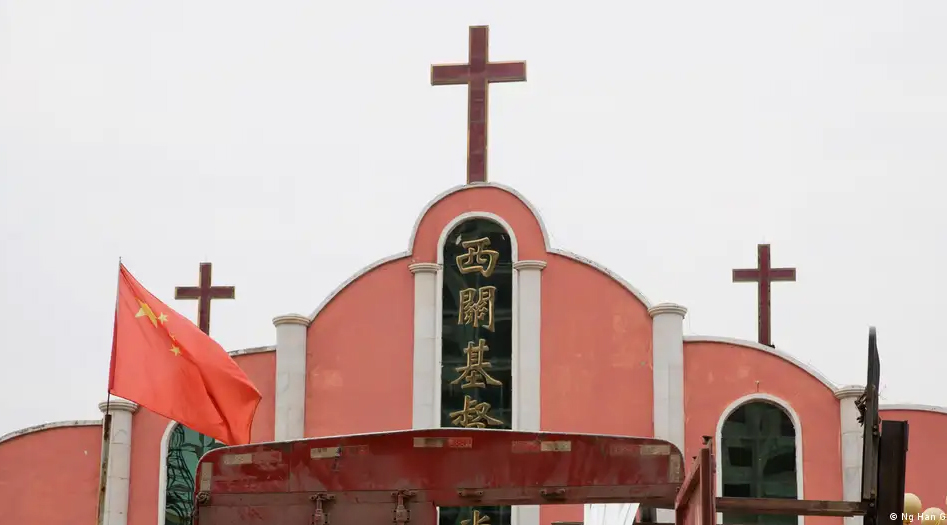







On January 5, 2026, hundreds of armed police surrounded Yayang Church in Wenzhou, a coastal city in China’s Zhejiang province. The operation culminated in the removal of the church’s cross from its scaffolding, a highly symbolic act that signalled more than a local zoning dispute.
Yayang Church is an unregistered Protestant congregation—one of many “house churches” that operate outside the state-approved religious system. Its targeting reflects an intensifying national campaign against independent Christian worship, one that has accelerated through late 2025 and into early 2026.
The action followed weeks of pressure. Reports indicate that the initial crackdown on Yayang Church began in mid-December, when several members were detained.
By early January, the confrontation had escalated into a full-scale police operation, underscoring the authorities’ determination to bring unofficial churches firmly under state control.
Unregistered churches and the limits of tolerance
China officially recognises Christianity, but only through state-controlled institutions.
Protestant churches are expected to operate under the Three-Self Patriotic Movement, while Catholics are required to align with the state-backed Catholic Patriotic Association. Churches that refuse registration, citing theological autonomy or resistance to political oversight, are deemed illegal.
For years, Zhejiang province—and Wenzhou in particular—has been known as a stronghold of independent Christianity. Often called “China’s Jerusalem,” Wenzhou has seen repeated clashes between congregations and authorities.
The removal of crosses, sealing of churches, and arrests of pastors have periodically erupted, but the recent actions suggest a renewed and more coordinated phase of enforcement rather than sporadic local initiatives.
A nationwide pattern emerges
The events in Wenzhou did not occur in isolation. During the same week, an underground church in Chengdu, the capital of Sichuan province, reported that several of its key leaders had been detained.
Chengdu’s Early Rain Covenant Church—one of China’s most prominent unregistered congregations—said nine members, including senior leaders, were taken into custody during what it described as a “concerted operation.”
Early Rain Covenant Church has faced sustained pressure for years, including raids, detentions, and long prison sentences for its pastor and elders.
The latest detentions indicate that the scrutiny has not eased with time but has instead become more systematic, targeting organisational leadership to weaken churches’ ability to function.
Further north, in Shanxi province, the Linfen Golden Lampstand Church has also been caught in the dragnet. In mid-2025, around a dozen individuals affiliated with the church were convicted on fraud charges, according to human rights groups.
Critics argue that such charges are frequently used as legal instruments to suppress religious groups when direct prosecution for worship activities would draw greater scrutiny.
Legal framework of control
China’s constitution nominally guarantees freedom of religious belief, but in practice, this right is tightly circumscribed by laws and regulations that prioritise state security and ideological conformity.
Revised religious regulations introduced in recent years have expanded the government’s authority to monitor, approve, and penalise religious activity. These rules require religious groups to register, submit to oversight, and align with “socialist values.”
Unregistered churches fall outside this framework and are therefore vulnerable to being labelled as illegal gatherings. Enforcement often relies on broad charges—such as fraud, illegal business operations, or disturbing social order—that carry severe penalties.
This legal ambiguity allows authorities to dismantle congregations while framing actions as routine law enforcement rather than religious repression.
Cross removals as a political signal
The removal of crosses has become one of the most visible markers of the crackdown.
In Zhejiang, cross-removal campaigns date back more than a decade, but their reappearance now carries renewed political weight. The cross, a central Christian symbol, is treated by authorities not merely as a religious emblem but as a public assertion of identity outside state narratives.
In the case of Yayang Church, the cross removal was accompanied by a heavy police presence, amplifying its message. Such displays are widely interpreted as warnings to other congregations that resistance—or even quiet non-compliance—will trigger decisive action.
From localised pressure to coordinated campaigns
Human rights observers note that recent operations show signs of coordination across provinces.
The near-simultaneous actions in Zhejiang, Sichuan, and Shanxi suggest a centrally driven approach rather than isolated enforcement by local officials. Detentions of senior church leaders, rather than rank-and-file members alone, point to an effort to dismantle organisational structures.
This approach mirrors tactics used against other civil society groups, including lawyers, activists, and independent media.
By targeting leadership and framing cases through criminal law, authorities can disrupt networks while maintaining an appearance of legal process.
Impact on congregations
For members of unregistered churches, the consequences extend beyond arrests and closures. Raids often involve confiscation of property, surveillance of families, and pressure on employers or landlords. Congregations may be forced to disband or meet secretly, increasing the risks for participants.
In Wenzhou, the encirclement of Yayang Church sent shockwaves through local Christian communities, many of whom have long navigated a precarious balance between worship and compliance.
In Chengdu, repeated detentions have left Early Rain Covenant Church functioning under constant threat, its activities constrained by fear of further reprisals.
International scrutiny and human rights concerns
International human rights organisations have repeatedly raised concerns about China’s treatment of religious groups.
They argue that the crackdown on unregistered churches violates international standards on freedom of religion and belief, including protections enshrined in the Universal Declaration of Human Rights.
Cases such as the convictions linked to Linfen Golden Lampstand Church and the detentions at Early Rain Covenant Church have been cited as examples of how criminal law is used to suppress peaceful religious practice.
The events of late 2025 and early 2026 reinforce these concerns, suggesting that pressure on unofficial churches is intensifying rather than easing.
A narrowing space for independent faith
The crackdown on churches forms part of a broader effort to align all social institutions with the ideological priorities of the Chinese Communist Party.
Religion, particularly when organised independently, is viewed through a lens of political risk. The insistence on registration, loyalty, and conformity leaves little room for communities that seek to practice faith without state mediation.
From the removal of crosses in Wenzhou to detentions in Chengdu and convictions in Shanxi, the pattern is increasingly clear — independent churches are being squeezed through legal, administrative, and police measures designed to curtail their visibility and influence.
Views: 255


