


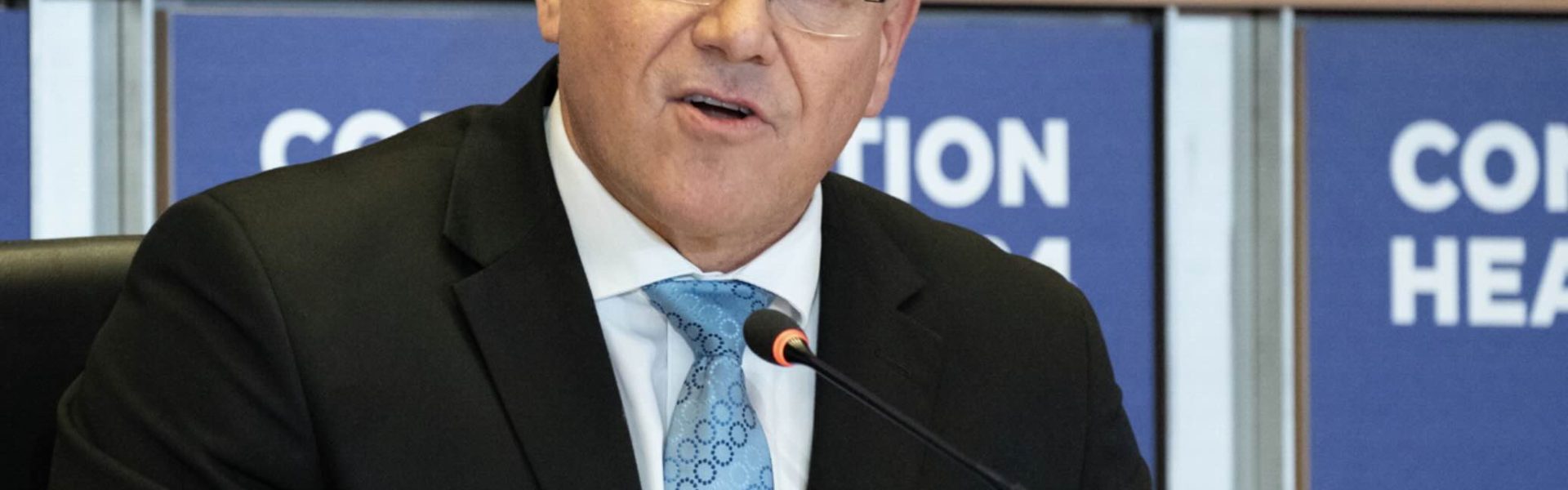







BRUSSELS: The confrontation between the Netherlands and China over the chipmaker Nexperia has rippled across Europe far beyond the boundaries of a corporate dispute. What unfolded over the past weeks has become a case study of how deeply the European Union remains exposed to external pressure in technology supply chains, and why Brussels is racing to deliver a new doctrine of economic security.
In an exclusive interview with Euronews, EU Trade Commissioner Maroš Šefčovič summed up the lesson in the starkest terms: “Everything can be weaponised.”
For Europe, he said, the warning signs have accumulated over the past years. It began with Russian gas. It continued with critical raw materials. It has now reached both high-end and low-end semiconductor chips. The pattern is unmistakable, and the Nexperia crisis has made it impossible to ignore.
A takeover that sparked a geopolitical storm
The chain reaction began on 30 September, when the Dutch government took control of Nexperia, a chipmaker whose ownership links to China had raised fears in The Hague. Dutch officials worried that production could be dismantled or relocated, and that sensitive technological know-how could quietly flow out of Europe.
Beijing’s response was immediate and forceful. Chinese authorities moved to restrict chip exports, a decision that rattled industries far beyond Europe. With automotive manufacturing already vulnerable to semiconductor shortages, the fear of a new global supply shock triggered urgent diplomatic engagement.
Šefčovič has been in constant contact with both Chinese and Dutch authorities for over a month, navigating a dispute that grew into yet another flashpoint in the complex China-EU relationship.
The situation eased only after a 30 October meeting between China and the United States in South Korea, where both sides agreed to a truce in their separate trade dispute. A White House statement announcing that China would resume some chip exports offered the first tangible relief. “China is taking appropriate measures to ensure trade from Nexperia’s facilities in China resumes,” it said, signalling that crucial automotive semiconductors would once again reach global markets.
Europe’s industry has since confirmed that supplies have begun to flow. Yet Šefčovič warns that the crisis is far from over: “We are only at the beginning of resolving this problem.”
The weaponisation of interdependence
For the EU, the Nexperia episode is not an isolated drama but part of a widening pattern in which strategic materials and high-tech components are used as political leverage. Rare earths, key technologies, and advanced manufacturing inputs have become bargaining chips in global rivalries.
Dutch Minister Vincent Karremans, who found himself at the centre of the dispute, has openly defended his government’s tough stance, suggesting he would handle the situation “the same way” again. To him, the episode simply highlights how dependent Europe has allowed itself to become.
The Commission shares that view. After securing a temporary easing of some Chinese restrictions on rare-earth exports, Brussels is racing to finalise a new EU economic security doctrine, expected by the end of the year. The document is designed to harden Europe’s defences against precisely the kind of disruption exposed by the Nexperia saga.
Stockpiles, safeguards, and a more unified Europe
Šefčovič argues that the EU must be much more strategic and far more coordinated. One model, he suggests, is Japan, which has long stockpiled critical raw materials and maintains strategic reserves of vital technologies.
“We have to work a little bit more like Japan,” he said, pointing to the need for buffers that protect European industry when tensions escalate abroad.
The forthcoming doctrine will push for tighter export controls, more uniform application of rules across member states, and a clearer framework for assessing foreign ownership in strategic sectors. Europe’s guiding principle remains “de-risking, not decoupling” from China: maintaining trade where possible, but insulating the most sensitive zones of the single market.
Šefčovič’s warning is blunt. Europe’s internal cohesion will determine whether these efforts succeed. “Economic security and effective export controls only work if they are applied homogeneously,” he stressed. A single weak point in the EU’s vast internal market can undermine the entire system.
A turning point for Europe’s strategic thinking
The Nexperia incident will not be the last test. But it may be remembered as the moment when European leaders recognised that economic and technological security cannot be outsourced, assumed, or improvised.
In a world where supply chains are increasingly entangled with geopolitics, the EU now faces a defining choice: either reshape its vulnerabilities, or continue to confront them in crisis mode.
For Šefčovič, the conclusion is already clear. Europe has entered an era in which every critical dependency can become a pressure point. And unless the continent develops the resilience to withstand such shocks, its economic future will be determined elsewhere.
Views: 64


