


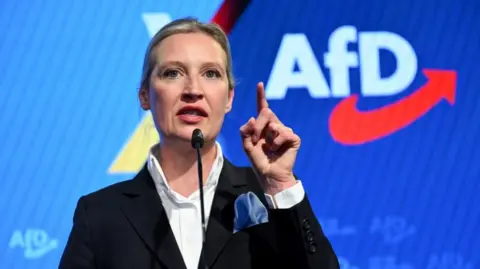







BERLIN: Germany’s Federal Office for the Protection of the Constitution (BfV) has officially classified Afd-Alternative for Germany party as a “proven right-wing extremist” organization, marking a historic escalation in the state’s assessment of the far-right party.
The BfV announced the designation on Friday, confirming that the AfD as a whole is now considered anti-constitutional. Until now, only the party’s state branches in Thuringia, Saxony, and Saxony-Anhalt had been categorized as extremist. Nationwide, the AfD was previously treated only as a “suspected case” of right-wing extremism.
This new classification lowers the legal threshold for state surveillance, allowing the use of intelligence-gathering tools such as phone tapping, undercover informants, and observation of internal meetings.
Step Toward a Possible Ban
The announcement is likely to intensify political debate over whether to initiate legal proceedings to ban the AfD. A party ban in Germany must be requested by the Bundestag, Bundesrat, or the federal government and submitted to the Constitutional Court in Karlsruhe. For many lawmakers, this official extremist classification was seen as a necessary step before considering such a drastic move.
According to Der Spiegel, the BfV has been working for months on a comprehensive report evaluating the AfD. The final document, submitted this week to the Federal Ministry of the Interior, is said to exceed 1,100 pages and includes extensive evidence supporting the conclusion that the AfD poses a threat to Germany’s democratic order.
The BfV concluded that the AfD’s “ethno-nationalist concept of the people” is incompatible with Germany’s constitutional values. The party, the report states, does not consider people with a migration background—especially from Muslim-majority countries—as equal members of the German nation. AfD leaders are also accused of consistently agitating against refugees and immigrants.
Political Context and Recent History
Plans to release the classification earlier were delayed due to the fall of the “traffic light” coalition and the snap Bundestag elections in February 2025. Officials reportedly feared that such a move before the election could violate political neutrality and party equality regulations.
The AfD has faced mounting legal and political challenges over its radicalization. In May 2024, a high court in North Rhine-Westphalia ruled that the BfV could continue monitoring the AfD as a suspected extremist entity, citing sufficient evidence that parts of the party undermine the dignity of foreigners and Muslims and reject democratic principles.
Since the departure of former party leader Jörg Meuthen in 2022, the AfD has shifted even further to the right. More moderate members have exited the party, and hardline nationalist factions have taken control. The party’s recent electoral campaigns in eastern states featured AI-generated videos portraying white Germans under threat from migrants, stoking racial fears.
In the 2025 national elections, the AfD captured 20.8% of the vote, becoming the second-largest party in the Bundestag with 152 seats—nearly double its previous representation. Party leader Alice Weidel vowed to “hunt down” the other parties and “shift into a higher gear.”
The AfD’s parliamentary faction is now more radical than ever. Figures like Matthias Helferich—who once referred to himself as the “friendly face of National Socialism”—have returned to prominence, along with Maximilian Krah, criticized for minimizing the crimes of the SS and for his ties to authoritarian regimes.
Links to Violent Extremism
Authorities have also uncovered ties between AfD members and violent far-right extremists. In November, federal prosecutors arrested eight individuals accused of forming the terrorist group “Saxon Separatists.” Three of the suspects were AfD members. Additionally, a former AfD Bundestag MP remains in custody for allegedly plotting a coup with a “Reichsbürger” group.
Despite the mounting controversies, the AfD has maintained strong electoral support, especially in eastern Germany.
International Reactions and Democratic Concerns
U.S. Secratary of State Marco Rubio responded to the BfV’s decision by warning of “a growing crisis for democratic norms across Europe.” In a statement shared on social media, Rubio said, “What’s happening in Germany is part of a broader trend—radical parties exploiting public fear to undermine democratic institutions. This must be a wake-up call for NATO allies and democratic leaders worldwide.”
Political analysts say the German classification of the AfD could resonate far beyond its borders, reinforcing concerns about the normalization of extremism across the continent. In recent years, far-right movements have gained traction in several EU countries, stoking fears of coordinated efforts to erode liberal democratic principles from within.
Unexpected Timing
The timing of the BfV’s announcement caught many by surprise. The outgoing government remains in a caretaker role, and a new interior minister, Alexander Dobrindt (CSU), is expected to take office in a matter of days. The BfV is also without a president, following Thomas Haldenwang’s resignation to run for parliament. His duties are being carried out by vice presidents Sinan Selen and Silke Willems.
Sources indicate that outgoing Interior Minister Nancy Faeser (SPD) opted not to delay the decision or exert political influence, allowing the intelligence agency to act independently based on its findings.
As Germany navigates its post-election landscape, the question looms: will this official extremist designation mark the beginning of the end for the AfD—or ignite further polarization in an already fractured political climate?
Views: 103


