


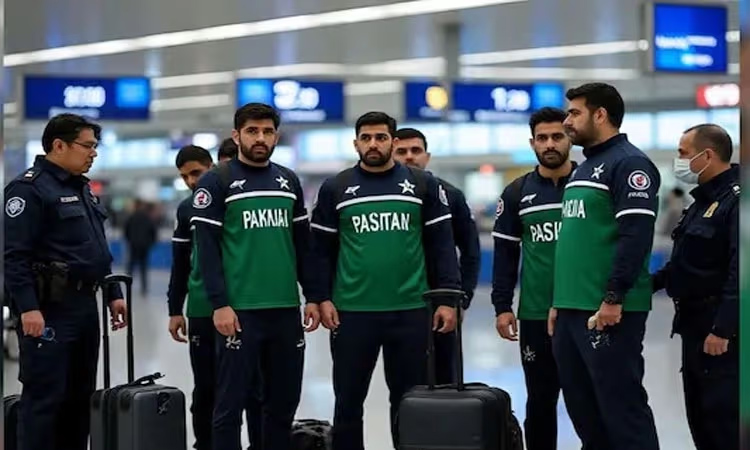







Fake football team, real crisis: Japan deportation exposes Pakistan’s dark trade in desperation
The story reads like a satire of bureaucratic farce — a “national football team” from Pakistan flying out of Sialkot Airport, fully uniformed, documents stamped, and itineraries approved, heading to Japan for a supposed international match.
But behind the illusion of sport lay something darker.
When Japanese authorities detected inconsistencies in their paperwork, the 22 “players” were immediately deported.
They weren’t athletes at all. They were desperate men, each having paid about $14,000 (4 million PKR) to human traffickers for a ticket to a new life. The “fake football team” was not just a scam; it was a symptom of a deep national malaise.
The Federal Investigation Agency (FIA) has since confirmed the operation was a meticulously planned human trafficking scheme.
The alleged mastermind, identified as Malik Waqas, had forged not only player registrations and match schedules but also fake letters of approval from Pakistan’s Ministry of Foreign Affairs.
According to the FIA, this was not his first attempt. In January 2024, Waqas had successfully smuggled 17 others to Japan using the same method. This time, the plan unravelled — not because of domestic vigilance, but because Japanese immigration officials detected the fraud.
The scandal is both shocking and depressingly familiar. Pakistan’s human trafficking networks have long exploited loopholes in its bureaucratic systems, preying on the despair of those who see no future at home.
The “football team” deception, however, represents a new low in the anatomy of illegal migration.
It demonstrates how deeply embedded trafficking syndicates have become — capable of forging entire institutional identities, complete with fake sports federation credentials and falsified government clearances.
At its core, the case reveals a brutal reality: for many Pakistanis, migration — legal or otherwise — has become an act of survival.
The country’s economic collapse, compounded by soaring unemployment, shrinking remittances, and the erosion of faith in governance, has created a market for dreams sold by criminals.
These traffickers do not merely move bodies across borders; they traffic in the currency of despair.
That each of the 22 men paid Rs 4 million — roughly $14,000 — speaks volumes about both the scale of exploitation and the depth of hopelessness.
For ordinary Pakistanis, this is an impossible sum, often raised through selling land, taking loans, or pawning family assets.
The traffickers’ pitch is cruelly simple: pay the price, get a visa, escape poverty. The dream of reaching Japan, Europe, or the Gulf is dangled like salvation. The reality, as this case shows, is humiliation and deportation.
Pakistan’s trafficking crisis is not new. The FIA, the UN Office on Drugs and Crime (UNODC), and the International Organisation for Migration (IOM) have repeatedly documented the country’s role as both a source and transit hub for irregular migration.
Thousands of citizens attempt to leave the country each year through illegal means, often via Iran, Turkey, and Libya, in perilous journeys that end in detention or death.
But the Sialkot “football team” incident signals a shift — from crude border smuggling to elaborate identity-based frauds. These networks are no longer just forging visas; they are manufacturing institutions.
This evolution reflects how impunity and complicity have metastasised. The traffickers did not operate in a vacuum.
Forged clearances bearing the Ministry of Foreign Affairs’ seal, fake football federation letters, and unchecked departures from a domestic airport all point to systemic dysfunction — if not active collusion.
How did 22 men board an international flight with counterfeit documents? How were their supposed credentials never verified by the relevant sporting or government authorities? These are not mere administrative lapses; they are indictments of a state apparatus that has lost control over its own gateways.
In this sense, the scandal is less about one trafficker’s ingenuity than about a bureaucracy’s collapse.
The FIA’s belated investigation — and the proud announcement of Waqas’s arrest — cannot mask the fact that this operation only came to light after foreign authorities intervened.
Pakistan’s institutions, tasked with safeguarding borders and enforcing laws, remain reactive at best and complicit at worst. For every Waqas caught, dozens more continue their trade, feeding off a system where corruption and despair converge.
What makes this particular case especially disturbing is its symbolic dimension. Sport, in Pakistan, has long carried a sense of national pride and unity. Cricket, football, and hockey have been cultural outlets in a country otherwise fragmented by politics and class.
To see even that domain hijacked by human traffickers is to witness the corrosion of something beyond legality — the erosion of collective dignity. The “fake football team” did not just embarrass Pakistan before the world; it desecrated one of the few institutions that once inspired hope.
The larger context only amplifies this humiliation. In recent years, Pakistan has been grappling with a historic brain drain and migration surge.
According to official data, more than 2.9 million Pakistanis left the country between 2021 and 2024 in search of employment.
Many of them migrated legally to the Gulf states, but a growing number took irregular routes through human smugglers.
The demographic pattern of these migrants — largely young men from Punjab’s industrial towns like Gujranwala, Sialkot, and Faisalabad — mirrors the composition of the fake football team.
They are not hardened criminals or con artists; they are products of systemic failure, driven by desperation into the arms of traffickers.
Japan, for its part, has increasingly become a target for traffickers due to its ageing population and labour shortages.
Pakistani migrants view it as an alternative to the saturated Gulf and dangerous Mediterranean routes.
This demand has opened a new frontier for smuggling syndicates who now tailor their methods to bypass Japan’s strict visa protocols through fabricated sports, cultural, or educational delegations.
The Sialkot case is simply the latest — and perhaps most theatrical — manifestation of this trend.
For Pakistan, the embarrassment is double-edged. On the one hand, it underscores the failure to regulate its own emigration channels.
On the other hand, it exposes the hollowness of its international reputation. A country already battling economic collapse and political instability now faces global scrutiny for exporting not just counterfeit goods, but counterfeit people.
The deported men have returned home, likely to face investigation, ridicule, and financial ruin.
But their plight also encapsulates the tragedy of Pakistan’s youth — trapped between the impossibility of living decently at home and the danger of escaping abroad.
Behind every fake document and forged seal lies a human story of poverty, humiliation, and broken trust.
The “fake football team” saga, absurd as it sounds, is not a bizarre one-off scandal. It is the logical consequence of a system that has normalised fraud as survival. It exposes how the machinery of exploitation — from traffickers and corrupt officials to indifferent policymakers — continues to thrive on the vulnerability of those who see no lawful exit from misery.
Japan’s immigration officers may have uncovered a fraud. But what they truly exposed was something far grimmer — a country where desperation has become an export commodity, and deceit a national industry.
The deportation of 22 fake footballers is not merely an international embarrassment; it is a mirror held up to Pakistan’s moral and institutional decay.
Views: 85


