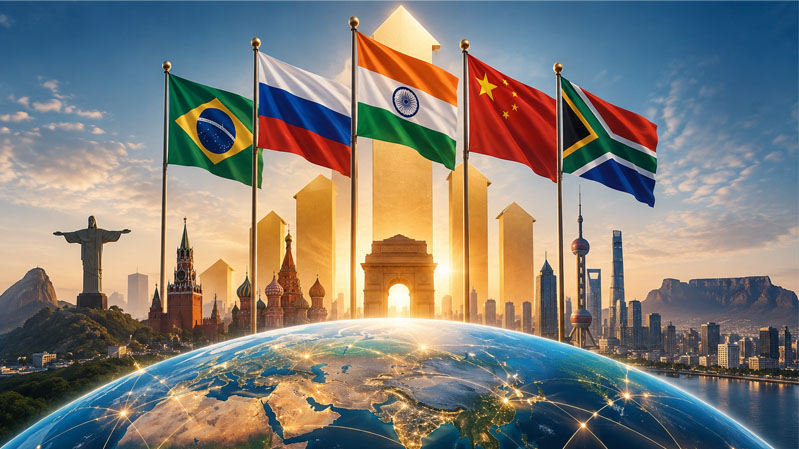







India’s 2026 BRICS Presidency offers strategic opportunities to expand exports, attract investments, strengthen manufacturing and technology partnerships, diversify supply chains, and enhance BRICS influence in the global economy.
The global economic landscape is undergoing a significant transformation, with emerging economies playing an increasingly influential role in shaping trade, investment, development finance and international economic governance. At the centre of this transformation is BRICS, which has evolved from a grouping of five major emerging economies into a much broader platform representing the aspirations and economic interests of the Global South.
India’s BRICS Presidency in 2026, under the theme “Building for Resilience, Innovation, Cooperation and Sustainability,” comes at a pivotal moment. With an expanded membership comprising Brazil, China, Egypt, Ethiopia, India, Indonesia, Iran, Russia, Saudi Arabia, South Africa, and the United Arab Emirates, along with 10 partner countries, BRICS@21 now has a significantly broader geographic and economic footprint. For India, this expansion presents a major opportunity to strengthen exports, attract investment, diversify supply chains, promote technology partnerships and contribute to a more inclusive and multipolar global economic order.
From Emerging-Economy Forum to Global Economic Force
BRICS came into force in the early 2000s as a grouping of major emerging economies. The inclusion of South Africa in 2011 transformed BRIC into BRICS, and the subsequent expansion to Egypt, Ethiopia, Iran, Saudi Arabia, the UAE and Indonesia substantially enhanced the grouping’s economic and strategic significance. Together, these countries account for approximately 40 per cent of global GDP, 26 per cent of world trade, nearly half of the world’s population, and nearly 22 per cent of global FDI flows. They also account for 43.6 per cent of global oil production, 36 per cent of natural gas production, and 78.2 per cent of global mineral coal production.
The partner countries, including Belarus, Bolivia, Kazakhstan, Cuba, Malaysia, Nigeria, Thailand, Uganda, Uzbekistan and Vietnam, further broadened their outreach. The significance of this expansion goes beyond numbers. BRICS brings together manufacturing powerhouses, major energy exporters, agricultural producers, large consumer markets, technology hubs and rapidly developing economies. This diversity creates considerable economic complementarities. Manufacturing economies require energy and raw materials, while commodity-producing countries seek technology, investment and industrial diversification. At the same time, large and growing consumer markets create opportunities for trade in manufactured goods, pharmaceuticals, food products, services and technology. This diversity is becoming a strategic strength as companies and countries work to build more resilient supply chains amid geopolitical tensions, trade disruptions and growing economic uncertainty.
Economic Overview of BRICS and Partner Economies, 2025
| Sr. No. | Countries | Size of GDP(USD Billion) | Growth of GDP(YoY % Change) | Per capita GDP(USD) | Total Exports(USD Billion)2025* | FOREX Reserves(USD Billion)Latest Available |
| 1. | India | 3.920 | 7.8 | 2880 | 863 | 740.8 |
| 2. | Brazil | 2280 | 2.3 | 10686 | 397 | 358.5 |
| 3. | China | 19626 | 4.9 | 13968 | 4,222 | 3748.7 |
| 4. | Russia | 2588 | 1 | 17972 | 535 | 608.3 |
| 5. | South Africa | 427 | 1.1 | 6769 | 133 | 76 |
| 6. | Egypt | 365 | 4.4 | 3379 | 81 | 48.8 |
| 7. | Ethiopia | 109 | 9.2 | 986 | 10 | 3.78 |
| 8. | Iran | 371 | -1.5 | 4264 | 117 | 7.68 |
| 9. | Saudi Arabia | 1277 | 4.5 | 35464 | 366 | 505.1 |
| 10. | UAE | 572 | 5.8 | 50232 | 616 | 292.3 |
| 11. | Indonesia | 1446 | 5.1 | 5082 | 322 | 156.5 |
Source: IMF, World Bank-Total Foreign Reserves, Trade map-Total exports.
*Note: Total exports are calculated as the combined value of goods exports and services exports. The latest available year for services exports is 2024 for all countries except Ethiopia (2023). For goods exports, the latest available data is 2025 for most countries, while Russia (2021), Ethiopia (2023), Iran (2023), and the UAE (2024) have older latest-available observations.
A Stronger Voice for the Global South
BRICS has increasingly emerged as an important platform for South-South cooperation and as a growing influence in the global economy. Its approach emphasises sovereign equality, inclusiveness, mutual respect and consensus-based engagement. Rather than being limited to trade, cooperation increasingly spans finance, technology, infrastructure, health, agriculture, energy, climate action and digital transformation.
The BRICS Foreign Ministers’ Meeting, held in New Delhi on 14–15 May 2026 under India’s Chairmanship, reinforced this broader agenda. The meeting emphasised stronger strategic cooperation across political, economic, financial, cultural and people-to-people dimensions and called for a more democratic, representative and accountable international system. BRICS is moving beyond being simply an economic grouping to becoming a platform through which emerging economies seek a stronger voice in global decision-making.
India’s Expanding Economic Engagement
The economic relations between the fastest-growing major economy, India, and BRICS have expanded considerably, underscoring the grouping’s importance to India’s external sector. India’s merchandise trade with the ten BRICS countries totalled approximately USD 418 billion in 2025-26, accounting for around 34 per cent of India’s total merchandise trade. India exported approximately USD 96 billion to these markets and imported around USD 322 billion.
The India-BRICS trade relations reflect substantial complementarities. India exports pharmaceuticals, engineering goods, automobiles and auto components, textiles, rice, chemicals, machinery and other manufactured products, and provides IT and healthcare solutions. Imports include crude oil, natural gas, fertilisers, machinery, electronic components, telecom equipment and solar panels.
One of India’s most significant opportunities lies in expanding exports to BRICS markets. According to a prestigious industry body ASSOCHAM report, The Rise of BRICS Nations, India’s exports to the ten BRICS countries could rise from around USD 96 billion in 2025-26 to USD 200 billion by 2030.
Greater market access, improved trade facilitation, stronger logistics connectivity and deeper economic partnerships will help Indian companies enter these markets more effectively. Expanding exports would not only improve India’s external-sector performance but could also stimulate domestic manufacturing, employment and integration into regional and global value chains.
Finance and Infrastructure: The Role of the New Development Bank
The New Development Bank (NDB) remains one of BRICS’ most significant institutional achievements. Established in 2015 and headquartered in Shanghai, the bank was created to finance infrastructure and sustainable development projects in emerging economies. It was established with an initial authorised capital of USD 100 billion and focuses on infrastructure and sustainable development projects. Its activities span clean energy, transport, water management, sanitation, digital infrastructure and sustainable urban development. In India, NDB-supported projects have included metro rail, renewable energy, transport infrastructure and smart city initiatives.
The growing emphasis on local-currency financing is particularly important. Expanding this financing will reduce exposure to currency volatility and strengthen the financial resilience of developing economies. Greater mobilisation of resources through the NDB, diversification of funding sources, and expansion of membership can enhance the institution’s role in supporting infrastructure development across the Global South.
Digital Transformation and Innovation
Technology is emerging as another major pillar of BRICS cooperation. India’s experience with digital public infrastructure, digital payments, global leadership in digital transactions and fintech, Aadhaar-enabled services, and a vibrant start-up ecosystem provides a strong foundation for leadership. BRICS cooperation in artificial intelligence, cybersecurity, e-commerce, digital infrastructure, and emerging technologies will help member countries accelerate digital transformation. The growing recognition of AI as a driver of economic growth creates opportunities for cooperation on AI governance, innovation, and responsible technology deployment. India’s hosting of the AI Impact Summit in February 2026 further strengthened its position in this emerging field. The proposed high-speed submarine-cable communication network among BRICS countries, together with initiatives such as the BRICS Startup Knowledge Hub, will further strengthen digital connectivity and innovation ecosystems.
Energy, Climate and Food Security
Energy security remains central to BRICS, as the grouping includes some of the world’s major energy producers alongside large energy-consuming economies. This creates opportunities for cooperation across energy supply chains, renewable energy, low-emission technologies and sustainable energy transitions. BRICS members have reaffirmed their commitment to the Paris Agreement and emphasised climate action aligned with national development priorities. Cooperation on climate-resilient infrastructure, agriculture, biodiversity, water security and disaster preparedness can contribute to sustainable development across the Global South.
Food security is another increasingly important priority. BRICS countries are seeking to strengthen agricultural value chains, address fertiliser shortages and ensure stable food supplies. Discussions around a possible BRICS Grain Exchange and enhanced agricultural trade could provide opportunities for India, given its significant capabilities in agriculture and food production.
Healthcare cooperation is similarly gaining importance through vaccine research, infectious-disease surveillance, digital health, traditional medicine and antimicrobial-resistance initiatives. India’s pharmaceutical and healthcare capabilities will make it an important contributor to these efforts.
India’s Strategic Opportunity
For India, BRICS represents both an economic opportunity and a strategic responsibility. As a founding member and one of the world’s major emerging economies, India is well positioned to shape the grouping’s future priorities. India can leverage BRICS to expand exports, attract investment, promote manufacturing, strengthen energy partnerships and integrate domestic companies into global value chains. At the same time, its strengths in digital public infrastructure, pharmaceuticals, renewable energy, innovation, healthcare and services offer valuable opportunities for India to contribute to wider South-South cooperation.
Conclusion
BRICS is steadily evolving into a major pillar of the emerging multipolar global economic order. Its expanding membership, substantial economic weight, demographic scale, resource base and growing institutional architecture provide a strong foundation for deeper cooperation among developing economies. Ultimately, BRICS’s future strength will depend on its ability to turn diversity into complementarity and translate political dialogue into tangible economic cooperation. If successful, BRICS can play a transformational role in building a more balanced, inclusive, resilient and representative global economic system, with India positioned prominently at its central stage.
Views: 86