


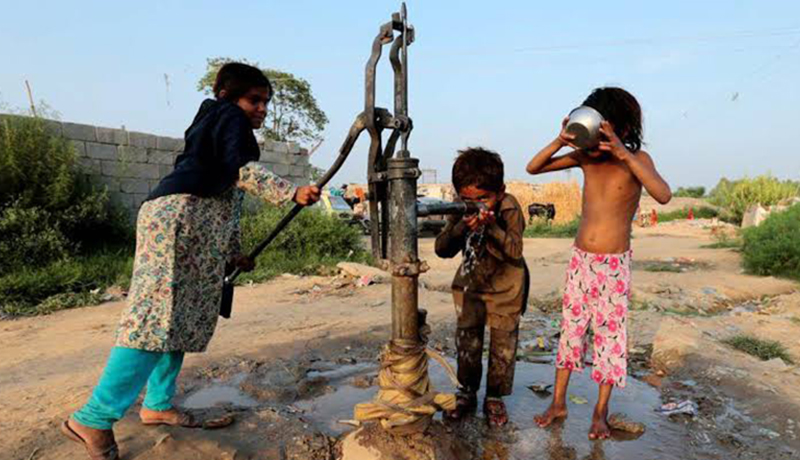







India, climate change and population growth are the easiest and politically convenient factors that Islamabad holds responsible for the growing water crisis in Pakistan, but they might have very little to contribute to it. The real factors behind for water scarcity in Pakistan are mismanagement, ineffective policies, uneven provincial distribution, and theft and corruption. One can find the root cause of the real crisis in how water is managed, distributed, priced, conserved, and regulated in Pakistan.
It is not that Pakistan is a country without water. It has an enormous network of big rivers, including the Indus, one of the world’s great river systems, and huge groundwater reserves. Yet, the country faces a crisis of scarcity. Inefficient irrigation, unequal canal distribution, uncontrolled groundwater extraction, poor investment and institutional failure have turned the resource-management problem transformed the resource-management problem into a full-fledged water security crisis.
After New Delhi suspended the Indus Waters Treaty (IWT) to make the best use of water under its natural right, Pakistani politicians got the best excuse to hide their failures and hold India responsible for the water crisis in the country. Moreover, India does not regulate or control the water that flows into Pakistan, while about 90-95 percent of water is consumed by agriculture, and most of it is wasted due to unscientific and inefficient irrigation methods. Pakistan went below the water-scarcity threshold of 1,000 cubic metres per person per year in 2010, so about 15 years before the IWT was suspended.
No governments in Pakistan have ever attempted to address these problems, leaving the country with low agricultural water productivity, dilapidated and outdated canal system, severe groundwater depletion, and weak enforcement. India cannot be blamed for those failures. Calling Pakistan’s water crisis “man-made”, South Asia expert Michael Kugelman said “Pakistan’s leaders and stakeholders need to take ownership of this challenge and declare their intention to tackle it. Simply blaming previous governments, or blaming India, for the crisis won’t solve anything.”
One should wonder why Pakistan did not build a single major reservoir in the past 50 years to store water when the country faced acute droughts. Similarly, no efforts were made for efficient management of water the country get through rivers or to prevent groundwater depletion. There are over 1.5 million of tubewells, which led to excessive and uncontrolled pumping inside Pakistan. Subsidized electricity and power theft have only added to the problem. While no efforts were made to recharge aquifers, the lack of clarity and policies aggravated heavy extraction for water-intensive crops. So it demonstrates Pakistan’s water vulnerability is purely self-created, and external forces have played hardly any role, contrary to the political narrative.
Climate change is another classic target of the political framing in Pakistan as politicians and bureaucrats often sound alarm over accelerated glacier melt that they claim would lead to a severe, long-term water crisis. But that is far from the truth. The World Bank has made clear that not climate change but poor water resource management and poor water service delivery are the real culprit. So climate change cannot absolve the state of Pakistan of its responsibility.
Notably, the government of Pakistan is well aware of the problem and has at times underlined the need to bring in necessary reforms. But it has failed to act. Pakistan’s groundwater crisis is due to governance failures and policy paralysis rather than physical water scarcity. Besides policy distortions, fragmented responsibilities among different government departments have created regulatory gaps, deprived the ecosystem of accountability and sustainability and a promise of adequate water.
Population growth is a contributor to the water crisis but it cannot alone be held responsible. Pakistan Institute of Development Economics (PIDE) has come up with scientific evidence that water crisis was simply not a population problem, but lack of attention to aging infrastructure, weak governance, theft by privileged. “We do not have a water crisis; we have a failure of governance with regard to water issues,” said Dr Ishrat Hussain, former governor of the State Bank of Pakistan.
Similarly, Ahmed Bilal Mehboob, president of Pakistan Institute of Legislative Development and Transparency (PILDAT), slammed governments for failing to find ways to address the water crisis. “The present water crisis is not a sudden development and we had sufficient time and advance notice to stem the tide,” he said. This state of affairs is alarming, but even more alarming is the lack of an adequate response to the crisis by successive governments in Pakistan.”
Views: 23


