






Pakistan Uses Brute Force and Political Engineering to Continue Its Illegal Control in PoJK
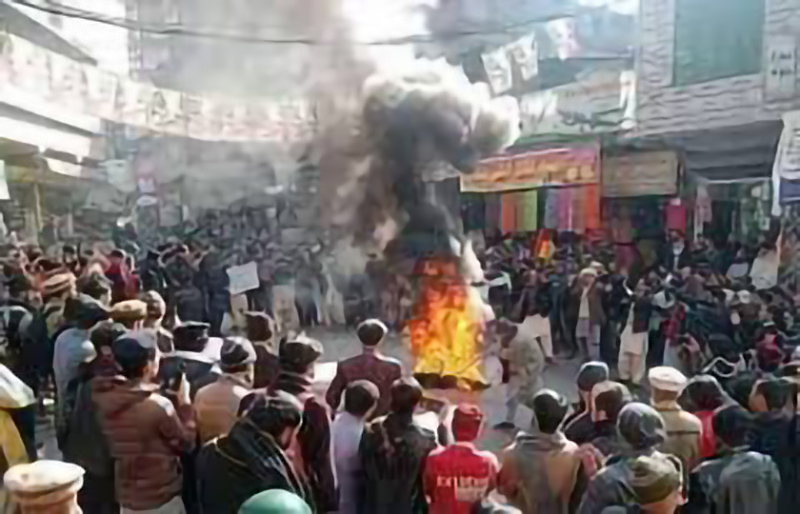
For the third year in succession, Pakistan Occupied Jammu and Kashmir (PoJK) is under a communications blackout and a violent security crackdown. Since the night of 5 June, mobile, broadband and in many areas landline services across the occupied territory have been suspended on official orders, with the cut due to last until 12 June. Under the cover of that blackout, the town of Rawalakot in Poonch district has seen the worst violence the region has known in decades. Reports confirm at least eleven people dead, with dozens injured, around thirty detained on the night of 7 June, and roughly seventy arrests in the preceding days. The Joint Awami Action Committee (JAAC), the civic platform at the centre of the unrest, claims a far higher toll and speaks of a ‘massacre’. With the communication lines down, it is nearly impossible to get the real casualties figure and extremely concerning claims circulating locally and by the overseas diaspora from PoJK.
What has provoked this response is striking for several reasons. The JAAC, which grew out of trader and civil-society mobilisations in 2023 and has since led the mass protests that convulsed the region in 2024 and 2025, advances a 38-point charter concerned with the price of electricity and flour and the structure of political representation in PoJK, demanding that residents pay for power at its local cost of generation and that wheat be subsidised at the rates given to other provinces. Its most contested demand concerns the fifty-three-member Legislative Assembly, of which thirty-three seats are filled by voters inside the territory while twelve are reserved for Kashmiri refugees who migrated to Pakistan after the conflicts of 1947 and 1965 and now live scattered across Karachi, Lahore, Rawalpindi and other cities. Because roughly 450,000 of these voters live outside the region, and because the party that captures their seats can ordinarily decide who forms the government in PoJK, the JAAC regards them as a device through which Pakistan’s mainstream parties and the military engineer the result of every election, and it has demanded their abolition.
The response has followed a familiar template of overwhelming force. Reports put the federal deployment at roughly fourteen thousand personnel, drawn from the Frontier Constabulary, the Rangers (mainly from Punjab), the Islamabad police and the Sindh police, sent in for the protest window. Almost none of this force is local. The trigger for the bloodshed was the killing of a trader and Committee activist, Shahzaib Habib, in a confrontation with security personnel on the night of 5 June. When mourners gathered outside the Combined Military Hospital in Rawalakot, where his body was held, police moved to clear them and firing broke out, leaving multiple casualties. It was followed by the complete breakdown of communication in the region to hide brazen state violence from the international community.
The same sequence unfolded in 2024 and again in the autumn of 2025 in PoJK, when protests over flour and electricity prices turned deadly and subsided only after paramilitaries had killed and injured peaceful demonstrators. Islamabad had promised concessions that it then failed to honour in full. A similar situation has been unfolding in Pakistan-occupied Gilgit-Baltistan (PoGB) as well, with the added grievance of land taken for projects tied to the China-Pakistan Economic Corridor (CPEC) and a population that lacks even the nominal self-rule granted to Muzaffarabad. The immediate cause changes from year to year, but the Pakistani state’s method does not. They cut the communication lines, ban the organisers, flood the streets with paramilitaries from other provinces, kill innocent civilians, then offer talks once the anger has been beaten down.
Behind the recurring violence lies a structure of control that is colonial in all but name. Defence, foreign affairs and the substance of any policy in PoJK rest with Islamabad. The region is, in practice, run through the federal Ministry of Kashmir Affairs and an Azad Jammu and Kashmir Council that sits in Islamabad and tightly controlled by the military. The senior bureaucracy is filled with officers deputed from Pakistan’s central services, frequently from Punjab. PoJK’s chief secretary has more than once been an officer moved straight from the Punjab government, and retired military men hold other key posts, with federal security and intelligence agencies overseeing the whole arrangement. The interim constitution bars political activity against the territory’s accession to Pakistan, so opposition to the framework is unlawful from the start. PoJK has no real fiscal autonomy and its representatives are kept out of the bodies that negotiate the economic projects reshaping its land. Its rivers feed power into the national grid and CPEC projects, while its own people queue during load-shedding.
The contrast between PoJK’s situation and that of Jammu and Kashmir could hardly be more pronounced. Across the border in India, an elected legislative assembly governs J&K. Official figures recorded nearly 18 million tourist visits in 2025, investment proposals have exceeded 1.6 lakh crore rupees, and a sustained infrastructure program has delivered new hydroelectric capacity, a wider transmission network, and rail connectivity linking the Kashmir Valley to the national rail network for the first time. J&K’s economic integration with other areas of the country is going at a fast pace and the ordinary functioning of representative institutions. Whereas the present condition of PoJK is defined by a communications blackout, a banned peaceful movement, army deployment and multiple civilian casualties – a divergence between the two regions that has become impossible to overlook.Therefore, the situation in PoJK demands close international scrutiny from Western capitals and the United Nations. The United Kingdom, the United States, etc, have already advised their nationals against all but essential travel to PoJK, and PoJK-associated rights organisations abroad have appealed for the killing to cease. Yet advisories and statements are no substitute for formal scrutiny of Pakistan. The UN human-rights machinery, together with the governments and institutions that have some influence over Pakistan, should be pressing Islamabad to restore communications, withdraw the paramilitary forces, release those detained for protesting peacefully, and account for every death in Rawalakot. After three consecutive years in which a civilian demand for rights has been answered with bullets in PoJK, the silence of the wider world would amount not to neutrality but to complicity
Views: 55