






Dr. S. Jaishankar’s arrival in Addis Ababa on 8 October 2026 brought India’s three-nation African diplomatic outreach to a destination of exceptional strategic significance. The city, the ‘new flower’ that Empress Taytu Betul and Emperor Menelik II planted in the Ethiopian highlands, has blossomed into Africa’s diplomatic nerve centre, the headquarters of the African Union and the capital of a fellow BRICS member and India’s newest Strategic Partner. Following engagements in Ghana and Côte d’Ivoire, Jaishankar arrived at the institutional heart of African multilateralism, where India’s historical solidarity with the continent increasingly intersects with its expanding economic, technological and geopolitical ambitions. His visit followed an unusually intensive sequence of bilateral engagements, including Prime Minister Narendra Modi’s historic December 2025 visit, the May 2026 market-access protocol supporting Ethiopia’s WTO accession and renewed leadership consultations during the September BRICS Summit in New Delhi. Together, these developments signalled a consequential evolution in India’s African diplomacy, with historical solidarity increasingly acquiring the institutional substance of economic partnership, technological cooperation and strategic convergence.
The deeper significance of this diplomatic engagement emerged at the Adwa Victory Memorial Museum, where Jaishankar invoked Ethiopia’s historic triumph over Italian colonial aggression in 1896 to articulate a contemporary philosophy of international partnership: the creation of capabilities rather than dependencies. Adwa’s enduring importance extends beyond the preservation of Ethiopian sovereignty. It represents the assertion of political agency against imperial domination, a principle that resonates with India’s civilisational consciousness, anti-colonial inheritance and commitment to strategic autonomy. More than a century later, that historical affirmation of sovereignty finds renewed expression in the pursuit of technological independence, economic self-reliance, diversified partnerships and equitable participation in global governance. The journey from Adwa to agency thus encapsulates a wider transformation in South–South cooperation, connecting the historical struggle for political freedom with the contemporary imperative of commanding the institutions and capabilities that make sovereignty meaningful.
Yet the promise of India – Ethiopia cooperation must ultimately be measured against its economic and strategic realities. Substantial Indian investment and a remarkable educational legacy coexist with modest, asymmetrical bilateral trade, while expanding opportunities in artificial intelligence, critical minerals, pharmaceuticals, agriculture and defence demand sustained institutional implementation. Ethiopia’s geopolitical centrality in the Horn of Africa, its proximity to the Red Sea commercial system and its growing participation in multilateral diplomacy further elevate the relationship’s strategic importance. Jaishankar’s visit therefore illuminates a defining transition: from a partnership of recognition to a partnership of delivery, in which civilisational affinity, sovereign equality and diplomatic trust become the foundations of productive interdependence, shared capabilities and consequential international influence.
1. The October Visit: Consolidation, Articulation and Precision
The West African legs established the tour’s grammar. In Ghana, Jaishankar called on President John Dramani Mahama and witnessed two memoranda on academic, scientific and agricultural cooperation; in Côte d’Ivoire, he reviewed a deepening defence relationship and bilateral trade exceeding US$1.5 billion (United News of India, 2026). Pharmaceuticals, digital technology, value addition and capacity building recurred in every capital, revealing a coherent continental doctrine that Ethiopia then received in its fullest form.
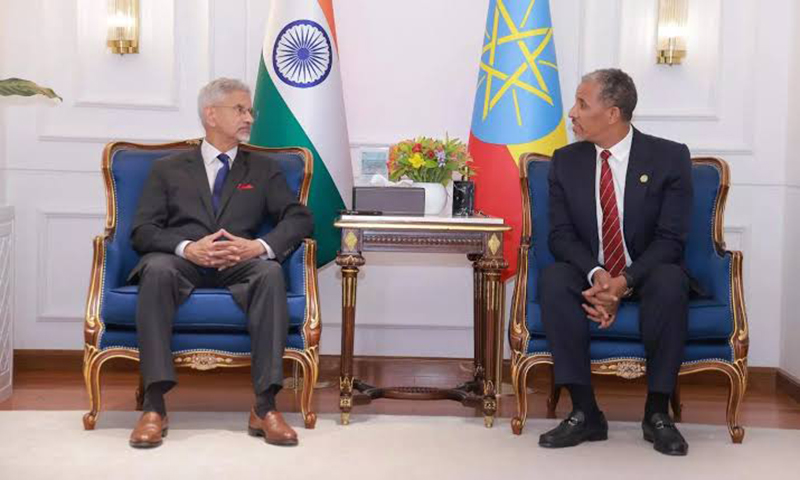
The Ethiopian engagements composed a deliberate sequence. The call on Abiy, carrying congratulations on his re-election and a personal message from Modi within four weeks of their Hyderabad House talks, sustained leader-level trust across Ethiopia’s electoral transition, the scarcest asset in any partnership. The talks with Gedion on 9 October reviewed trade, investment, agriculture, renewable energy, health, education, skills, defence, mining, artificial intelligence and digital public infrastructure. The Ethiopian News Agency’s account foregrounded education, culture, trade, investment and digitalisation (Ethiopian News Agency, 2026). This divergence of emphasis is instructive: the convergence zone of trade, investment, education and digital cooperation marks the terrain for early delivery, while defence and mining register Indian interest that still awaits fuller Ethiopian prioritisation. The meeting with Brook Taye, Chief Executive of Ethiopian Investment Holdings, the sovereign wealth fund holding stakes across telecommunications, aviation, logistics and mining, opened a state-backed channel for co-investment whose outcomes remain prospective. The visits to the Artificial Intelligence Institute, the Science Museum and the National Palace Museum joined technological ambition to imperial continuity, and the regional Heads of Mission Conference, convened at the African Union’s seat, aligned India’s continental machinery ahead of the Fourth India–Africa Forum Summit.
Analytical precision requires a clear ledger. The visit announced the next Jaipur Artificial Limb Fitment Camp in Ethiopia, following a 2024 camp in Afar that served about 450 beneficiaries, and offered specialised training in forensic sciences, women and child development and media governance (United News of India, 2026). Every other sectoral item was discussed. The customs, data-centre and peacekeeping agreements belong to December 2025, the market-access protocol to May 2026 and the defence memorandum to February 2025. The visit’s achievement therefore lies in consolidation, agenda-setting and the articulation of a governing philosophy, which places the burden of the next phase squarely on implementation.
2. Adwa, Memory and the Philosophy of Capability
On 1 March 1896 Menelik’s forces defeated Italy at Adwa, preserving Ethiopian independence in the very decade of Africa’s partition. Adwa became a foundational emblem of African sovereignty and Pan-African consciousness, and its colours adorn the flags of many independent African states. Italy’s later occupation of 1936 to 1941 proved brief, and Indian soldiers of the 4th and 5th Indian Divisions fought in the 1941 East African campaign that ended it. Jaishankar’s address at the Adwa Victory Memorial Museum on 9 October, at an event convened by Ethiopia’s Ministry of Foreign Affairs and the Institute of Foreign Affairs, situated Indian diplomacy within Africa’s own narrative of self-determination.
The address moved from memory to method. Jaishankar framed the enduring question uniting India and Africa as who decides their future, recalled India’s opposition to colonialism and apartheid and the generations of Indian teachers in Ethiopian classrooms, and then advanced its governing proposition: partnerships must “help create capabilities, not promote dependencies” (DD India, 2026). History, he argued, has supplied trust; the relationship must now mature into development cooperation founded on respect, equality and shared prosperity. He aligned Agenda 2063 with Viksit Bharat 2047, cited more than 220 India-supported projects across Africa and training for over 70,000 Africans, identified digital public infrastructure, space, drones and artificial intelligence as new frontiers, named the fuel, food, fertiliser and finance pressures bearing on developing economies, and called for Security Council reform granting Africa representation in both categories, consistent with the Ezulwini Consensus and the Sirte Declaration.
The capability principle constitutes a theory of partnership. It redefines development cooperation as the construction of agency, mirroring India’s own experience of building national capability in pharmaceuticals, space and digital infrastructure through deliberate institution-building. For Ethiopia it implies respect for sovereign policy choice, local manufacturing, fair market access, calibrated technology transfer, debt-sustainable finance and diversified partnerships. It also performs a comparative function in a crowded Horn of Africa, positioning India as the partner whose offer enlarges Ethiopian autonomy. Recognition reinforces the claim: Indian leaders honoured Adwa twice in ten months, converting history into a normative commitment whose standard Ethiopians themselves define.
Ethiopia answered with equal seriousness. On 10 October the Institute of Foreign Affairs published Hermela Getachew’s brief, From Adwa to Action, which treats the capability principle as a measurable standard and proposes “agency-first partnership,” in which the host country owns priorities, sequencing and projects (Getachew, 2026). The brief regards figures cited in speeches as statements of intention, warns that broad commitment lists fragment without ownership and review, and recommends a short ranked agenda led by education, health and pharmaceuticals, and digital cooperation, each with a named owner, a review date and published progress notes. This response marks the visit’s most significant intellectual outcome. India supplied the principle; Ethiopia supplied the method. Their convergence transforms a diplomatic lecture into a governance discipline and reveals Ethiopian agency as an independent variable shaping the partnership’s terms.
The two readings also expose a productive tension. India speaks the language of comprehensive strategic menus, spanning defence, minerals, digital systems and multilateral coordination; Ethiopia speaks the language of sequencing, insisting that a reforming state with finite administrative bandwidth must choose. Each perspective corrects the other. Indian breadth supplies optionality and political ambition; Ethiopian selectivity supplies focus and accountability. A partnership that learns to rank its ambitions without narrowing them will prove more resilient than one sustained by declaration alone.
3. From Adulis to Strategic Partnership
The relationship rests on two millennia of exchange. The first-century Periplus of the Erythraean Sea records Adulis, the Axumite port, as an emporium where African ivory met Indian textiles and iron, and by the sixth century Indian merchants exchanged silk and spices for Ethiopian gold (Casson, 1989; Embassy of India, 2025a). The two civilisations thus first encountered one another as trading equals, long before colonial hierarchies reordered the Indian Ocean.
Independent India established legation-level relations in 1948 and full ambassadorial ties in 1950. Emperor Haile Selassie’s visits of 1956 and 1968 inaugurated an educational partnership of lasting depth: thousands of Indian teachers served across Ethiopia, including its remotest provinces, and about 150 Indian faculty still teach in Ethiopian universities (Embassy of India, 2025a). This legacy constitutes a distinctive form of Indian soft power, embedded in Ethiopian institutional memory and personal biography. Afro-Asian solidarity, opposition to apartheid and Non-Aligned diplomacy then sustained continuity across Ethiopia’s imperial, Derg and federal eras, a testament to a relationship anchored in state-to-state respect.
Institutionalisation followed economic opening: a Trade Agreement in 1997, an irrigation agreement in 2002, a Joint Ministerial Commission and Bilateral Investment Promotion and Protection Agreement in 2007, and the Second India–Africa Forum Summit in Addis Ababa in 2011, which placed the city at the centre of India’s continental architecture. Indian lines of credit financed sugar development, rural electrification and the Ethiopia–Djibouti transmission line. The trajectory runs from commercial reciprocity through educational partnership to institutional density, and each layer remains a resource for contemporary statecraft.
4. December 2025: The Architecture of Partnership
Modi’s visit of 16 to 17 December 2025 constituted the partnership’s constitutional moment. He addressed a joint sitting of Parliament, received the Great Honour Nishan of Ethiopia and visited the Adwa Museum, while the leaders elevated relations and conveyed Indian support for Ethiopia’s WTO accession and New Development Bank membership (Mohan, 2025). Maheep (2025), writing in The European Times, interpreted the visit as a carefully staged civilisational dialogue and read the elevation from the Comprehensive Partnership of 2011 as recognition that the relationship had matured in institutional substance and strategic relevance. His reading of the foreign ministry data centre as an investment in Ethiopian digital state capacity anticipated the capability principle articulated at Adwa.
The outcomes possess distinct functional logics. The customs agreement on mutual administrative assistance prepares the administrative ground for predictable trade as accession advances. The data centre at Ethiopia’s Ministry of Foreign Affairs strengthens sovereign diplomatic infrastructure. The arrangement between India’s Centre for UN Peacekeeping and Ethiopia’s International Peace Support Training Institute links two leading troop contributors in doctrine and training. India’s participation in debt treatment under the G20 Common Framework positions New Delhi as a responsible creditor. Expanded ICCR scholarships, specialised AI courses under ITEC and maternal and neonatal care at the Mahatma Gandhi Hospital extend the partnership into human capital and welfare.
The ten months that followed show institutional deepening. The market-access protocol signed in Geneva on 22 May 2026 concluded long-running negotiations with agreed goods and services commitments (Embassy of India, 2026). Defence engagement advanced from the first Joint Defence Cooperation meeting in October 2025 to discussions in September 2026 on training, joint manufacturing and peacekeeping, and the Hyderabad House talks added critical minerals and clean energy to the leadership agenda (Prime Minister’s Office, 2026). Itemised public reporting on implementation remains limited, which itself defines a priority: a jointly published implementation tracker would convert architecture into demonstrable delivery.
5. Economic Statecraft: Complementarity, Asymmetry and Investment Quality
Bilateral merchandise trade in fiscal year 2024–25 (April 2024 to March 2025) totalled US$550.19 million, comprising Indian exports of US$476.81 million and imports of US$73.38 million, and India ranks as Ethiopia’s second-largest trading partner (Embassy of India, 2025a). India exports steel, pharmaceuticals, machinery and chemicals; Ethiopia exports pulses, flax yarn, gemstones, seeds, leather and spices. The resulting surplus of US$403.43 million and export ratio of about six and a half to one describe a classic asymmetry between manufactures and primary commodities. Two cautions govern comparison: Ethiopian customs data follow a fiscal year beginning on 8 July (1 Hamle) and record imports on a cost, insurance and freight basis, while merchandise figures exclude the education, health and technology services Ethiopians purchase from India.
Investment constitutes the relationship’s most substantial economic pillar. Modi cited over US$5 billion invested by Indian firms, more than 75,000 local jobs and over 650 registered companies (Mohan, 2025), while the Adwa address referred to over 600 companies across two decades. These figures demand disaggregation into licensed investment registered with the Ethiopian Investment Commission, commitments announced by firms and capital realised in operating facilities, since Ethiopian licensing data historically exceed realised capital for every source country. The Institute of Foreign Affairs rightly treats such figures as statements rather than audited results, and a jointly verified investment census would strengthen both governments’ credibility. Quality matters as much as magnitude. The Gambela agricultural land leases of the late 2000s, including the Karuturi project, generated disputes over land rights and underperformance, whereas manufacturing and pharmaceutical ventures produced employment, skills and import substitution. Accountable, employment-intensive investment embedded in local supplier networks represents the capability principle in commercial form.
Ethiopia’s reform programme reshapes this landscape. The July 2024 shift to a market-determined exchange rate under an IMF-supported Extended Credit Facility eases the foreign-exchange scarcity that long constrained profit repatriation and input imports, while depreciation strengthens Ethiopian export competitiveness. Debt restructuring, progressive liberalisation of banking, telecommunications and logistics, and WTO accession anchored by the May protocol together promise the regulatory predictability that Indian firms value. The Embassy’s export-opportunities study on oilseeds, pulses, cotton, gemstones and coffee identifies the products through which asymmetry can narrow (Embassy of India, 2025b). India’s structural deficit in pulses and edible oils, its leadership in gem cutting and its expanding speciality coffee market create natural demand. The decisive transition lies from commodity exchange to co-production: processing sesame and pulses in Ethiopia to Indian phytosanitary standards, integrating Ethiopian cotton into Indian textile value chains and establishing gem-cutting facilities in Ethiopia. Rupee–birr settlement, EXIM Bank buyer’s credit, a revitalised joint business council and an SME facilitation desk would translate complementarity into interdependence.
A sharper question concerns India’s own capacity for economic statecraft. New Delhi possesses competitive firms, a respected development-partnership administration and growing export finance, yet its toolkit relies heavily on private enterprise and concessional lines of credit whose disbursement has historically moved slowly. Effective statecraft in Ethiopia therefore requires blended finance that de-risks private investment, faster project preparation and closer coordination among the Ministry of External Affairs, the Department of Commerce, EXIM Bank and industry chambers. Interdependence that serves both states will emerge from these instruments, giving Ethiopia diversified markets and India a trusted production partner on Africa’s eastern seaboard, where the African Continental Free Trade Area enlarges the reach of every factory established in Ethiopia. Maheep (2025) identified precisely this logic, presenting Ethiopia as a gateway through which Indian enterprise can join Africa’s emerging continental value chains in agriculture, infrastructure and digital services.
6. Productive Transformation: Agriculture, Minerals, Technology and Human Capital
Agriculture employs most of Ethiopia’s workforce and anchors its export base, making it the decisive arena for inclusive development. India’s transition from the Green Revolution to cooperative dairying, micro-irrigation and digital agricultural services offers experience suited to a smallholder economy, and institutional foundations already exist in the 2002 irrigation agreement and the 2011 memorandum linking the Indian Council of Agricultural Research with the Ethiopian Institute of Agricultural Research. Joint research on drought-tolerant pulses, oilseeds and millets, mechanisation adapted to highland farms, solar irrigation, cold chains, livestock health and digital crop advisories would raise productivity at scale. A bilateral pulses and oilseeds compact, pairing Indian assured offtake with Ethiopian productivity investment, would simultaneously serve Indian food security, Ethiopian foreign-exchange earnings and smallholder incomes.
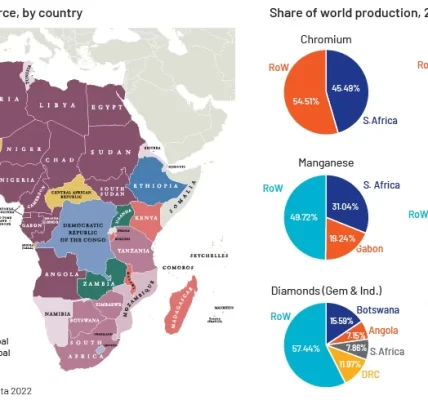
Ethiopia’s mineral endowment requires careful discrimination between resource and reality. Potash deposits in the Danakil Depression of Afar carry global significance for fertiliser security; gold is commercially produced; opal is a recognised export; iron ore, tantalum, lithium-bearing pegmatites and rare-earth occurrences remain largely at the exploration stage. A bilateral mineral study launched in June 2025 mapped trade and investment opportunities, and critical minerals entered the leadership agenda in December 2025 and September 2026 (Prime Minister’s Office, 2026). India’s National Critical Mineral Mission, KABIL’s overseas mandate and its heavy dependence on imported potash create a clear strategic interest. Ethiopian potash has nevertheless faced repeated delays owing to financing, infrastructure and the logistics of moving bulk cargo from Afar to Djibouti. Cooperation designed around exploration finance, Geological Survey of India capacity building, beneficiation within Ethiopia, environmental safeguards and community participation would align India’s supply diversification with Ethiopia’s industrialisation.
Technology forms the partnership’s most forward-looking pillar. The 2024 memorandum on digital public infrastructure between India’s Ministry of Electronics and Information Technology and Ethiopia’s Information Network Security Administration connects India’s experience of interoperable, population-scale systems with Ethiopia’s Fayda digital identity programme and Digital Ethiopia strategy (Embassy of India, 2025a). The Ethiopian Artificial Intelligence Institute embodies Addis Ababa’s ambition for sovereign capability, and the shared vision of AI for All points towards joint work on language models for Amharic, Afaan Oromo, Tigrinya and Somali, drawing on India’s Bhashini experience, together with shared compute, open digital public goods and applications in agriculture, health and public services. Technological assistance becomes technological sovereignty when Ethiopia acquires the capacity to build, govern and own its systems.
Health and human capital give the partnership its human face. Indian pharmaceutical firms supply a large share of Ethiopia’s medicines and manufacture locally, and regulatory reliance, local production of essential medicines and telemedicine would convert supply into health security. The Mahatma Gandhi Hospital commitment and the Jaipur limb camp translate diplomacy into dignity. ITEC, ICCR and AYUSH programmes, including the 2025 training of Ethiopian parliamentarians and federal police, extend the legacy of Indian teachers, and an institutional knowledge partnership linking Indian technical, agricultural and diplomatic academies with Ethiopian universities would give that legacy a durable home.
7. The Horn of Africa and the Indian Ocean Strategic Space
Ethiopia anchors one of the world’s most consequential strategic theatres. The Horn overlooks the Bab el-Mandeb, a chokepoint for trade between Asia and Europe, and borders the Red Sea corridor linking the Indian Ocean to Suez. Landlocked since Eritrea’s independence in 1993, Ethiopia conducts most of its external trade through Djibouti along the electrified Addis Ababa–Djibouti railway. Its demographic weight, military capacity, the Grand Ethiopian Renaissance Dam and its role as African Union host make it indispensable to regional order. The security environment remains volatile: war in Sudan, al-Shabaab in Somalia, tensions with Eritrea sharpened by Ethiopia’s pursuit of sea access, and Houthi attacks on Red Sea shipping and Gulf targets, including strikes on Riyadh reported during the week of the visit (DD India, 2026).
India’s interest flows from its identity as a resident Indian Ocean power. The Indian Navy has sustained anti-piracy deployments in the Gulf of Aden since 2008 and expanded western Indian Ocean operations in response to attacks on merchant shipping, guided by the vision that evolved from SAGAR into MAHASAGAR. Ethiopia supplies the continental depth to this maritime posture: the principal hinterland of the Djibouti corridor, a leading contributor to UN and African Union peace operations and a partner in counter-terrorism. The February 2025 defence memorandum, the peacekeeping training arrangement and the September 2026 discussions on joint manufacturing outline a defence pathway in which Indian training, maintenance and selected platforms build Ethiopian capability.
External competition defines the strategic setting. China maintains a base in Djibouti and an extensive infrastructure footprint; the United States, France, Japan and Italy hold facilities there; the United Arab Emirates and Saudi Arabia wield substantial financial influence; and Türkiye has entrenched itself in Somalia. India commands fewer financial resources than several of these actors, yet it offers a distinctive proposition: influence through training, technology and trust, with no coercive leverage and a declared commitment to Ethiopian autonomy. Ethiopia, practised in diversified diplomacy, gains an additional partner that strengthens its bargaining position. Indian expertise in port-led development and logistics digitalisation could further support Ethiopia’s corridor diversification in ways that respect the sovereignty of every littoral state, making India a constructive stakeholder in Red Sea stability.
Prudence must accompany ambition. Ethiopia’s quest for maritime access touches the vital interests of Eritrea, Djibouti, Somalia and their external patrons, and Indian engagement will retain its value only by remaining scrupulously neutral on contested sovereignty questions while supporting commercial connectivity and regional dialogue under African Union auspices. Ethiopia’s internal consolidation after the 2022 Pretoria agreement likewise conditions the pace of defence cooperation. India’s comparative strength lies precisely in this calibrated posture: a partner that equips Ethiopian institutions, respects regional sensitivities and contributes to collective maritime security without becoming a party to the region’s rivalries.
8. The African Union, BRICS and the Reform of Global Order
The partnership attains its widest significance at the level of international order. Both states regard the post-1945 architecture as unrepresentative and pursue its reform through institutions. India’s Voice of the Global South Summits, in which Abiy participated, and its G20 Presidency, which secured permanent African Union membership in September 2023, demonstrated reform through coalition. Jaishankar’s Adwa address extended that logic to the Security Council. BRICS, which Ethiopia joined in January 2024, now offers a shared platform for development finance and governance reform, and Indian support for Ethiopia’s borrowing membership of the New Development Bank opens a practical avenue for infrastructure finance. Ethiopia’s hosting of COP32 in 2027, endorsed by India, will place Addis Ababa at the centre of climate diplomacy and create space for joint positions on adaptation finance and for International Solar Alliance support to Ethiopian renewable energy.
Ethiopia’s diplomatic geography amplifies these convergences. With the African Union Commission, Africa CDC and the UN Economic Commission for Africa in Addis Ababa, India’s embassy functions simultaneously as a bilateral mission and a continental gateway. Maheep (2025) described Addis Ababa as “Africa’s diplomatic conscience,” a capital whose partnership grants India institutional proximity to continental agenda-setting, and argued that India’s 2026 BRICS chairship would furnish a plurilateral platform for development finance, technology transfer and debt sustainability. The October visit gave that formulation institutional expression: by convening India’s African Heads of Mission at the seat of the African Union, Jaishankar treated Addis Ababa as the continent’s diplomatic conscience in practice, while his tribute to Ethiopia’s BRICS participation confirmed the plurilateral forecast. India’s strategic autonomy and Ethiopia’s diversified diplomacy express a common conviction that emerging powers secure their interests through multiple partnerships and institutional reform, each amplifying the other’s voice within an increasingly plural order.
9. Critical Assessment and an Agenda for Delivery
The visit accomplished four things. It sustained leadership momentum across Ethiopia’s electoral transition, articulated a distinctive philosophy of partnership with a measurable standard, delivered tangible welfare and training commitments, and aligned India’s continental diplomacy at the African Union’s seat. Its significance now depends on overcoming five structural constraints. Trade remains modest and markedly asymmetrical relative to two economies with a combined population exceeding 1.5 billion. The gap between licensed and realised investment obscures the true scale of Indian economic presence. Ethiopia’s foreign-exchange adjustment, debt restructuring, infrastructure bottlenecks and regional insecurity raise transaction costs. The record of Indian lines of credit, including long-delayed sugar projects, shows that supervision and contractor performance shape reputation as decisively as financial commitment. Finally, competitors command larger financing packages, so India’s advantage must rest on relevance, quality and responsiveness, while the breadth of the declared agenda risks dispersal of effort.
The deeper analytical test distinguishes strategic partnership from strategic dependence. A partnership enlarges the options of both states; dependence concentrates leverage in one. By that measure, the India–Ethiopia relationship possesses favourable foundations, since India lacks the financial dominance that breeds dependence and Ethiopia retains a diversified portfolio of partners. The same features, however, oblige India to compete through excellence of delivery and oblige Ethiopia to articulate its priorities with clarity. Multilateral visibility, likewise, becomes substantive influence only when coordinated positions in BRICS, the G20 and climate negotiations yield concrete outcomes in finance, representation and technology access.
These constraints define a prioritised agenda that honours Ethiopian ownership:
| Horizon | Priorities | Lead institutions |
| Immediate (0–2 years) | Education and AI training; pharmaceutical regulatory reliance and local production; Mahatma Gandhi Hospital and limb camp delivery | ICCR, ITEC, health ministries, Ethiopian AI Institute |
| Medium term (1–4 years) | Digital public infrastructure adaptation; pulses and oilseeds compact; rupee–birr settlement; joint investment census and co-investment with Ethiopian Investment Holdings | MeitY, INSA, commerce ministries, EXIM Bank, EIC, EIH |
| Long term (2–7 years) | Agricultural research partnership; potash logistics and mineral beneficiation; defence industrial and peacekeeping cooperation | ICAR, EIAR, mining ministries, GSI, KABIL, defence ministries |
Governance will determine outcomes. A Joint Ministerial Commission session dedicated to implementation, an annual published review assigning a named owner to each priority, and a Track 1.5 dialogue between the Institute of Foreign Affairs and Indian research institutions would institutionalise accountability and convert the Adwa principle into the partnership’s operating system.
Conclusion: From Memory to Capability
Jaishankar’s visit accomplished something more durable than a ceremonial review. It supplied the India–Ethiopia partnership with a governing principle and anchored that principle in the one setting where its meaning carries greatest authority. At Adwa, India embraced a standard that Ethiopia itself had defined in 1896: partnership must honour the right of a people to determine its own destiny. Ethiopia’s reply, grounded in ranked priorities, national ownership and transparent review, converted that principle into a discipline of delivery. Maheep (2025) read the December 2025 elevation as a maturation in institutional substance and strategic relevance; the October visit confirmed that reading and gave it an operational standard.
The agenda ahead is precise. Trade must diversify beyond its present six-to-one asymmetry; investment must advance from licensed figures to jointly verified, employment-intensive enterprise; minerals must be processed where they are mined; and technology cooperation must leave Ethiopia equipped to build and govern its own digital systems. Success on these terms would serve a constituency far wider than two governments. Ethiopian farmers would gain assured markets, Indian firms a trusted production base on Africa’s eastern seaboard, African institutions a partner invested in their representation, and the wider developing world a working model of cooperation among equals that enlarges the choices of every participant.
The vision therefore reaches beyond bilateral advantage. India and Ethiopia can jointly demonstrate that a plural international order rests most securely on nations that possess the capacity to shape their own futures. Two civilisations that first met as equals in the markets of Adulis now meet as sovereign partners in a pluralising world. Adwa once proved that sovereignty could be defended. The task of this generation is to prove that sovereignty can be equipped.
Views: 1039

Dr. Maheep
Dr. Maheep is Director, Indian Perspective on Global Affairs (IPGA), and a leading analyst of India’s foreign policy and South Asian geopolitics. He earned his PhD in Arab and Islamic Studies. With more than a decade of teaching and research experience in International Relations and Global Politics, he contributes regularly on issues shaping national and global affairs.