









August 11 and the Minority March: Confronting Pakistan’s Broken Promise of Equal Citizenship
On August 11, Pakistan observes National Minorities Day, a date chosen to commemorate Muhammad Ali Jinnah’s historic address to the Constituent Assembly in 1947. In that speech, the country’s founder envisioned a Pakistan where citizens were free to worship in temples, mosques, or churches, and where religion, caste, or creed would not determine their standing before the state. It was a vision of equal citizenship, rooted in dignity and freedom. Yet, nearly eight decades later, the lived reality of Pakistan’s minorities remains far removed from that promise.
The day itself was officially designated in 2009, thanks to the efforts of Shahbaz Bhatti, Pakistan’s federal minister for minorities affairs. Bhatti was an outspoken critic of the misuse of blasphemy laws and a tireless advocate for minority rights. He was brutally gunned down in Islamabad on March 2, 2011, because he dared to speak against Pakistan’s blasphemy laws and defend the rights of its most vulnerable citizens.
Despite constitutional guarantees, discrimination persists. Article 20 of Pakistan’s Constitution promises freedom of religion; Article 25 ensures equality before the law; Article 22 prohibits religious discrimination in schools; Article 36 obligates the state to safeguard minority rights; and Article 33 calls for the elimination of sectarian prejudice. Yet these protections remain little more than words on paper, as the lived reality for minorities is defined by exclusion, violence, and fear.
Christians, Hindus, Ahmadis, and other minority communities continue to report attacks on places of worship, forced conversions, and exclusion from equal citizenship. The misuse of blasphemy laws has become a recurring weapon, with false accusations leading not only to legal jeopardy but also to mob violence and vigilante attacks. Constitutional safeguards are routinely betrayed, leaving minorities to navigate a reality where faith determines opportunity, safety, and even survival.
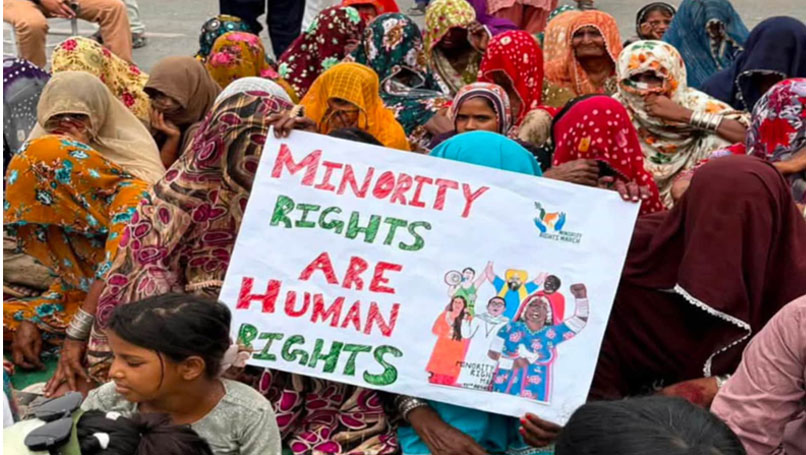
This years’ Minority Rights March held outside Mazar-i-Quaid in Karachi this year highlighted these contradictions. Activists put forward eleven demands, ranging from criminalizing forced conversions, ensuring quotas in education and employment, removing discriminatory content from textbooks, and amending constitutional provisions that exclude minorities from leadership are fundamental guarantees any state should provide. Alongside these, activists called for denationalisation of minority-founded institutions, protection of minority properties and places of worship, greater political representation, expanded access to education, employment opportunities, and the creation of an independent judicial commission to investigate misuse of blasphemy laws. They also demanded measures to protect those accused under such laws from mob violence. They demanded protection for minority women, who are disproportionately targeted in cases of abduction and coerced marriage, often under the guise of religious conversion. Courts, critics argue, have too often sided with perpetrators, granting impunity to those who exploit vulnerable girls.
Organiser Sheema Kermani who is also an activist & cultural icon says, “August 11 is an important reminder of Jinnah’s vision. He said religion would not be the business of the state and citizens would be free to practise their faith. Yet minorities continue to face attacks, their places of worship are targeted, and they are not treated as equal citizens.”
Pastor Ghazala said, “One of the biggest challenges minorities face is forced faith conversions, especially of minors. Through this march, we place our issues and demands before the state. Minorities chose to remain in Pakistan trusting the promises of its founder — those promises must now be honoured.”
The march also raised the issue of constitutional discrimination at the highest levels of political office. Article 41(2) stipulates that only a Muslim can serve as President of Pakistan, while Article 91(3) requires the Prime Minister to be Muslim. Activists argue that these provisions deny minorities the full rights of citizenship, excluding them from the nation’s most powerful offices. Organisers of the march noted the irony of Pakistanis celebrating religious freedom abroad such as when Zohran Mamdani, a Muslim, became Mayor of New York while denying equal opportunity at home.
The Parliamentarians Commission for Human Rights (PCHR) has echoed these concerns, calling for the establishment and activation of a National Commission for Minority Rights. Its chairman, Riaz Fatyana, reminded audiences that the Pakistan Resolution itself was rooted in protecting minorities from majority domination. Denying minorities their rights, he argued, amounts to negating Jinnah’s vision. Yet, despite repeated calls, the commission remains non-functional, leaving minority communities without a dedicated institutional safeguard.
Education remains a stark arena of exclusion. Reports suggest that nearly 60 percent of minority students face discrimination, including denial of enrollment, segregation, and compulsory study of religious subjects irrelevant to their faith. In Sindh, 44 percent of minority children are out of school, compared to the national average of 27 percent. Even where university quota seats exist, they often go unfilled due to financial barriers, lack of awareness, and weak enforcement. This structural exclusion perpetuates cycles of poverty and marginalization, leaving minorities unable to access higher education or professional advancement.
Seventy-nine years after independence, Pakistan still struggles to turn constitutional guarantees into lived reality. The absence of a Hindu temple in Rawalpindi or Islamabad where the community can freely worship is emblematic of this failure. The targeting of churches, temples, and Ahmadi mosques reflects a broader climate of intolerance. The assassination of Shahbaz Bhatti remains a chilling reminder of the risks faced by those who dare to speak out. And the continued misuse of blasphemy laws, often weaponized against minorities, underscores the fragility of their protections.
The symbolism of August 11 is powerful, but symbolism alone cannot substitute for substantive change. National Minorities Day risks becoming a ceremonial observance unless it is tied to concrete reforms. The strength of a nation, as activists remind us, is not measured by its majority but by how it treats its minorities. In Pakistan, the question of minority rights is not abstract; it is a matter of law, morality, and state responsibility. The persistence of mob violence, forced conversions, exclusion from education, and constitutional discrimination reveals a gap between principle and practice that cannot be ignored.
The demands raised by activists this year are not radical or excessive but the bare minimum of equal citizenship. Yet in Pakistan, even these fundamental rights remain contested, delayed, or denied. Until they are realized, National Minorities Day will stand not as a celebration of progress but as a stark reminder of how far the nation has failed to live up to its founding promise.
Views: 11


