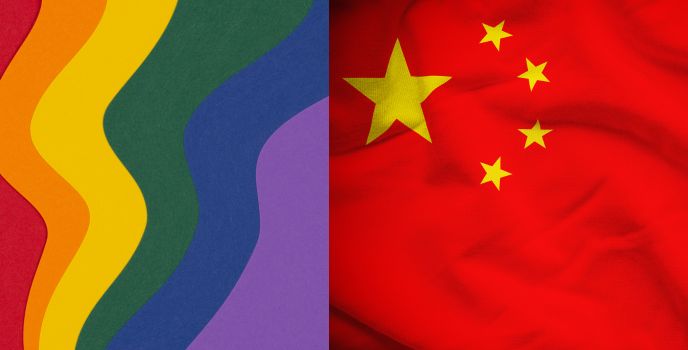







There is a deliberate lack of explicit public policies relating to lesbian, gay, bisexual, transgender, queer or questioning, intersex, asexual, and more (LGBTQIA+) people in the People’s Republic of China (PRC).
The official policy in China regarding the LGBTQIA+ community is somewhat contradictory. On one hand, homosexuality is legal, and there have been some efforts to recognize gender identity through surgery. However, there are no explicit anti-discrimination protections for LGBTQIA+ individuals, and same-sex marriage and adoption are not recognized. In China LGBTQIA+ individuals and activists face significant repression, including censorship on social media, forced closures of LGBTQIA+ organisations, and increased scrutiny from authorities. Safe spaces for the LGBTQIA+ community are shrinking, and social acceptance remains low. Many LGBTQIA+ people in China still face discrimination in various aspects of their lives, including at work and within their families, despite homosexuality being decriminalised since 1997 and removed from the list of mental illnesses in 2001.
So, even though there’s legal room for people to live as they choose, the lack of explicit protections makes it a constant struggle for many. Without such protections, discrimination in the workplace, housing, and even in accessing services is more common. It’s not just about legal recognition; it’s about having a society where people can live openly and safely, which is a whole other challenge.
A lot of grassroots efforts are pushing for change, but progress is slow and met with significant opposition. It’s a complex situation where the gap between policy and lived reality is pretty stark.
After years of operating in the grey area permitted by the “Three NOs Policy”, namely “not encouraging, not discouraging, and not promoting”, the LGBTQIA+ organisations and activists have faced severe attacks in recent years. Same-sex marriage and de facto relationships are not legally recognized. This means that LGBTQIA+ individuals lack legal protections and rights that heterosexual couples enjoy. Without legal recognition, same-sex couples face challenges in areas like inheritance, medical decision-making, and adoption. It’s like a shadow over personal and societal acknowledgment.
And while there have been some public discussions and increasing visibility of LGBTQIA+ issues, legal reforms remain out of reach. The repression of rights-advocated NGOs and individual activists has intensified, shifting from intimidation to a law-based, systematic crackdown. This legal vacuum forces many to navigate complex and often discriminatory systems on their own. It’s a stark contrast to the progress seen in other parts of the world.
LGBTQIA+ content is often censored on social media platforms, and activists face significant pressure from authorities. Traditional Confucian values emphasising family and heterosexual norms still influence societal attitudes. This leads to discrimination and marginalisation of LGBTQIA+ individuals in China.
Since President Xi Jinping took office in 2013, there has been a noticeable increase in the repression of LGBTQIA+ activities in China. This crackdown has been systematic and relentless, targeting activists, organisations, and even online content. Since 2020, the crackdown on LGBTQIA+ activism in China has further intensified. Activists attribute the difficulties they encounter to government oppression, internal community issues, and attacks from counter-movements. These challenges result in mental stress, moral dilemmas, and disenchantment with the movement.
In 2020, Shanghai Pride , the largest and longest-running LGBTQIA+ festival in China, was compelled to cancel due to local government pressures. The year 2021 witnessed the sudden deactivation of WeChat official accounts of numerous LGBTQ+ student organisations and local branches of Trueself (formerly PFLAG China).
Authorities have also shut down other prominent organisations, such as LGBT Rights Advocacy China in 2021. Safe spaces for the LGBTQIA+ community are shrinking, making it harder for individuals to find support and community.Social media platforms like WeChat have been used to censor LGBTQIA+ content, making it difficult for activists to communicate and organise. This repression is part of a broader effort to promote conservative and conformist values around gender and sexual identity.
For example, the Beijing LGBTQIA+ Center, a prominent advocacy group, was forced to close in 2023. The Beijing LGBT Center, which had been a vital hub for the LGBTQIA+ community in Beijing, was forced to close on May 15, 2023. The centre had been operating for 15 years and provided crucial services like mental health counselling, community events, and advocacy work. The closure was a significant blow to the community, as it represented one of the few safe spaces for LGBTQIA+ individuals in the city. The centre’s shutdown was part of a broader crackdown on LGBTQIA+ activities and organisations in China under President Xi Jinping’s government. This has made it increasingly difficult for activists to operate and for the community to find support
Recently renowned transgender celebrity and choreographer Jin Xing recently faced a significant setback when her request to stage an adaptation of the classic play “Sunrise” was rejected by authorities in Guangzhou. The Guangzhou Culture and Tourism Bureau cited procedural issues as the reason for the rejection, but the decision has raised concerns about ongoing LGBT censorship in China and the broader cultural oppression faced by the LGBTQIA+ community. Jin Xing publicly questioned the rejection on social media, attributing it to potential personal biases. Her post garnered massive attention, highlighting the complex and evolving attitudes towards LGBT individuals in the country.
Activists in authoritarian China, in addition to facing “hard repression” from the state, such as the death penalty, also face “soft repression” from non-state actors, because LGBTQIA+ culture is perceived as a Western culture, activists have also suffered accusations of being “unpatriotic.”
This systematic suppression has significantly affected both organisations and individual activists, who have had their careers suspended, and community members, who lost their safe spaces. Negative emotions, including trauma related to the social movement, fear, disgrace, and political depression, have been frequently highlighted in recent research and reports on China’s LGBTQIA+ activism (Foreign Policy, 2023). The chilling effect of these measures has built up a pervasive atmosphere of uncertainty and apprehension within the LGBTQIA+ community in China.
Views: 236