


ROME: The fourth Intergovernmental Summit between Italy and Turkey, held today in Rome, offered a compelling snapshot of how strategic interests are redrawing the Mediterranean’s geopolitical map. Ignoring Erdogan’s blatant attempts to subvert democracy in his country as well as bomb Kurdish positions in Syria, Italy has welcomed him in Rome.
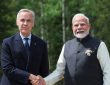
Italian Prime Minister Giorgia Meloni and Turkish President Recep Tayyip Erdoğan presided over a day of talks and agreements that, while heavy on trade and defence, carried deeper diplomatic implications.
“It was a very productive meeting,” said Prime Minister Meloni. “I’m particularly satisfied with the results we achieved.” She highlighted that bilateral trade has grown from $26 billion in 2023 to over $32 billion in 2024 — a record increase that prompted both sides to raise their target to $40 billion in the medium term. Italian exports to Turkey have surged by more than 28% in the past year alone.
Yet this summit was not just about numbers.
What makes this meeting significant is the evolving context of Erdoğan’s leadership. Once an outlier in the European diplomatic space, Erdoğan’s ideological roots in political Islam and his long-standing ties to the Muslim Brotherhood have historically complicated his country’s relations with Western Europe. However, in Rome, pragmatism prevailed.
“Turkey and Italy share strong industrial and economic complementarities,” Meloni emphasized. “Over 400 Italian companies operate in Turkey, and our entrepreneurs play a key role in manufacturing and infrastructure development.”
The summit showcased a major defence and aerospace breakthrough: the acquisition of Piaggio Aerospace by Turkey’s Baykar Technologies and the formation of a joint venture with Italy’s Leonardo to co-develop unmanned aerial systems. “This is a significant agreement,” Meloni said, “that leverages the strengths of both nations and opens new markets, particularly in Europe.”
Beyond defence and trade, the scope of cooperation extended into digital infrastructure and energy. TIM Sparkle and Turkcell signed an agreement to build a state-of-the-art 4,000 km digital backbone linking Italy and Turkey — a project aimed at enhancing connectivity between Europe, the Middle East, and Asia.
Energy collaboration also featured prominently, particularly through the Trans Adriatic Pipeline (TAP), with shared intentions to explore opportunities in renewables and hydrogen. “We are already strategic partners in natural gas,” Meloni said, “and now we aim to deepen cooperation on sustainable energy.”
On the geopolitical front, Meloni and Erdoğan addressed global crises from Ukraine to Gaza. The Italian leader thanked Erdoğan for his mediation efforts during the war in Ukraine, particularly on food security. She reiterated Italy’s full support for “a just and lasting peace,” noting the symbolic importance of the recent meeting between U.S. President Trump and Ukrainian President Zelensky at the Vatican.
On the Middle East, Meloni emphasized the need for credible reconstruction plans for Gaza and durable regional peace, stating, “We must guarantee a democratic transition in Syria, ensure the voluntary and safe return of refugees, and continue the fight against terrorism — a domain in which Italy and Turkey intend to strengthen their already effective cooperation.”
Migration was also addressed, with Meloni noting that irregular departures from Turkey’s coasts have been “substantially reduced.” She thanked Erdoğan for the collaboration and pledged continued efforts to combat trafficking and criminal networks.
The summit concluded with over a dozen intergovernmental agreements signed and the participation of more than 500 companies in the Italy–Turkey Business Forum. “We are laying the groundwork for even greater progress in the months and years to come,” Meloni declared.
This high-level convergence may not erase ideological differences, but it reinforces a broader truth: in a fragmented global landscape, shared interests are reshaping alliances. For Italy and Turkey — allies in NATO and neighbors in the Mediterranean — realpolitik has once again become the language of diplomacy.
Views: 46