






Emmanuel Macron has always had a taste for theatre. He likes symbolism, staging, dramatic backdrops and the kind of political choreography that makes diplomacy look like a Renaissance painting with better lighting. His decision to hold the 2026 G7 summit in Évian-les-Bains fits that instinct perfectly.
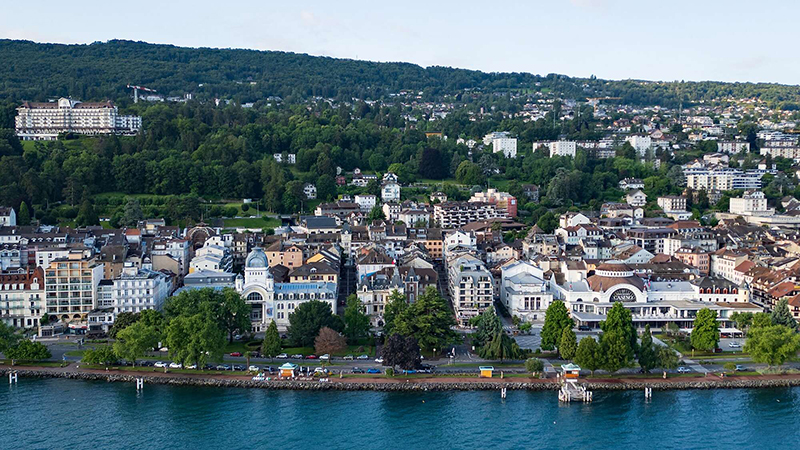
On paper, it is beautiful. A French spa town on Lake Geneva. Alpine scenery. Historic resonance. A discreet distance from Paris. Enough elegance for the cameras, enough remoteness for the security planners, and just enough proximity to Geneva to make Swiss infrastructure extremely useful without giving Switzerland the pleasure of being the host.
You can’t but admire the efficiency of the arrangement. France gets the summit, the prestige, the images of world leaders arriving in a picturesque lakeside setting under the benevolent shadow of the Élysée. Switzerland, meanwhile, gets the airport pressure, the security burden, the police mobilisation, the border controls, the protest anxiety and, apparently, the public irritation.
It is French grandeur with Swiss logistics.
The summit, scheduled for 15 to 17 June 2026, is taking place just across the water from Geneva, with delegations expected to transit through Swiss infrastructure, especially Geneva Airport. The Swiss federal authorities have acknowledged that the event requires exceptional security measures on their side of the border, particularly in the cantons of Geneva, Vaud and Valais. Switzerland is not the host, but it is being asked to behave like a co-host, with all the disruption that implies.
This is where Macron’s shrewdness becomes Swiss irritation. From Paris, Évian looks like a picturesque and strategic venue. From Geneva, Lausanne and Bern, it looks like a French summit with a Swiss bill attached.
The anger is not merely administrative. According to Le Monde, the upcoming G7 has placed serious strain on relations between France and Switzerland, with Swiss frustration focused on consultation, cost-sharing, airport transit, policing and the management of protests. The Swiss concern is not abstract. They fear that France will enjoy the diplomatic theatre while Switzerland carries much of the operational burden.
The Bern angle is especially delicate. The Swiss federal government cannot simply ignore the event. It must coordinate with Paris, support the affected cantons, manage public order and protect Switzerland’s reputation as a reliable international partner. But Bern is also under pressure from cantonal authorities and citizens who see the summit as an imposed burden. The Confederation has already classified the impact of the summit as requiring exceptional measures, while Geneva, Vaud and Valais have requested federal support.
In other words, Bern is caught in the classic Swiss trap: too close to Europe to be unaffected, too independent to be treated as a mere logistical extension of France, and too responsible to shrug off the consequences.
The strongest resentment appears to be local. Geneva, in particular, remembers what happened in 2003, when Évian hosted the G8. That summit left a deep mark on the Swiss side of the lake. Demonstrations and disorder spilled into Geneva and Lausanne, and the memory of vandalism, policing pressure and public disruption still shapes today’s fears. Swiss reporting has repeatedly referred to that precedent as part of the current nervousness.
That historical trauma matters because it turns the 2026 summit into more than a security file. For Geneva, this is not simply another normal international event. It reopens old woulds echoing the events of the past. The city is being asked to prepare for the possible consequences of a summit it did not choose, in a country that is not technically hosting it, because the geography of Lake Geneva makes the border almost fictional in practical terms.
The World Cup fan zone controversy has made the resentment even more visible. Geneva authorities confirmed that large public events in the city centre would not be authorised from 1 to 28 June 2026, with police heavily mobilised for the G7 across the lake. Large fan zones for the opening weeks of the World Cup were therefore taken off the table, though smaller local arrangements may still be possible.
Lausanne has faced a similar situation. Reports indicate that the city will also go without its usual major World Cup fan zone, including at Ouchy, because of organisational and security constraints linked to the G7 in Évian. For ordinary citizens diplomatic inconvenience becomes personal when a summit of leaders across the lake is suddenly cancelling football gatherings at home.
This is politically toxic. The Swiss public may tolerate security measures for events they host or benefit from. It is far harder to accept restrictions, police saturation and cancelled public celebrations for a French-hosted summit. The rancour is therefore not just about money. It is about dignity, consent and proportionality.
There is also a broader European lesson here. Macron often speaks the language of European sovereignty, strategic autonomy and continental ambition. Yet in this case, the method looks rather less noble: choose the glamorous venue, export the complications, and expect everyone else to admire the architecture of the decision. It is a style of leadership that confuses consultation with notification.
France, of course, insists that coordination is taking place. There will be meetings, working groups, communiqués and the usual vocabulary of cross-border cooperation. But the tone of Swiss unease suggests something has already gone wrong. Neighbours do not usually become this irritated when they feel genuinely included.
The summit’s most uncomfortable lesson may therefore emerge before the leaders even arrive. France chose the stage. Switzerland is being asked to manage much of what happens around it. And for Bern, Geneva and Lausanne, the message from across the lake must feel painfully familiar: France gets the summit, France gets the stage, France gets the applause. Switzerland gets the barriers, the police overtime, the cancelled fan zones and the privilege of being told that this is all part of excellent bilateral cooperation.
Views: 90