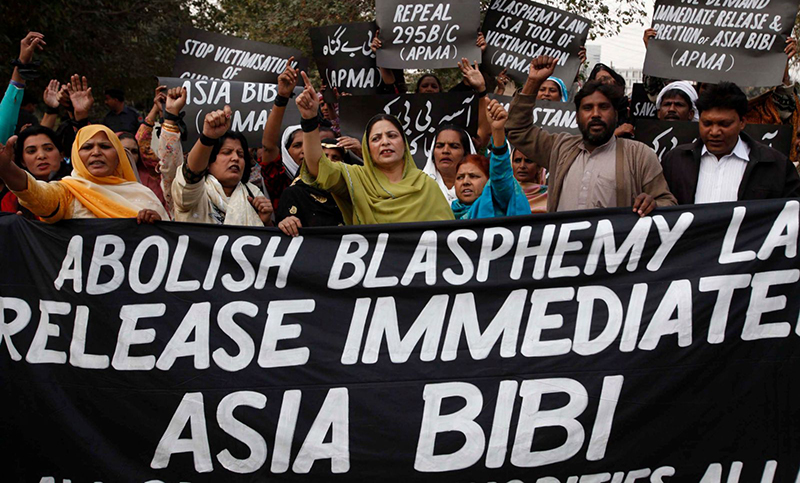







A religious accusation in Pakistan can begin with a whispered allegation and end with a prison cell, a death sentence or a mob outside a family home. For Christians, Hindus and Ahmadis, the danger is not confined to extremists operating outside the law.
Pakistan’s legal framework itself contains provisions that criminalise religious expression and, in the case of Ahmadis, restrict how a community can identify and practise its faith.
Across the border, India follows a fundamentally different constitutional model. It has no official state religion. Its Constitution describes the country as a secular democratic republic and guarantees freedom of conscience and the right to profess, practise and propagate religion.
That does not mean every religious dispute disappears, but the legal architecture places religious freedom within a secular constitutional framework rather than making adherence to a particular faith a condition of citizenship.
The contrast becomes particularly stark when Pakistan’s blasphemy laws are examined alongside the experiences of its religious minorities over the past decade.
Pakistan’s blasphemy law: religion enters the criminal code
Pakistan’s Constitution declares Islam the state religion, while its Penal Code contains some of the world’s most severe blasphemy provisions. Section 295-C provides the death penalty for defiling the name of Prophet Muhammad, while other provisions carry prison terms of up to life imprisonment.
The country has not carried out a state execution specifically for blasphemy, but those accused can remain imprisoned for years, sometimes on death row.
The legal framework extends beyond conventional blasphemy provisions. Pakistan’s laws also impose specific restrictions on Ahmadis, including prohibitions on presenting themselves as Muslims or describing their places of worship as mosques.
The result is a system in which religious identity itself can become legally consequential.
The numbers underline the scale of the problem. According to the Centre for Social Justice, 344 people were accused of blasphemy in 2024.
They included 242 Muslims, 49 Ahmadis, 32 Hindus and 20 Christians. While Muslims constituted the largest absolute number, minority communities were disproportionately represented relative to their population.
A decade of accusations, arrests and death sentences
The past decade has seen a succession of cases showing how accusations can lead to lengthy imprisonment or death sentences.
In September 2016, Christian teenager Nabeel Masih was arrested after being accused of posting allegedly blasphemous material on Facebook. He was charged under Sections 295 and 295-A of the Penal Code and remained imprisoned until his release in March 2021.
The following year, Christian man Nadeem James was arrested after allegedly forwarding blasphemous content to a friend.
In September 2017, a sessions court sentenced him to death under the blasphemy provisions. His case became another example of how digital communication could trigger the most severe religious-offence charges.
The case of Asia Bibi remains the most internationally recognised illustration of the consequences of a blasphemy accusation.
A Christian mother of five, she spent almost a decade in prison after being convicted and sentenced to death. Pakistan’s Supreme Court overturned the conviction in October 2018, criticising weaknesses in the prosecution case. She eventually left Pakistan for Canada in 2019.
The same year, brothers Qaiser and Amoon Ayub, both Christians, received death sentences after allegations concerning articles and images posted online. Their case demonstrated how blasphemy prosecutions could reach beyond verbal disputes and into digital expression.
In 2019, Christian teenager Nabeel Masih’s case was still moving through the courts, while other Christians faced new accusations. Christian man Saleem Masih was arrested that year after a relative accused him of burning pages of the Quran. He was later granted bail.
The scale increased sharply in 2020. The US State Department, citing the Centre for Social Justice, recorded at least 199 people accused of blasphemy that year, the highest annual figure reported by the organisation at the time.
Shia Muslims accounted for 70 percent of cases and Ahmadis for 20 percent, while Christians and Hindus also faced accusations.
In 2021, Ahmadi community leaders reported that 61 Ahmadis had been charged under blasphemy laws since 2019. The community also faced separate prosecutions under anti-Ahmadi legislation.
Courts, personal disputes and the threat of the mob
The misuse of blasphemy provisions has repeatedly been linked to personal disputes, property conflicts and social hostility. In 2022, Hindu teacher Notan Lal was sentenced to life imprisonment after a student accused him of insulting Prophet Muhammad.
The student later reportedly admitted fabricating the accusation after being reprimanded by the teacher.
That same year, Christian bicycle mechanic Ashfaq Masih was sentenced to death after being accused of making allegedly blasphemous remarks. He had been imprisoned since 2017 and maintained that personal and financial disputes lay behind the accusation.
The consequences extend beyond courtrooms. In February 2023, a mob stormed a police station in Nankana Sahib and lynched a man detained on blasphemy allegations.
In August that year, hundreds attacked a Christian settlement in Jaranwala after two Christians were accused of desecrating the Quran. Churches, homes and a cemetery were vandalised or set on fire.
In May 2024, Sargodha witnessed another violent episode after a Christian man was accused of desecrating the Quran. A mob attacked a Christian settlement, set fire to property and severely beat the elderly man.
Reuters reported that Pakistan’s blasphemy laws had frequently triggered mob violence, including over accusations later found to be false or disputed.
The problem continued into 2025. The US Commission on International Religious Freedom reported that Pakistani authorities continued enforcing blasphemy and anti-Ahmadi laws, while minority communities remained vulnerable to violence.
In one case, an Ahmadi man was killed by a mob in Karachi, while another Ahmadi doctor was shot dead in Punjab.
2026: fewer cases, but the fear remains
The latest developments offer a more complicated picture. Reuters reported in August 2026 that registered blasphemy cases had fallen by roughly two-thirds following a crackdown on hardline Islamist groups. Yet the decline has not removed the underlying danger.
In July, a mob of hundreds gathered outside the home of a Christian family in Karachi after blasphemy allegations spread. Police intervened before the situation escalated. An initial inquiry reportedly found the allegation to be false.
In August, Christian man Amir Masih was arrested in Gujranwala following a blasphemy allegation linked to a TikTok video. Police registered a case under Sections 295-A, 295-C and 298 of the Penal Code.
A Catholic man, Amir Peter, also died in July after spending about a year in detention following a blasphemy accusation. A Catholic news agency reported that his health deteriorated during imprisonment and that his case remained unresolved when he died.
The recent cases demonstrate why a reduction in the number of accusations does not erase the structural issue: an allegation can still place a minority citizen in the path of criminal prosecution, prolonged detention and mob mobilisation.
India’s constitutional model stands apart
India’s legal foundation rests on a different principle. The Constitution explicitly defines India as a “secular” democratic republic and guarantees liberty of thought, expression, belief, faith and worship.
Article 25 gives all persons freedom of conscience and the right freely to profess, practise and propagate religion, subject to public order, morality and health.
Articles 26 and 27 further protect religious denominations and prevent compulsory taxation for the promotion of a particular religion.
India does have criminal provisions concerning religious offences.
The Bharatiya Nyaya Sanhita (BNS), which replaced the Indian Penal Code, criminalises deliberate and malicious acts intended to outrage religious feelings, damaging or defiling places of worship, disturbing religious assemblies and deliberately wounding religious feelings.
Section 299 carries a maximum sentence of three years for deliberate and malicious insults to religion or religious beliefs.
These provisions are materially different from Pakistan’s blasphemy regime.
India has no standalone blasphemy offence comparable to Pakistan’s Section 295-C and does not prescribe the death penalty for insulting a religion or religious figure.
The distinction is also visible in the constitutional treatment of religious communities.
India officially recognises six religious minorities at the national level — Muslims, Christians, Sikhs, Buddhists, Jains and Parsis — while the Constitution protects the right of religious groups to establish institutions, manage religious affairs and preserve their cultural identity.
Two legal frameworks, two very different pressures
The comparison ultimately turns on the role assigned to the State.
In Pakistan, Islam’s constitutional status as the state religion exists alongside criminal blasphemy provisions and explicit restrictions on Ahmadis.
The documented cases of Christians, Hindus and Ahmadis show how accusations can move rapidly from allegations to arrest, imprisonment, death sentences or mob violence.
Meanwhile, in India, the constitutional framework does not make adherence to one religion a condition of citizenship. Religious freedom is embedded in a secular Constitution that protects conscience, worship and religious institutions across communities.
That difference matters most when faith becomes contested.
In Pakistan, the blasphemy framework can place the criminal law directly at the centre of a religious accusation, while in India, the constitutional model places religious freedom within a secular legal order in which no faith is designated as the religion of the State.
Over the past decade, the record of Pakistan’s blasphemy cases — from Nabeel Masih and Nadeem James to Asia Bibi, Notan Lal, Ashfaq Masih, Jaranwala and the cases still emerging in 2026 — shows the human consequences when religious accusation acquires the force of criminal law.The contrast with India lies not merely in demographics or religious diversity, but in the constitutional starting point: one country constitutionally identifies Islam as its state religion and criminalises blasphemy with penalties reaching death; the other defines itself as secular and constitutionally guarantees freedom of conscience and religion without a Pakistan-style blasphemy law
Views: 20