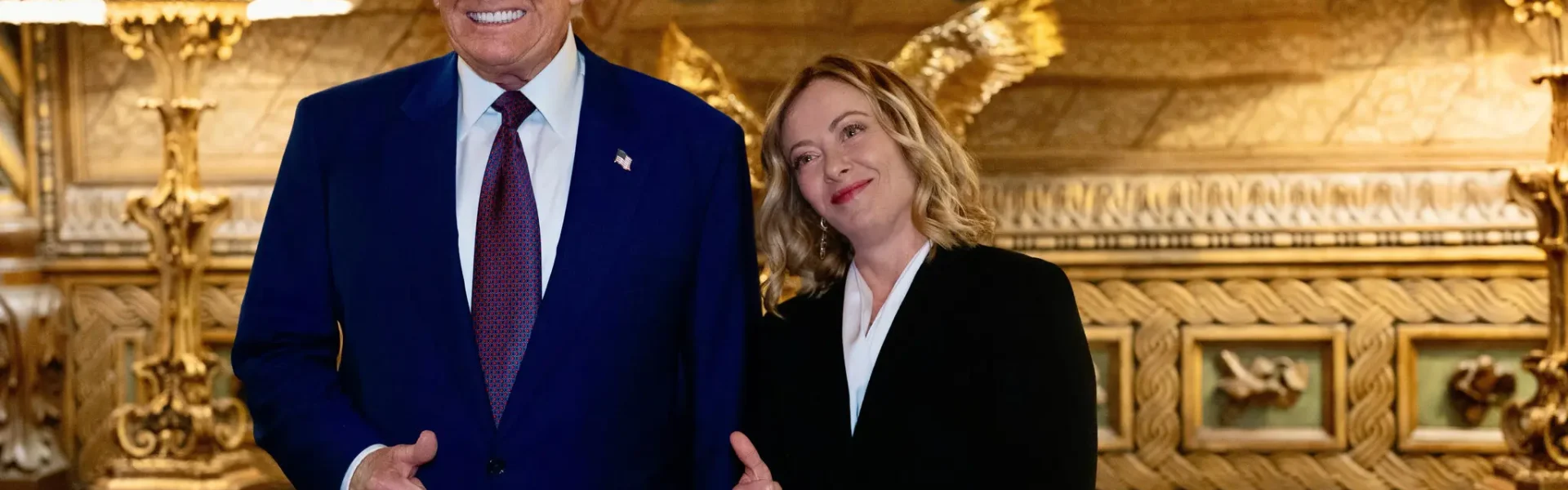







ROME: Italian Prime Minister Giorgia Meloni has strongly dismissed the notion that Italy must choose between aligning with the United States or the European Union, calling such a perspective “childish” and “superficial.” In her latest remarks, Meloni emphasized that fostering a strong transatlantic relationship does not mean compromising Italy’s role within Europe. Instead, she sees her country as a bridge between the two powers, working to prevent divisions that could weaken both the European Union and the broader Western alliance.
Meloni’s comments come at a time when tensions between Europe and the United States are being closely scrutinized, particularly as former U.S. President Donald Trump’s possible return to power looms over diplomatic relations. She has acknowledged Trump’s critical stance on Europe but framed it as frustration directed at European leadership rather than an outright opposition to the continent itself. She argues that Trump’s demands for Europe to take on a greater role in its own defense are not entirely unwarranted and could serve as a much-needed wake-up call for European nations to bolster their security efforts.
One of the key points in Meloni’s argument is that the idea of Europe achieving full security independence from the United States is unrealistic. While she supports strengthening Europe’s defense capabilities, she believes this should happen within the framework of NATO rather than as a separate project that could distance Europe from Washington. She warns that attempting to detach European security from the U.S. would leave the continent more vulnerable in a world where geopolitical threats are rapidly evolving.
Meloni has also proposed an alternative approach to ensuring Ukraine’s security, suggesting that NATO extend its defensive umbrella over the country without granting it full membership in the alliance. This, she argues, would offer Ukraine protection while avoiding a move that could be seen as overly provocative by Russia. However, her proposal has been met with skepticism, as it raises questions about how NATO could credibly guarantee Ukraine’s security without a formal commitment to collective defense under Article 5. European leaders and Ukrainian officials have expressed concerns that such a halfway measure may not provide the concrete assurances needed to deter Russian aggression.
At the heart of Meloni’s foreign policy is an attempt to balance Italy’s alliances carefully. She has engaged with European leaders in key diplomatic discussions but has also maintained strong connections with figures like Donald Trump, seeking to keep Italy in a strategic position regardless of the shifting political landscape. This balancing act, however, has drawn criticism from within Europe, with some accusing Italy of distancing itself from deeper European integration. Critics argue that Meloni’s reluctance to take a clear stance within the EU’s leadership structure has left Italy somewhat isolated, particularly at a time when European nations are working to present a united front on major issues such as defense, economic policy, and geopolitical stability.
Despite these criticisms, Meloni remains committed to her vision of a pragmatic and flexible foreign policy. She insists that Italy’s interests are best served by maintaining strong relations with both the United States and Europe, rather than being forced into a binary choice between the two. Her approach reflects a broader shift in global politics, where traditional alliances are being reevaluated, and countries are seeking to maximize their strategic options rather than adhering to rigid alignments.
As the political landscape continues to evolve, Meloni’s ability to navigate these complex relationships will be crucial in determining Italy’s role on the world stage. With challenges such as the ongoing war in Ukraine, growing concerns about European defense capabilities, and the unpredictability of U.S. foreign policy under potential future administrations, her leadership will be tested in the coming years. Whether her strategy of positioning Italy as a bridge between the U.S. and Europe proves successful will depend on how well she can manage both internal and external pressures while keeping Italy’s long-term interests at the forefront of her diplomatic efforts.
Views: 28