








India-France Building a New Pillar of Global Economic and Strategic Cooperation
India and France are deepening their Special Global Strategic Partnership through stronger cooperation across trade, defence, innovation, artificial intelligence, clean energy, space, and education. Bilateral trade exceeded USD 15 billion in FY26 and has the potential to reach nearly USD 30 billion by 2030.
The India–France partnership is entering a transformative phase characterised by deeper economic integration, technological collaboration, and strategic convergence. With bilateral trade already exceeding USD 15 billion, expanding cooperation across defence, aerospace, artificial intelligence, clean energy, digital technologies, and advanced manufacturing is expected to create new engines of growth.
The India–EU Free Trade Agreement could further enhance market access, attract investment, and integrate businesses into resilient global value chains. Given the strong momentum across trade, innovation, and strategic sectors, bilateral trade could reach nearly USD 30 billion by 2030, making the India–France relationship one of the most dynamic and forward-looking economic partnerships between India and Europe. Together, both nations are well-positioned to shape a more innovative, sustainable, and prosperous global economic order.
From strategic trust to an innovation-led alliance
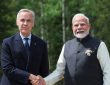
Addressing the India Innovates (Bharat Innovates) event in Nice, France, on 14 June 2026, Hon’ble Prime Minister Narendra Modi underscored the remarkable transformation of India–France relations into a partnership driven by innovation, technology, entrepreneurship, and shared global aspirations. Sharing the stage with French President Emmanuel Macron, the Prime Minister highlighted that both countries are moving beyond traditional areas of cooperation to embrace emerging sectors, including artificial intelligence, semiconductors, quantum technologies, cybersecurity, biotechnology, digital public infrastructure, green hydrogen, advanced manufacturing, and deep-tech innovation. The event, organised under the India–France Year of Innovation 2026, showcased more than 100 Indian innovations and reflected both nations’ determination to build future-oriented economic and technological partnerships.
PM Modi’s remarks reflected a broader strategic vision in which India and France work together to strengthen bilateral ties. He emphasised that India and France have complementary strengths that can shape the next wave of global economic transformation. He called for deeper collaboration among startups, innovators, researchers, universities, and industries, stressing that co-development and co-creation would define the future of resilient bilateral supply chains, accelerate sustainable growth, promote technological sovereignty, and contribute to a more balanced and multipolar world order.
The significance of this vision was reinforced on 17 February 2026, when Prime Minister Modi and President Macron elevated bilateral ties to a Special Global Strategic Partnership, marking a historic milestone in a relationship that has steadily deepened since the Strategic Partnership was established in 1998. Today, India and France are among each other’s most trusted strategic partners, collaborating across defence, trade, investment, space, civil nuclear energy, climate action, education, innovation, and global governance.
A strong diplomatic foundation for economic cooperation
The India–France relationship has evolved on the basis of enduring political trust and strategic convergence. The adoption of the Horizon 2047 Roadmap in 2023 provided a long-term framework for cooperation extending through the centenary year of India’s independence. Over the years, both countries have established robust institutional mechanisms to support economic and strategic cooperation. The Joint Committee on Economic and Commercial Cooperation, ministerial consultations, and high-level political engagements have ensured continuity and momentum in bilateral relations. The February 2026 summit added further depth by creating an Annual Foreign Ministers’ Comprehensive Dialogue, amending the Double Tax Avoidance Agreement (DTAA), and committing to launch a bilateral Economic and Financial Dialogue.
France has consistently supported India’s aspirations on major international platforms, including India’s candidature for permanent membership of the United Nations Security Council. The two countries work closely within the G20, the United Nations system, and other multilateral forums. This strategic alignment has created a stable environment that has encouraged businesses and investors to pursue long-term partnerships.
Trade relations reaching new heights
Economic cooperation has become a cornerstone of India–France relations. France is India’s third-largest trading partner in the European Union and one of India’s most important export destinations globally. Bilateral trade has grown significantly over the past five years, reflecting resilience amid global economic uncertainties. According to the latest available trade figures for FY 2025-26, bilateral merchandise trade reached USD 15.82 billion, the highest level recorded during the review period. India’s exports to France stood at USD 7.10 billion, while imports from France reached USD 8.71 billion.
Investment partnerships driving growth
Investment flows have emerged as another crucial pillar of bilateral economic cooperation. France is India’s eleventh-largest source of foreign direct investment. Between April 2000 and March 2025, cumulative French equity inflows into India reached EUR 9.79 billion, accounting for 1.61 per cent of India’s total FDI inflows. French investments span a diverse range of sectors, including services, cement and gypsum products, air transport, petroleum and natural gas, manufacturing, and infrastructure. Around 1,000 French companies currently operate in India, reflecting strong confidence in India’s growth potential.
Defence and aerospace are gaining the flagship space
No sector better illustrates the depth of India–France cooperation than defence and aerospace. Over the years, defence cooperation has evolved from buyer-seller transactions to joint manufacturing, technology transfer, co-development, and industrial partnerships. The acquisition of 36 Rafale fighter aircraft from Dassault Aviation for approximately EUR 7.87 billion remains the flagship defence project between the two countries. The programme has generated extensive industrial linkages, offset arrangements, and technological collaboration. In April 2025, India further strengthened this partnership by signing an agreement to acquire 26 Rafale-Marine fighter jets for the Indian Navy.
The Scorpène submarine programme, developed in partnership with Naval Group, marks another major achievement. The delivery of the sixth and final Kalvari-class submarine in January 2025 marked the successful completion of a landmark project that significantly enhanced India’s indigenous naval capabilities.
The relationship is entering a new phase centred on co-production and technological collaboration. Safran and Hindustan Aeronautics Limited are collaborating on the Indian Multi-Role Helicopter programme. A maintenance, repair, and overhaul facility for LEAP engines has been established, and a joint venture between Bharat Electronics Limited and French partners will manufacture HAMMER missiles in India.
In February 2026, the H125 Final Assembly Line, a joint venture between Tata Advanced Systems and Airbus, was inaugurated. This facility marks India’s first private-sector helicopter manufacturing line and symbolises the growing emphasis on “Make in India” within bilateral defence cooperation.
Cooperation in civil nuclear energy and space
Civil nuclear cooperation remains one of the most strategically important aspects of the India-France bilateral relationship. The proposed Jaitapur Nuclear Power Plant in Maharashtra is expected to become one of the world’s largest nuclear energy facilities, with a planned capacity of 9.6 GW. Led by EDF, the project has the potential to significantly strengthen India’s clean energy infrastructure and create substantial opportunities for industrial cooperation. Both countries are deepening collaboration across the entire nuclear value chain, spanning research, skill development, industrial applications, and emerging technologies, including Small Modular Reactors and Advanced Modular Reactors.
Space cooperation is another long-standing success story. Collaboration between ISRO and the French space agency, CNES, spans satellite development, launch services, space applications, and human spaceflight programmes. The decision to strengthen the India–France Strategic Space Dialogue and to expand cooperation on space situational awareness reflects the growing importance of space as both an economic and a strategic frontier.
Artificial intelligence, digital technologies and innovation
Innovation has emerged as the defining theme of the next phase of India–France relations. The India–France AI Declaration, launched at the Paris AI Action Summit in February 2025, identified artificial intelligence as a major area for future collaboration. Both countries are promoting ethical, inclusive, and open-source AI development and ensuring that technological progress benefits developing economies. The India–France Innovation Network is helping connect startups, research institutions, incubators, universities, and investors.
Partnerships such as the agreement between T-Hub and Nord France Invest are creating new opportunities for entrepreneurs and innovators. The proposed binational centre for digital sciences and technology between INRIA and India’s Department of Science and Technology, along with the Joint Centre for Advanced Materials involving CNRS and DST, further demonstrate the growing technological depth of bilateral relations.
France has also become the first European country to accept India’s Unified Payments Interface (UPI), with major establishments in Paris already facilitating UPI-based transactions. This development represents a practical example of how digital cooperation is strengthening tourism, business interactions, and people-to-people connectivity.
Sustainability, education and human connections
Climate action and sustainable development are central to India–France cooperation. Both countries co-lead the International Solar Alliance and co-preside over the Coalition for Disaster Resilient Infrastructure. Their collaboration spans renewable energy, disaster resilience, biodiversity conservation, green finance, and energy transition planning. The people-to-people dimension is equally significant. France aims to welcome 30,000 Indian students by 2030, up from around 10,000 today. New educational partnerships, mobility arrangements, and academic collaborations are strengthening societal ties between the two countries. Initiatives such as the AI in Healthcare Research Centre, involving Sorbonne University, AIIMS New Delhi, and the Paris Brain Institute, further illustrate how education, healthcare, and technology are converging to shape future cooperation.
The road ahead
India–France relations are entering a transformative phase. The elevation of ties to a Special Global Strategic Partnership, rising trade volumes, expanding investment flows, deepening defence cooperation, growing innovation partnerships, and shared commitments to sustainability collectively point to an exceptionally promising future. The India–EU Free Trade Agreement, the operationalisation of the Jaitapur project, greater collaboration in artificial intelligence and deep technologies, and expanded educational exchanges could further accelerate this relationship in the coming years.
As the global economy undergoes profound geopolitical and technological shifts, India and France are increasingly aligned on shared objectives, including strategic autonomy, technological sovereignty, resilient supply chains, sustainable growth, and a rules-based international order. Together, they are building not just a bilateral partnership but a powerful pillar of global economic and strategic cooperation, capable of shaping the twenty-first century.
Views: 64


