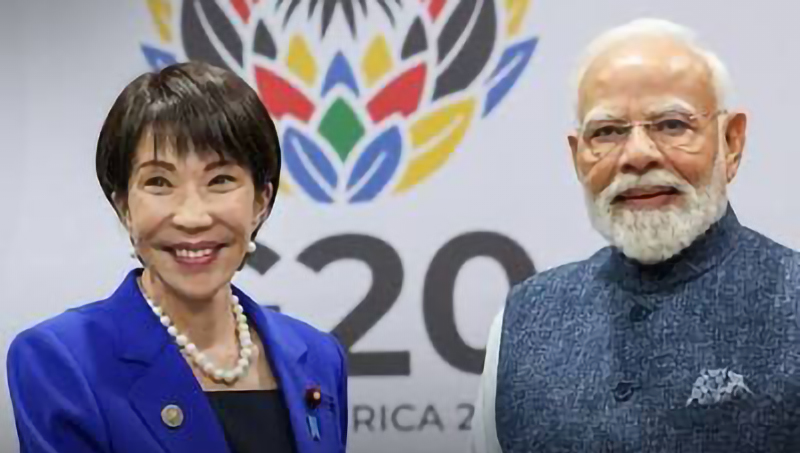







On the afternoon of 2 July 2026, at Hyderabad House in New Delhi, Prime Minister Narendra Modi welcomed Japan’s Sanae Takaichi for the Sixteenth India–Japan Annual Summit. The timing was pointed. Days earlier, Beijing had imposed fresh export controls on some forty Japanese firms after Takaichi warned that a Chinese assault on Taiwan could pose an existential threat to Japan. Against that backdrop, the two leaders were expected to unveil a joint statement, a dedicated declaration on artificial intelligence, and a cluster of agreements spanning critical minerals, energy resilience and a proposed mechanism to settle bilateral trade directly in yen and rupees. It would be easy to read all of this as a summit about China. It would also be incomplete.
Expanding Quad cooperation, maritime anxieties and the scramble for resilient supply chains have genuinely accelerated India–Japan ties in recent years. These pressures explain the pace of convergence; the relationship’s depth runs deeper still. The Sixteenth Summit revealed a partnership unlike any other in the Indo-Pacific: best understood as a Civilisational–Strategic Convergence, resting on six mutually reinforcing pillars, civilisational affinity, economic resilience, security cooperation, technological collaboration, maritime connectivity, and a shared stake in a multipolar order, rather than a coalition assembled against a common adversary. Together, these pillars explain why this relationship has proven so durable, a durability that any single pillar, or any single adversary, would struggle to sustain alone.
Its roots reach back to the sixth century, long before the Cold War, when the transmission of Buddhism carried Indian philosophy, art and statecraft into Japan and left it permanently, visibly altered. That inheritance did more than precede the strategic relationship: it continues to lower the cost of building one, supplying a reservoir of trust that newer partnerships must labour for years to earn.
This article argues that the Sixteenth Summit is best read as evidence, proof of a convergence built over centuries, accelerated since the Cold War’s end, and now being institutionalised across economic security, defence, maritime governance and regional connectivity, rather than as a milestone in itself. The India–Japan partnership predates this summit by generations. The summit simply revealed, with unusual clarity, how much the relationship had quietly become while the world was watching China.
A Partnership Older Than the State System
Long before either country existed in its modern form, a current of ideas flowed from the Gangetic plain to the Japanese archipelago. Buddhism, carried across Central and East Asia by monks and merchants, reached Japan by the sixth century and was, by the eighth, being actively cultivated at the highest levels of the Japanese state. In 752, the Indian monk Bodhisena presided over the eye-opening ceremony of the Great Buddha at Todaiji in Nara, an event still invoked today as the symbolic inauguration of direct India–Japan contact. A generation later, Kūkai and Saichō returned from Tang China bearing esoteric teachings saturated with Sanskritic content, embedding Indian philosophical categories permanently within Japanese religious life.
What makes this history diplomatically useful, rather than merely decorative, is the extent to which Indian civilisational content was absorbed, not simply transmitted. Saraswati became Benzaiten. Lakshmi became Kisshōten. Shiva’s fierce aspect, Mahakala, was transformed into Daikokuten, the god of wealth whose image remains ubiquitous in Japanese commercial life. Ganesha entered Japanese religion as Kangiten; Brahma and Indra as Bonten and Taishakuten. This is a depth of cultural absorption with no parallel in India’s relationship with any Western power, and it explains something a purely strategic reading misses: why the relationship carries so little of the transactional brittleness that characterises partnerships built on interest alone. Modi’s own frequent invocation of the Nalanda-to-Nara intellectual corridor, and the institutionalisation of yoga and Ayurveda as instruments of soft power, are a deliberate mobilisation of a reservoir of trust that lowers the transaction costs of everything that follows, rather than decorative flourishes on an otherwise hard-nosed strategic relationship.
What does this deep history tell us about a summit convened in 2026 amid Chinese export controls and Taiwan-related tension? Simply this: that the ease with which Modi and Takaichi could move directly to substantive negotiation, rather than spending political capital on relationship-building, is itself a dividend of civilisational trust accumulated over fourteen centuries. States without this reservoir typically need years of confidence-building before they can discuss semiconductors and currency settlement in the same afternoon as maritime security. India and Japan skipped that stage before either delegation had left for Delhi.
From Estrangement to Special Strategic Partnership
The contemporary relationship’s structural history is one of accretion rather than sudden transformation, and its timing rewards scrutiny. India’s 1991 liberalisation opened the possibility of Japanese capital and technology flowing into a market that had, until then, offered little for a trade- and investment-oriented economy like Japan’s. That possibility was nearly extinguished in May 1998, when India’s nuclear tests triggered a Japanese response, suspension of grants and loans, disproportionate to the tests’ actual strategic significance but entirely consistent with Japan’s identity as the only state to have suffered nuclear attack. The episode is worth dwelling on because it demonstrates something realist accounts of the relationship consistently underplay: Japan’s reaction was driven as much by normative conviction as by strategic calculation, and the relationship’s slow repair, formalised in the Global Partnership of 2000, was an act of identity reconciliation as much as renewed material exchange.
What followed was a steady institutional deepening: Strategic and Global Partnership in 2006, a Security Cooperation Declaration in 2008, a Comprehensive Economic Partnership Agreement in 2011. The elevation to Special Strategic and Global Partnership in 2014, coinciding with the near-simultaneous arrival of Modi and Shinzo Abe, two leaders with unusually explicit civilisational instincts and genuine personal rapport, marks the point at which the relationship acquired its contemporary density: expanded defence cooperation, a civil nuclear agreement, and the beginning of a connectivity diplomacy aimed squarely at India’s Northeast. The Joint Vision for the Next Decade, concluded in Tokyo in August 2025, and the sixteenth summit that followed less than a year later, represent the most recent phase of an institutional pattern that has now outlasted a dozen changes of government on both sides, a durability that only a deeply rooted relationship could sustain.
Read against this chronology, the sixteenth summit extends rather than departs from an established pattern: each elevation in the relationship’s status, 2000, 2006, 2014, has arrived as ratification of momentum already built at the working level, rather than as a rupture. What is different in July 2026 is pace. Where earlier elevations required years of quiet institution-building before a summit could formalise them, the interval between the 2025 Joint Vision and this year’s concrete deliverables, an AI declaration, a currency-settlement proposal, a green ammonia project, has compressed to under twelve months. The relationship is accelerating, and doing so faster than at any point in its recent history.
Reading the Sixteenth Summit
The July 2026 summit deserves to be read as more than a ceremonial waypoint. If a single sentence captures what has changed in the economic relationship over the past decade, it is this: the partnership’s centre of gravity has shifted from infrastructure finance to economic security. Where the 2000s and early 2010s were defined by yen loans for metro systems and highways, the vocabulary of 2026 is semiconductors, critical minerals, trusted telecom and artificial intelligence, a shift in emphasis from building things India lacked toward building resilience against risks both countries now share. The summit’s substantive agenda, artificial intelligence, critical minerals, pharmaceuticals, battery technology and energy resilience, illustrates how far the relationship has travelled from its earlier, narrower focus on infrastructure finance and defence dialogue. The elevation of AI cooperation to the status of a dedicated joint statement, building on the existing Japan-India AI Cooperation Initiative and extending into large language models, joint research and startup ecosystems, signals that both governments now regard frontier technology as warranting an institutional register equal to, not subordinate to, traditional security cooperation. The prospective yen-rupee settlement mechanism, building on an existing seventy-five-billion-dollar currency swap line, would allow the more than fourteen hundred Japanese firms now operating in India to bypass dollar intermediation altogether, a modest-sounding technical fix that would nonetheless mark a genuine, if incremental, step toward monetary diversification that both capitals have periodically signalled interest in pursuing.
Equally instructive is what the relationship has struggled to deliver. The joint development of the US-2 amphibious search-and-rescue aircraft, discussed intermittently for over a decade, remains unresolved, a reminder that Japan’s continuing caution over arms exports, however loosened since the previous decade, still lags the ambition of joint communiqués. The maritime and defence relationship more broadly has advanced through institutional accretion rather than dramatic breakthrough: the Malabar exercise, which began as a bilateral India–United States engagement and now includes Japan as a permanent participant, together with bilateral drills such as Dharma Guardian and Veer Guardian, constitute the visible face of a cooperation whose less visible core lies in maritime-domain-awareness sharing and anti-submarine-warfare coordination, both aimed squarely at the expanding Chinese naval presence in the Indian Ocean. The UNICORN radar-mast programme for Indian warships, still working through the technology-transfer sensitivities that have historically slowed Japanese defence-industrial cooperation, illustrates both the direction of travel and its characteristic pace: real, but rarely as fast as the rhetoric surrounding it suggests. Energy security supplies a further, closely related thread. Japan’s near-total dependence on hydrocarbons transiting Indian Ocean sea lanes makes the security of those lanes a matter of literal survival rather than abstract preference, while India’s own transition toward green hydrogen, offshore wind and next-generation battery storage has opened fresh avenues for Japanese technology and capital, of which the proposed Odisha green ammonia project and expanded biogas cooperation are the latest instalments. Civil nuclear cooperation, formalised in 2016 after years of negotiation complicated by Japan’s Fukushima-era caution and its lingering unease since the 1998 tests, remains modest in commercial terms but carries diplomatic significance disproportionate to its scale, marking, as it does, the furthest point yet reached in the trust-repair process that began with the Global Partnership of 2000.
Bilateral trade, at roughly twenty-seven billion dollars in the last fiscal year, leaves Japan ranked only around eighteenth among India’s trading partners, a modest figure that fifteen years of a Comprehensive Economic Partnership Agreement have barely moved, and one that sits oddly alongside the strategic weight both governments attach to the relationship. This gap between institutional ambition and commercial delivery is real, and it should temper any triumphalist reading of summit communiqués. Investment has moved faster than trade: Japan has for four consecutive years ranked India as its most promising medium-term manufacturing destination in surveys by the Japan Bank for International Cooperation, and Japanese investment into India has now surpassed investment into China for two consecutive years, a reversal of considerable symbolic weight given the historical primacy of the Chinese market in Japanese corporate strategy. It is this investment logic, corporate diversification away from China-concentrated supply chains that increasingly does more work in sustaining the relationship’s economic substance than trade figures or joint statements alone.
The China Variable, Properly Weighted
Any honest account must acknowledge China’s central role in accelerating this relationship. India’s 2020 clashes along the Himalayan frontier and Japan’s sustained pressure in the East China Sea around the Senkaku Islands have supplied both capitals with congruent, if not identical, threat perceptions. Chinese naval expansion into the Indian Ocean, its port investments across South Asia and East Africa, and its demonstrated willingness to weaponise trade dependencies, most visibly through rare-earth export controls, have driven both governments toward the economic security architecture, semiconductor cooperation, critical-minerals partnerships, trusted-telecom standards, that now occupies a central place in joint statements.
But treating China as the relationship’s sole engine misreads both the timing and the texture of the evidence. The relationship’s most significant pre-2014 institutionalisation occurred before Chinese assertiveness reached its contemporary intensity. And the relationship continues to sustain domains, Buddhist heritage diplomacy, bamboo value chains in Meghalaya, medical college construction in Nagaland, whose connection to China-balancing is at best indirect. China functions as an accelerant that has sharpened and organised a convergence whose deeper roots lie elsewhere: in civilisational trust, in India’s search for strategic autonomy, and in Japan’s own careful recalibration of its post-pacifist security posture. Strip away the China factor entirely, and a thinner but still substantial relationship would very likely persist; strip away the civilisational and normative substrate, and the security cooperation now underway would likely prove considerably more brittle than it has so far shown itself to be.
The timing of the sixteenth summit, arriving days after Beijing’s export controls on Japanese firms, will tempt observers to read it as a China summit in all but name. The more accurate reading is that Chinese pressure supplied urgency to an agenda, AI cooperation, currency settlement, critical minerals that both governments had already been building toward independently of any single provocation. The provocation shaped the summit’s headlines; the agenda itself, built well before Beijing’s latest move, determined its content.
The Northeast as Strategic Laboratory
If any single arena demonstrates that the relationship exceeds the logic of China-balancing, it is Japan’s development assistance to India’s Northeast, coordinated since 2017 through the Act East Forum and channelled overwhelmingly through the Japan International Cooperation Agency. Cumulative JICA commitments to the region now exceed 385 billion yen, the great majority disbursed within the past decade and a half, making Japan the only foreign partner sustaining large-scale infrastructure programming across all eight states of a region that borders Myanmar, Bangladesh, Bhutan and China itself. The flagship road-connectivity project has financed more than 750 kilometres of highway, including the Dhubri–Phulbari Bridge across the Brahmaputra, which will reduce an eight-hour journey to roughly twenty-three minutes upon completion.
The choice of the Northeast is deliberate, not incidental. Its proximity to India’s own contested frontier with China lends Japanese-financed infrastructure a quiet strategic salience that investment elsewhere in India would lack. Its position as the hinge between South Asia and Southeast Asia makes it structurally indispensable to the Industrial Value Chain concept linking Assam and Meghalaya, via Bangladesh’s Matarbari port, to Bay of Bengal and ASEAN production networks, a concept that gives India’s long-rhetorical Act East Policy its most concrete physical expression to date. And where Chinese connectivity financing elsewhere in South Asia has drawn scrutiny for opaque terms and unsustainable debt, Japanese ODA has been structured through comparatively transparent concessional loans paired with technical cooperation in forestry, biodiversity and bamboo-based livelihoods, a contrast both governments have periodically, if diplomatically, invoked. The Northeast, in short, functions as a laboratory in which India’s connectivity ambitions, Japan’s Indo-Pacific vision and an implicit rejoinder to Chinese infrastructure diplomacy converge in physical, load-bearing form.
That the Northeast programme received renewed high-level attention at the sixteenth summit, rather than being left to bureaucratic routine, confirms that connectivity diplomacy has become a permanent fixture of annual summitry rather than a project-level footnote. Few bilateral relationships anywhere sustain this kind of leader-level attention to a single sub-national region for over a decade; that India and Japan do so is itself evidence of how far this partnership now operates below the level of headline security cooperation.
Strategic Autonomy Meets Post-Pacifism
The theoretical puzzle at the heart of this relationship is why two states with such different postures toward alliance politics, India’s studied avoidance of binding commitment, Japan’s formal treaty alliance with the United States, have built a partnership of such evident strategic depth while each preserves its core orientation intact. The answer lies in recognising that both states are, in different registers, pursuing the same underlying good: expanded latitude. India’s strategic autonomy, reformulated substantially since 2014 from its Nehruvian non-alignment origins, is a determination to retain independent decisional space across the widest possible range of partnerships, rather than mere equidistance. Japan’s own trajectory, from the constitutional pacifism of Article 9 toward the more assertive posture articulated in its 2022 National Security Strategy, represents an analogous search for room to manoeuvre within, rather than against, its American alliance. Read this way, India and Japan converge because both are diversifying their strategic options against overreliance on any single patron or bloc, India’s instinctive wariness of binding itself to Washington, Japan’s quiet interest in partners who ask little in return for much, rather than because one is balancing China while the other stands apart. This is why the relationship has proven compatible with, rather than a substitute for, each country’s other major partnerships, with the United States, with Australia, with France, even as it has developed a normative density that surpasses all of them.
It is worth pausing on the competing explanations that scholars and practitioners offer for this convergence, because each captures part of the truth. Those who see the relationship as primarily an exercise in balancing China can point to its clear acceleration since 2017. Those who emphasise economic complementarity can point to the JBIC investment data. Those who stress shared democratic values correctly notice that Japan reserves comparable strategic depth for very few large non-democratic Indo-Pacific powers. And those who foreground strategic autonomy correctly identify what makes the relationship distinctive rather than merely convenient. The more persuasive reading, and the one this essay advances, treats these as mutually reinforcing conditions rather than as competing hypotheses: security convergence paired with civilisational trust has produced a partnership considerably thicker than the transactional relationships India maintains elsewhere in the Indo-Pacific; civilisational affinity paired with economic substance has given cultural familiarity real strategic consequence. It is the interaction among these logics that explains why this relationship has proven more resilient than most.
Placed alongside India’s other major partnerships, the distinctiveness sharpens further. The relationship with Washington, broader in scope and increasingly ambitious in defence technology, still carries a residual asymmetry and periodic trade friction that New Delhi and Tokyo have largely avoided with one another. The relationship with France offers a comparable respect for Indian non-alignment instincts but lacks India–Japan’s civilisational depth or economic scale. The relationship with Australia, maturing rapidly within the Quad, shares the normative architecture but remains considerably thinner in the connectivity and development-assistance domains where Japan has invested for decades. And Japan’s own alliance with Washington, involving formal mutual-defence obligations that India has deliberately avoided replicating, remains categorically different in kind from anything on offer with India, a difference both governments appear content to leave unresolved rather than force toward false symmetry. What distinguishes the India–Japan case is precisely this combination: strategic substance without the encumbrance of formal alliance, historical depth without adversarial memory, a rare configuration among the major bilateral architectures either country maintains.
What It Means for the Region
The implications radiate in several directions at once. For the Quad, the timing of this summit alongside acute Sino-Japanese friction reaffirms the minilateral’s continuing relevance as a coordinating mechanism, even as the India–Japan bilateral track continues to advance largely on its own momentum rather than strictly through Quad channels, consistent with each country’s preference for retaining flexibility across overlapping frameworks rather than subordinating itself to any one of them. For ASEAN, the deepening of the Industrial Value Chain concept signals that both India and Japan continue to conceive of their connectivity ambitions as complementing, rather than substituting for, the centrality Southeast Asian states insist upon in their own regional architecture. For China, the economic-security agenda represents a further, still modest, step in diversifying supply chains away from Chinese-dependent nodes, though the scale of concluded critical-minerals cooperation remains small relative to the scale of Chinese processing dominance it seeks to offset, a reminder that meaningful diversification is a multi-decade project rather than an accomplished fact. For the United States, the summit’s technology and currency agenda proceeds in a register that is largely complementary to, though not contingent upon, Washington’s own Indo-Pacific strategy, evidence of the increasingly trilateral texture that even ostensibly bilateral India–Japan initiatives now carry.
These achievements deserve equal candour about the frictions that persist alongside them. Bureaucratic delay on the Indian side continues to slow project implementation relative to Japanese planning expectations. Japan’s demographic contraction, the structural force underlying its ambitious labour-mobility commitments, raises longer-term questions about the sustainability of its outward investment and aid capacity. And the persistent gap between joint-statement ambition and concluded delivery, visible in the US-2 saga and in trade figures that have grown only modestly despite CEPA’s institutional maturity, should discipline any tendency toward diplomatic self-congratulation. A relationship this consequential deserves candour about its limits as much as celebration of its achievements.
What Comes Next
The frictions above are largely inherited, the residue of implementation gaps decades in the making. A more interesting question is what genuinely new challenges this partnership must now confront, since a relationship built for the twentieth century’s infrastructure and non-proliferation questions is being asked to govern problems that scarcely existed a decade ago. Artificial intelligence supplies the clearest case: the joint statement expected from the sixteenth summit commits both governments to collaboration on large language models and applied AI, but says comparatively little about the harder question of joint governance, shared standards for model safety, data protection and algorithmic accountability, that will determine whether this cooperation produces genuine interoperability or merely parallel national programmes that happen to share a communiqué. Semiconductor competition poses a related test: both countries have positioned themselves as partners in diversifying supply chains away from Chinese-dominated nodes, but neither has yet resolved how India’s nascent fabrication ambitions and Japan’s more mature but contracting semiconductor base will divide labour within a shared ecosystem rather than compete for the same investment. And climate-resilient infrastructure, a theme implicit in the Northeast’s mountainous terrain and in the Odisha green ammonia project alike, will increasingly test whether Japanese quality-infrastructure standards can be delivered at the pace and scale India’s development timeline demands, without which the connectivity diplomacy examined above risks becoming a showcase of individual projects rather than a genuinely transformed regional economy. These challenges leave the relationship’s foundations intact. But they mark the frontier where consolidation ends and genuine innovation in the partnership must begin.
Conclusion
What India and Japan have constructed since the 1950s, and accelerated with particular purpose since 2014, is a demonstration that civilisational memory, carefully cultivated, can lower the costs of strategic cooperation between states with genuinely different postures toward the international order, far more than merely a hedge against a common adversary. A rising power determined to preserve its own room to manoeuvre, and a status-quo power recalibrating the limits of its own pacifism, have built something durable together while each preserves its core identity intact. The Civilisational–Strategic Convergence sketched at the outset of this essay, cultural affinity, economic resilience, security cooperation, technological collaboration, maritime connectivity and multipolar governance, is the pattern the sixteenth summit itself traced in miniature, from the AI declaration to the Odisha green ammonia project to the quiet reaffirmation of Northeast connectivity, and stands as considerably more than an academic abstraction imposed after the fact. As the Indo-Pacific enters a period of accelerating contestation, technological, maritime and economic, the India–Japan partnership offers both an empirical case of unusual theoretical interest and a template, however imperfectly transferable to other dyads lacking comparable civilisational depth, for how strategic partnership might be built on foundations sturdier than the anxieties of any single moment. The measure of this relationship’s success will be found in whether the infrastructure now rising across India’s Northeast, the artificial intelligence laboratories now being planned jointly, and the currency settlements now under negotiation are still standing, and still expanding, long after the particular Chinese provocation that made this summit’s headlines has faded from memory, rather than in the communiqué issued at Hyderabad House on 2 July 2026 alone. On the evidence of the past three decades, and on the evidence of this summit in particular, that is the safer wager.
Views: 1257

Dr. Maheep
Dr. Maheep is Director, Indian Perspective on Global Affairs (IPGA), and a leading analyst of India’s foreign policy and South Asian geopolitics. He earned his PhD in Arab and Islamic Studies. With more than a decade of teaching and research experience in International Relations and Global Politics, he contributes regularly on issues shaping national and global affairs.