






What happens to a political leader in democracies after losing power? The answer is simple. He or she goes into opposition, fights the next election to seek power again. However, it is not as simple or straightforward in Pakistan. If one looks closely, Pakistan’s history offers a very different answer. Many of its former presidents, prime ministers, and military rulers became subjects of vindictive responses once they stepped down from their positions, which often led to punitive action.
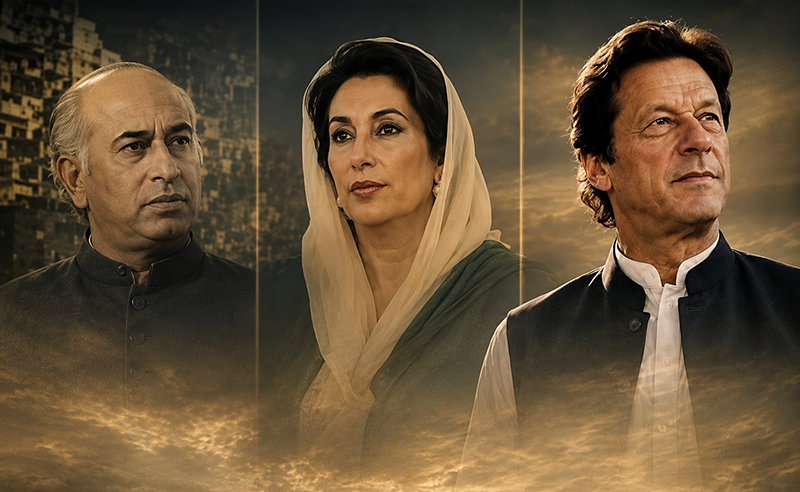
The treatment being meted out to former prime minister Imran Khan by the incumbent civil-military establishment fits into Pakistan’s long pattern of retribution against former rulers. Famous leaders, from Zulfikar Ali Bhutto and Benazir Bhutto to Nawaz Sharif and Pervez Musharraf, the political leaders, who fell out of favour faced persecution, exile, imprisonment, and even execution. So the very system they once controlled ended up targeting them.
The latest controversy surrounding the health of former prime minister Imran Khan is not just about health, but about how his political defeat has turned out to be a form of political punishment for him. His family and lawyers have repeatedly accused the government of harassment through fabricated cases against him, harsh detention conditions, restricted access to family members and inadequate medical treatment. Khan’s supporters fear that such extremely worrying prison conditions may lead to his death.
A UN Special Rapporteur expressed concerns over the 72-year-old Khan’s solitary confinement, inhuman conditions, and inadequate medical treatment, which he said amounted to “torture” and constituted a form of “psychological torture”. Many have blamed Pakistan’s Army Chief Asim Munir for Khan’s prolonged harassment, which arose from personal hostility as well as institutional rivalry. Khan’s decision to remove Munir as the chief of spy agency Inter Service Intelligence (ISI) created a lasting resentment.
One can debate if Khan is right or Munir. But the larger question is why such cases have occurred regularly in Pakistan’s political history when political rivalry easily turned into personal retribution? It began with the harassment of Pakistan’s fifth prime minister Huseyn Shaheed Suhrawardy by General Ayub Khan, who had seized power through a coup. After taking power, Ayub Khan harassed and politically suppressed Suhrawardy by banning him from contesting elections and later arresting him in 1962 on reportedly concocted charges of “anti-state activities”.
Pakistan continued to witness such cases where political disagreement could become a criminal offence. The case of prime minister Zulfikar Ali Bhutto is one such. He was removed from power by General Zia-ul-Haq in 1977, and later arrested on the charges of murdering a political opponent. Even after a court ordered Bhutto’s release, he was arrested again under martial-law regulations that could not be challenged in court. He was later executed by hanging.
Observers call the episode one of the darkest and most brutal episodes in Pakistan’s political history. Notably, Bhutto was the first prime minister elected by the people. His daughter, Benazir Bhutto, who also became prime minister of Pakistan, was another example of political persecution and vindictive use of the state. She was the first woman to head a government in a Muslim-majority country, and later was imprisoned and exiled.
Benazir was imprisoned over charges of corruption, which were overturned by the apex court later. Whether Benazir was corrupt or not remains a debatable issue, but it is reasonable to say that the official-legal process adopted to pursue the accountability was deeply politicised and was used against her.
Even a military ruler was not spared in the country, which was governed for most of the time since its formation, and its governance still remains under tremendous influence of the armed forces. General Pervez Musharraf, who seized power in 1999 and ruled the country for almost a decade was placed under house arrest in connection with the assassination of Benazir Bhutto and other charges.
Other prime ministers and presidents such as Nawaz Sharif, Yousuf Raza Gilani, Raja Pervaiz Ashraf, Shahid Khaqan Abbasi, and Iskander Mirza faced similar situations. Pakistan’s history shows that political power was hardly followed by political reconciliation. Those in power were either removed unceremoniously or through coup, and then faced retaliation, prosecution and humiliation. Imran Khan is just the latest episode of the old cycle of revenge that turned political rivalry into personal retribution and political defeat into punishment.
Views: 40