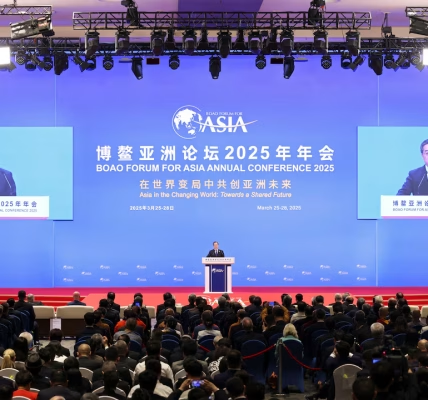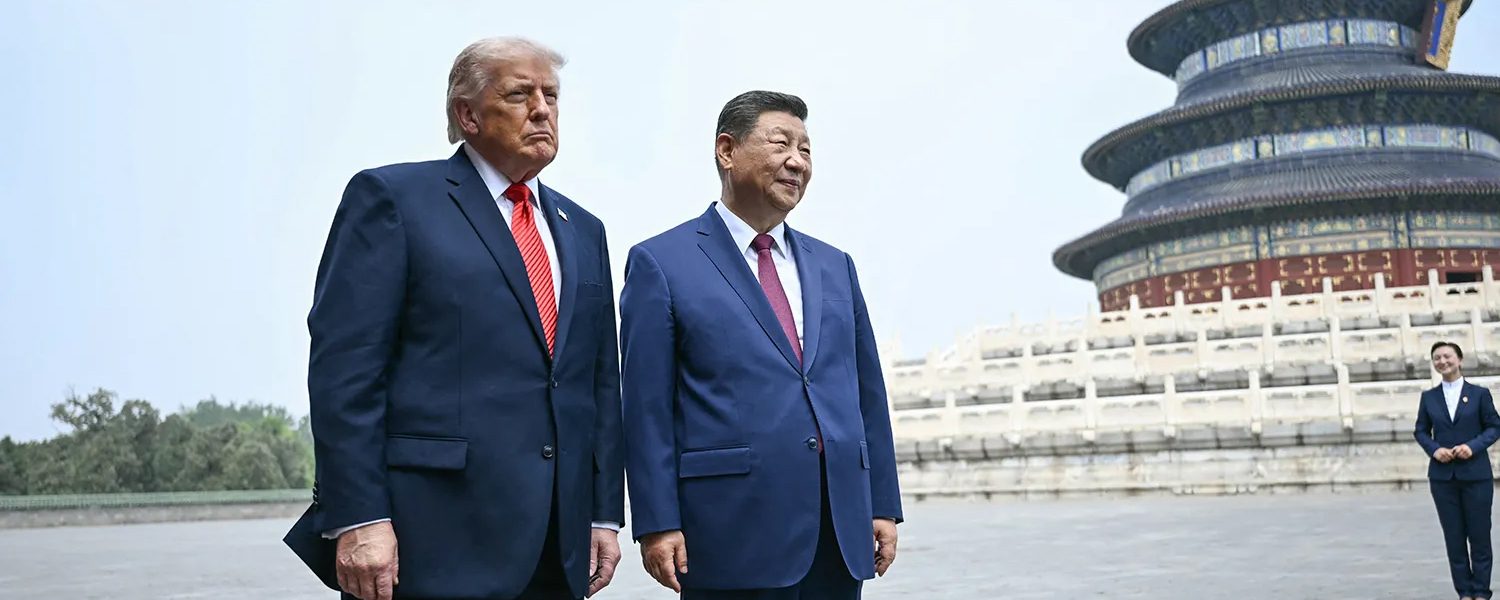







When President Donald Trump stepped onto the tarmac at Beijing Capital International Airport on 13 May 2026, the symbolism arrived carrying the weight of a decade of accumulated geopolitical turbulence. The reception, managed by China’s Vice President and junior protocol officials rather than by Xi Jinping himself, sent a carefully calibrated diplomatic signal that was read with equal precision from Beijing to New Delhi. It established the tone for everything that followed: a summit marked by extraordinary ceremonial grandeur yet deliberately restrained substantive depth. For two days, the world’s most consequential bilateral relationship unfolded through an elaborate political theatre at Zhongnanhai. The spectacle included a PLA honour guard review, state banquets in gilded halls, and a meticulously staged procession through the Temple of Heaven. Yet perhaps the most surreal moment, one that would almost certainly have amused Bismarck, was the sound of the PLA band performing “YMCA” as its echoes reverberated through the symbolic heart of Chinese Communist Party power.
The markets had hoped for transformation. The Indo Pacific had feared accommodation. India watched with what Chietigj Bajpaee perceptively characterised as “trepidation”, anxious above all that Washington might succumb to the chimera of a G2 condominium that would marginalise middle powers and restore Beijing to the centre of American foreign policy. These anxieties were understandable but, as this research demonstrates, ultimately misplaced, not because President Donald Trump proved a stalwart custodian of India’s interests, but because the deep rooted dynamics driving Sino-American rivalry proved entirely immune to presidential summitry.
The Council on Foreign Relations characterised the summit as a “decent peace”: expectations modest, broadly met. Center for Strategic and International Studies described it as “a relatively modest step toward greater stability and predictability.” The Atlantic Council asked the question lurking beneath official optimism: “Where’s the beef?”, concluding that Trump had sidestepped Beijing’s most dangerous trap on Taiwan while underperforming on almost everything else. Politico Europe offered perhaps the most surgical verdict of all: “Big promises, thin results.”
For India, these assessments represent far more than diplomatic understatement. They constitute the empirical foundation of a widening strategic horizon and signal the emergence of an expanding era of Indian influence, geopolitical leverage, and civilisational leadership.
Domestic Compulsion Dressed as Grand Strategy
Donald Trump arrived in Beijing carrying neither a coherent Indo-Pacific strategy nor a unified diplomatic brief. He carried instead a collection of commercially legible demands shaped by American industrial politics, the approaching 2026 midterm elections, market anxieties generated by nearly two years of escalating tariff warfare, and the conviction — characteristic of his negotiating style — that summitry with leaders he respects can substitute for policy coherence. The specific agenda was narrow and publicly legible: Chinese agricultural purchases to placate Midwestern farm constituencies, Boeing aircraft commitments (200 confirmed orders aspirationally toward 750, though neither timeline nor binding contractual detail emerged), and a managed relaxation of rare earth export controls which, when Beijing partially activated them in April 2025, brought American and European auto manufacturing to the edge of paralysis. One CFR analyst described China’s rare earth grip as “a complete chokehold” over critical components of US defence and industrial systems — a vulnerability that no single trade mission could structurally resolve.
| Strategic Signal The $870 Billion DelegationTrump’s entourage — Elon Musk of Tesla, Tim Cook of Apple, Jensen Huang of Nvidia, Larry Fink of BlackRock, Boeing’s leadership, and a Wall Street constellation with combined net worth approaching $870 billion — was a trade mission dressed in presidential livery. Each carried specific anxieties: Musk sought accommodation for his Shanghai operation; Cook sought supply chain continuity even as Foxconn and Tata scale Indian production; Huang sought clarity on Nvidia’s oscillating export-control fate; Fink sought stability for BlackRock’s Chinese capital market positions. Together, they illustrated “techno-geopolitics” — the entanglement of national security with commercial interdependency that makes clean decoupling impossible even when strategically imperative. For New Delhi, a Washington whose China posture is calibrated by electoral cycles and corporate balance sheets, rather than strategic coherence, is a Washington that will remain a fundamentally unreliable long-term architect of the Indo-Pacific order. |
Xi Jinping’s Strategic Calculus: Confidence Built On Enduring Leverage
If President Donald Trump entered Beijing with a narrow transactional agenda, Xi Jinping arrived with something considerably more sophisticated: a systemic confidence grounded in a clear eyed assessment of the balance of power in May 2026, combined with a strategic patience that stood in sharp contrast to American improvisation. The CSIS assessment by Elisabeth Kagan captured this asymmetry with remarkable precision. China appeared sufficiently confident to remain firm on sanctions, technology controls, critical minerals, and Iran, yet its evident eagerness to host the summit also revealed a level of insecurity far greater than many observers had assumed. Xi’s confidence did not arise from unqualified economic strength. GDP growth had slowed, fixed asset investment remained under pressure, and the property sector continued to weigh heavily on domestic demand. His assurance instead rested on embedded structural leverage: China’s commanding position in rare earth supply chains, the manufacturing dependency that American corporations had spent three decades constructing, and the political advantage enjoyed by a leader operating under virtually no electoral pressure.
Sinological depth demands engaging seriously with what Rush Doshi, in The Long Game, identifies as the CCP’s defining temporal horizon: a civilisational patience, rooted in the Zhongguo Meng and Xi Jinping Thought, which measures success in decades rather than election cycles. China approached the summit as David Shambaugh’s analysis of the Leninist party-state prescribes: with coherent institutional co-ordination across the Foreign Ministry, the PLA, the Ministry of Commerce, and the United Front Work Department, each operationalising a unified strategic brief. Crucially, Xi could not be moved on the essentials. No meaningful concession on Taiwan emerged. No permanent resolution of rare earth tensions was achieved. No deep strategic convergence signalling a US pivot toward G2 accommodation materialised. By contrast, Washington’s delegation was unified in its interest and fractured in its agenda. That asymmetry in strategic depth, which Chatham House identified as Beijing’s most enduring competitive advantage, constitutes the summit’s most consequential analytical takeaway.
Anatomy of Limited Outcomes: What Failed, and Why It Matters
The significance of the May 2026 summit lies less in what was achieved than in what remained unresolved. Against carefully managed expectations, the two governments agreed to establish bilateral Trade and Investment Councils, a dialogue mechanism of modest ambition. Beijing signalled preliminary commitments to resume rare earth shipments approaching pre-April 2025 volumes, explicitly described by Reuters as preliminary, a managed relaxation rather than any foundational resolution. Washington cleared Nvidia H200 chip sales to approximately ten major Chinese firms including Alibaba, Tencent, ByteDance, and JD.com, a reversal of uncertain durability given the ongoing strategic debate about selling advanced AI infrastructure to a systemic competitor.
Against these limited gains, the failures proved considerably more consequential. On Taiwan, Xi Jinping described the matter as “the most important issue,” while President Donald Trump declared that he had made “no commitment either way” regarding the pending fourteen billion dollar arms package. The outcome left Taipei suspended in precisely the strategic ambiguity that Beijing’s negotiating strategy has long sought to cultivate.
China offered only a vague commitment to pressure Iran over the Strait of Hormuz, without any credible mechanism, enforceable timeline, or clear framework for implementation. On fentanyl, Beijing announced arrests without convictions, echoing gestures made during the Biden years that were later reversed. The Heritage Foundation captured the fragility of the arrangement with striking directness: nearly every concession made by both sides remained reversible, given that the snap back provisions themselves expire in late 2026.
What emerged from the summit was therefore not a durable strategic architecture, but a temporary political arrangement shaped by tactical necessity rather than structural reconciliation. The rivalry has not been resolved. It has merely entered a period of managed suspension.
| Strategic Imperative: India’s Semiconductor Sovereignty India Semiconductor Mission 2.0, announced in the Union Budget 2026–27, moves decisively beyond assembly to target the full value chain — equipment manufacturing, advanced materials, full-stack indigenous intellectual property, and supply chain fortification. Financial outlay: ₹8,000 crore for 2026–27. The Design Linked Incentive Scheme supports 24 semiconductor design startups attracting ₹430 crore in venture capital. India’s semiconductor consumption is projected at USD 70 billion by 2026 — the world’s fastest-growing market outside China. Meanwhile, India’s defence exports crossed ₹21,083 crore in FY2024, a tenfold increase from FY2017, signalling simultaneous ascent across both technological and security domains. When Jensen Huang negotiated Nvidia chip access in Zhongnanhai, he was equally aware that India’s semiconductor market — governed by rule of law, open to foreign investment, incentivised by PLI support — offers an alternative AI infrastructure node entirely free of China’s political and security complications. |
Technology War: Semiconductor Rivalry and India’s Indispensability
Of all the dimensions of Sino American competition illuminated by the summit, none carries deeper implications for India’s long term strategic positioning than the contest over semiconductors, artificial intelligence infrastructure, and digital governance. These are not merely commercial rivalries. They encompass the foundational technologies that will shape twenty first century military power, economic productivity, technological sovereignty, and civilisational autonomy.
The reported clearance involving NVIDIA’s H200 chips was immediately contextualised by the Council on Foreign Relations as a “freeze” rather than a reversal, a temporary suspension of export control escalation that offers Beijing meaningful technological breathing space while simultaneously providing Washington commercial relief. Beneath the diplomatic surface, however, the deeper contest continues with undiminished intensity: the struggle between Nvidia’s artificial intelligence infrastructure dominance and China’s accelerating domestic ecosystem represented by Huawei, Cambricon, and Alibaba’s T Head initiative.
China’s near total dominance of global rare earth processing constitutes a coercive instrument of extraordinary potency. When Beijing activated export licensing restrictions in April 2025, the American defence industrial base confronted vulnerabilities in weapons system replenishment precisely when advanced munitions stockpiles had been heavily depleted by conflict in the Middle East. Chatham House described the summit’s rare earth commitment as “a managed pause, not a structural resolution,” leaving the underlying vulnerability fundamentally intact. For India, the strategic prescription advanced by Priyadarshi Tripathi of the Observer Research Foundation in ORF Occasional Paper No. 513 encapsulates the logic with elegant economy: leverage the geopolitical rift between Washington and Beijing while maintaining strategic autonomy, positioning India as the indispensable third node in a triangular architecture, too valuable to be excluded and too independent to be controlled. This is no longer aspiration; it is already, in significant measure, operational reality.
India’s manufacturing transformation provides empirical substance to this strategic shift. Approximately 99.2 per cent of smartphones sold in India are now domestically manufactured, while mobile phone imports have declined by nearly 77 per cent since FY2020 to 2021. More significantly, Indian facilities now export printed circuit board assemblies and specialised components back to China, a reversal of the traditional flow unimaginable when Apple first shifted iPhone production to India in 2021. Production Linked Incentive supported sectors have generated exports exceeding ₹8.3 lakh crore across fourteen strategic manufacturing domains. The China Plus One imperative is therefore not conjunctural but systemic, and the summit’s failure to achieve a foundational resolution of technological tensions accelerates rather than arrests that transformation.
India’s Strategic Opportunity: Beyond the China Plus One Reductionism
It has become fashionable to describe India’s geopolitical ascent through the reductive shorthand of “China Plus One”, as though India’s significance were merely derivative, contingent upon China’s complications, and reducible to the status of a convenient substitute. Such a framing is analytically misleading. India’s emergence as the preferred manufacturing, technological, and strategic partner of the democratic world rests upon structural advantages that command attention independently of Sino American rivalry. These advantages are demographic, institutional, civilisational, and increasingly technological in character.
India possesses the world’s largest young working age population, with a median age of twenty eight compared to China’s thirty nine, creating a labour dividend capable of sustaining productive capacity precisely as China confronts deepening demographic contraction. It also possesses democratic institutional foundations, including courts, contractual enforceability, and intellectual property protections, that provide technology companies with a far more predictable operating environment than an authoritarian system frequently marked by regulatory arbitrariness and political intervention. Equally significant is the scale of India’s domestic market. With 1.4 billion consumers, India offers a demand base that no conventional export platform can realistically replicate.
The national security dimension of this transformation is frequently underestimated, yet it remains central to India’s strategic calculus. Semiconductor chips are deeply embedded within India’s defence systems, communications networks, financial architecture, and critical national infrastructure. India’s semiconductor push therefore transcends the realm of industrial policy. It constitutes a geopolitical project designed to position India as a crucial alternative destination: a democratic and legally stable environment at a time when authoritarian governance models increasingly generate irreducible security risks for Western technology partners.
When Ronak Desai of the Hoover Institution at Stanford University warned that a Trump Xi grand bargain could encourage Washington to treat China as Asia’s principal negotiating partner rather than its central strategic challenge, he identified precisely the anxiety that India’s doctrine of strategic indispensability seeks to render permanently irrelevant.
| Theoretical Framework · India’s Four Doctrinal Pillars Strategic Amplification: India leverages great-power rivalry to expand its strategic space beyond what material capabilities alone justify — indispensable to Washington as democratic counterweight to Chinese dominance, to Beijing as the power whose neutrality prevents consolidation of a comprehensive anti-China coalition, and to the Global South as the voice articulating a path between subordination and conflict. Resilient Multi-Alignment: deep, substantive engagement across competing powers governed by consistent principles — strategic autonomy, non-alliance, civilisational sovereignty — but tactically flexible, resisting coercive pressure because no single power can credibly threaten India with strategic isolation. Civilisational Balancing: foreign policy rooted in the accumulated strategic wisdom of a culture that has processed millennia of geopolitical interaction, emerging with distinctive patience, synthesis, and contextual confidence. Strategic Equidistance with Tactical Convergence: India maintains overall independence while selectively converging with Washington on Indo-Pacific maritime security and democratic values, and with Beijing on selective developmental issues — extracting maximum value from each relationship without surrendering the independence that makes India strategically indispensable to both. |
Taiwan, the Quad, and Indo-Pacific Security Architecture
The most consequential dimension of the May 2026 summit, and the one most directly shaping India’s strategic environment, is the unresolved Taiwan question. Taiwan emerged from Zhongnanhai not as a settled matter but as the defining fault line of the entire relationship. As Center for Strategic and International Studies observed, Taipei’s deepest anxiety was that Beijing would persuade President Donald Trump to express support for peaceful unification, or that Trump’s confidence in his relationship with Xi Jinping would translate into diminished American support for Taiwan in both security and trade. These anxieties proved partially well founded. Trump’s ambiguous language regarding the pending fourteen billion dollar arms package, his comment that “the last thing we need right now is a war 9,500 miles away,” and his suggestion that Taiwan had “stolen” America’s semiconductor industry all reveal a restrainer instinct that leaves Taiwan’s defenders in precisely the uncertainty Beijing’s strategy seeks to cultivate.
For India, the Taiwan dynamic illuminates a crucial asymmetry in how Washington and New Delhi interpret Indo Pacific security architecture. The United States views Taiwan primarily through the lens of extended deterrence commitments. India views the Taiwan Strait as a barometer of Beijing’s revisionist ambitions, because the logic used to justify coercive unification with Taiwan is the same logic, expressed on a broader scale, which underlies China’s assertiveness along the Line of Actual Control, in the South China Sea, and across the wider Indo Pacific maritime domain. The Galwan Valley clash of June 2020, in which Indian and Chinese soldiers engaged in lethal hand to hand combat in Ladakh, remains a vivid reminder that Beijing’s assertiveness is not a distant abstraction but an immediate military reality.
India’s response has been the construction of an Indo Pacific deterrence architecture built upon three reinforcing pillars: the Quad partnership encompassing 24 per cent of the global population, 35 per cent of global GDP, and 18 per cent of world trade; deepening bilateral defence co-production with Washington covering GE 414 jet engines, MQ 9B drones, and the iCET technology partnership spanning quantum technologies, semiconductors, space, and artificial intelligence; and an indigenous naval expansion programme including aircraft carriers, nuclear powered submarines, and a maritime domain awareness satellite network that shares strategic data across Quad partners.
IMEC, BRI, and the Geopolitics of Resilient Multi-Alignment
The contest between China’s Belt and Road Initiative and the India-Middle East-Europe Economic Corridor represents the most vivid geopolitical expression of the deeper competition that the May 2026 summit failed to resolve. While Trump and Xi negotiated agricultural purchases in Zhongnanhai, the foundational rivalry over who will build the infrastructure governing Eurasian trade flows, set technical standards, shape digital ecosystems, and exercise long-cycle influence across the Global South continued undiminished. IMEC, announced at India’s G20 presidency in September 2023 and given institutional momentum by the India-EU Free Trade Agreement concluded at the 16th India-EU Summit in January 2026, envisions a ship-to-rail network connecting India to the Gulf and Europe. The EU-Africa-India Digital Corridor via the Blue Raman submarine cable system extends this strategic architecture into the digital domain. The Hormuz blockade, through which approximately 20 per cent of the world’s energy supply transits, simultaneously underscores the vulnerability of existing routes and accelerates the strategic logic for alternatives that India, through IMEC, is uniquely positioned to anchor.
India’s navigation of the Russia-Ukraine war and the Iran crisis provides the most sophisticated illustration of its strategic autonomy doctrine in practice. Washington has repeatedly pressed New Delhi to reduce dependence on Russian energy and defence systems. India has politely, firmly, and consistently declined, not from indifference to rules-based norms but from clear-eyed assessment of its strategic interests. Russia remains India’s single largest defence supplier, and discounted Russian energy imports have provided economic relief precisely when the Hormuz crisis created severe upward pressure on global energy costs. The irony noted with quiet satisfaction by Indian analysts, that Washington penalised India with 25 per cent tariffs for purchasing Russian oil while overlooking Chinese purchases of the same Russian energy, captures the transactional inconsistency of Trump’s foreign policy with surgical precision. This calibrated posture is Resilient Multi-Alignment not as abstraction but as lived strategic practice: deep relationships with multiple competing powers, maximum value extracted from each, independence preserved.
| India’s Historical Moment: The Convergence Of Strategic Advantage Never before in independent India’s history has the conjunction of advantage been more propitious. India stands simultaneously as the world’s fifth-largest economy on its trajectory to third place; the most populous nation with the world’s largest young working-age population; a nuclear-armed power with credible deterrence capabilities; a recognised leader of the Global South — convening 125 nations through the Voice of Global South Summits and chairing the most consequential G20 presidency in decades; and the preferred partner for the democratic alliance network in the twenty-first century’s defining strategic competition. Semiconductor consumption projected at USD 70 billion, defence exports tenfold higher than a decade ago, PLI-driven manufacturing exports crossing ₹8.3 lakh crore — this is not rhetoric. It is the measurable architecture of a civilisational ascent. The question is not whether India can navigate this moment, but whether it will do so with the strategic discipline, civilisational confidence, and long-horizon patience that a moment of this magnitude demands. |
The Enduring Rivalry and India’s Historical Moment
The May 2026 Beijing summit will be remembered, when the broader history of this epoch is written, neither as breakthrough nor rupture but as a managed interval, a carefully staged pause in the grinding competition between the world’s two greatest powers, during which both sides extracted tactical value, demonstrated diplomatic composure, and left every foundational dispute as unresolved as they had found it. The pageantry of Zhongnanhai, the state banquets, ceremonial gardens, handshakes, and toasts, belonged to the theatre of diplomacy rather than the substance of strategy. Chatham House captured the essential dynamic with notable precision: Washington and Beijing shared a preference for managing their rivalry rather than resolving it. Yet while Xi Jinping pursued this relationship management as a coherent long term strategy, President Donald Trump approached it through transactional improvisation, an asymmetry in strategic depth that favours China’s medium term positioning and sharpens the imperative for India’s strategic self reliance.
The enduring divisions that the summit failed to bridge, including Taiwan’s political status, the militarisation of the South China Sea, export control regimes governing semiconductors and artificial intelligence hardware, the governance of rare earth supply chains, the structure of energy trade, and the architecture of global connectivity, are systemic rather than conjunctural. They arise not from misunderstandings that patient diplomacy might eventually resolve, but from fundamentally incompatible visions of international order, its governing principles, and the values that should animate it. Graham Allison’s Thucydides Trap, John Mearsheimer’s offensive realism, Henry Kissinger’s analysis in World Order, and Yan Xuetong’s moral realism within Chinese strategic thought all converge upon the same conclusion: the contradictions driving Sino American competition are embedded within the structural logic of great power politics, and no summit, however grandly presented, can dissolve antagonisms rooted in incompatible civilisational visions of international order.
For India, this enduring rivalry represents not a geopolitical misfortune but a civilisational opportunity, perhaps the greatest that independent India has yet encountered. India’s Doctrine of Strategic Amplification prescribes neither triumphalism nor complacency. China remains a formidable rival: patient, systematic, and capable of strategic surprise. Its military presence along the Himalayan frontier, expanding naval ambitions in the Indian Ocean, and comprehensive competition across South Asia together constitute a direct and immediate challenge requiring sustained vigilance, military investment, and diplomatic discipline. Ashley Tellis of the Carnegie Endowment for International Peace and C. Raja Mohan, writing across multiple platforms, have both argued that India’s greatest strength within this competition derives precisely from its independence and from its refusal to subordinate national strategic judgment to the agenda of any great power.
What the May 2026 summit confirms, with the clarity of empirical demonstration, is that this strategic space will not be closed through Sino American accommodation. The rivalry is too deep, too multidimensional, and too profoundly rooted in incompatible civilisational visions to be dissolved by summit diplomacy alone. India’s strategic task is therefore not to prevent accommodation between Washington and Beijing, an objective beyond the capacity of any single power, but to ensure that India’s indispensability to both sides becomes so firmly established that neither can negotiate without keeping New Delhi’s interests clearly in view. Tanvi Madan of the Brookings Institution and Shivshankar Menon in his seminal work Choices have each articulated variations of this principle: India’s greatest strategic asset is the credibility of its independence.
The twenty first century will neither be the Chinese century envisioned by Beijing’s strategic planners nor the continued American century still imagined by Washington’s most optimistic observers. It will be, if India’s strategic leadership rises to its historical moment, the Indo Pacific century, an era in which the world’s largest democracy, positioned at the maritime and strategic crossroads of Asia, exercises the civilisational influence for which its scale, values, ambitions, and historical wisdom have long prepared it.
The echoes of Kautilya’s Arthashastra, with its sophisticated understanding of the mandala of states, the geometry of strategic interests, and the patient cultivation of indispensability, resonate across the millennia into a present whose fundamental dynamics Kautilya himself would have recognised with remarkable clarity. India has navigated periods of far greater strategic peril than a managed rivalry between Washington and Beijing. The question is whether it will seize this moment with the discipline, strategic patience, and civilisational confidence that the age demands. The trajectory of the past decade provides every reason to believe that the answer is emphatically affirmative and historically grounded.
Views: 1450

Dr. Maheep
Dr. Maheep is Director, Indian Perspective on Global Affairs (IPGA), and a leading analyst of India’s foreign policy and South Asian geopolitics. He earned his PhD in Arab and Islamic Studies. With more than a decade of teaching and research experience in International Relations and Global Politics, he contributes regularly on issues shaping national and global affairs.