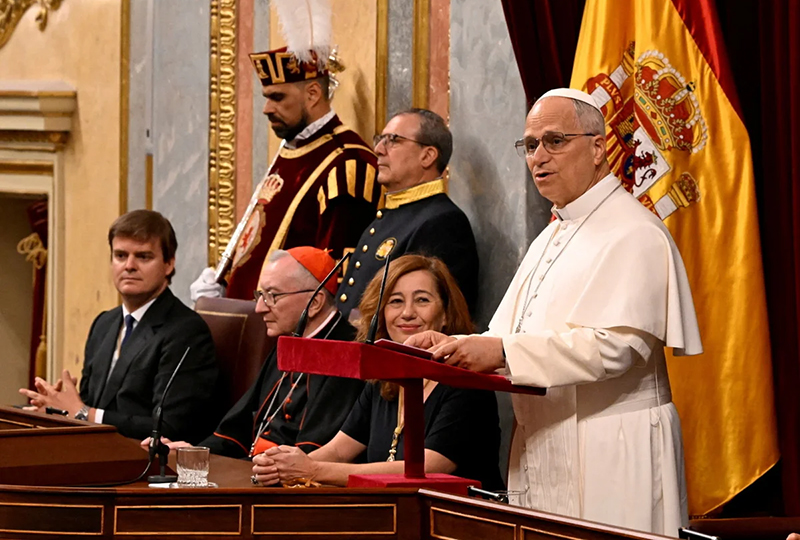







Pope Leo XIV delivered a historic address before Spain’s Parliament this week, warning that the world is experiencing a profound spiritual and cultural crisis driven by war, political polarization, forced migration and the unchecked advance of technology.
Speaking before a joint session of the Cortes Generales in Madrid, Leo became the first Pope in history to address Spain’s legislature, receiving a prolonged standing ovation from lawmakers. The address offered one of the clearest outlines yet of the priorities that are emerging under his pontificate: peace, human dignity, ethical governance and the responsible use of technology.
“The world is living through a deep spiritual and cultural crisis,” the Pope declared, pointing to growing mistrust between nations, social fragmentation and the normalization of violence in international affairs.
At a time when conflicts in Ukraine, the Middle East and other regions continue to destabilize global politics, Leo urged governments to reject the illusion that military power alone can guarantee security. He called for what he described as “diplomatic courage,” warning leaders not to place their faith in the temporary calm produced by weapons and rearmament.
Peace, he argued, must be understood not merely as a political objective but as a moral imperative. Without justice, dialogue and mutual trust, lasting stability would remain unattainable.
Migration occupied a central place in the Pope’s speech. Describing the plight of refugees and migrants as one of the defining tragedies of the modern era, Leo argued that the issue represents a test of the international community’s commitment to human dignity.
While praising Spain’s efforts to provide legal pathways and social integration for migrants, he insisted that governments must move beyond simply managing migration flows. The international community, he said, has a responsibility to address the underlying causes that force millions to leave their homes, including poverty, conflict and environmental degradation.
The Pope outlined what he called a “twofold demand of justice”: welcoming those who are forced to migrate while simultaneously creating conditions that allow people to remain and prosper in their countries of origin.
Turning to domestic politics, Leo warned lawmakers against allowing fundamental rights to become hostage to shifting political majorities or temporary social trends. He called for a moral renewal of public life and reaffirmed the Catholic Church’s long-standing position on the protection of life from conception to natural death, referencing debates surrounding abortion and euthanasia.
The address also highlighted one of the newest concerns of the Vatican: artificial intelligence.
Echoing warnings issued earlier this year, the Pope called for rigorous ethical oversight of emerging technologies, particularly in military applications. He expressed concern over the prospect of autonomous weapons systems and urged governments to ensure that decisions involving human life and death remain under meaningful human control.
As governments around the world race to develop increasingly sophisticated AI systems, Leo warned that technological progress without moral responsibility risks creating new threats to human dignity and global security.
The speech reflected the broader direction of a pontificate that has consistently emphasized the need to reconnect politics with ethics. Rather than focusing solely on policy prescriptions, Leo’s message sought to address what he views as the deeper causes of contemporary instability: the erosion of trust, the weakening of social solidarity and the growing tendency to reduce human beings to economic, political or technological variables.
In Madrid, the Pope’s message was ultimately a call for moral leadership. At a moment when the international system faces mounting pressures from war, migration, demographic change and technological disruption, Leo argued that political solutions alone will not be enough.
Without a renewed commitment to human dignity, solidarity and ethical responsibility, he warned, the world risks deepening a crisis that is as spiritual as it is political.
Views: 17