






The security history of Europe is now at a critical juncture. The gradual withdrawal of the United States from the role of security guarantor for Europe is increasingly revealing the weaknesses of NATO. In fact, the members of the Alliance can no longer ignore the reality that the power of the United States can no longer be automatically relied upon for the defence of Europe. It is up to Europe either to build up its own defence autonomy or to expose itself to vulnerability.
For decades, NATO served as the security guarantor for Europe. For decades, the model of a core of U.S. military forces within NATO served as a means for European countries to maintain low defence spending in the face of an external threat, while at the same time benefiting from the superior intelligence gathering capabilities of the U.S. and long-range strike capabilities. The model is increasingly becoming unsustainable. The focus of the U.S. is shifting to the Indo-Pacific region. In addition, there is growing pressure on the U.S. to reduce its military involvement worldwide. As a result, Europe is increasingly forced to realise the limits of its dependence on the U.S. The result for NATO is a weakening of its deterrence and a growing gap between the ambitions of Europe and its current capabilities.
Several political and operational challenges need to be addressed by European defence. A key challenge lies in the different threat perceptions held by individual NATO members. While the Eastern European member states consider Russia to be an existential threat and demand corresponding deterrence, Western and Southern European countries are focused on other challenges. The issues of migration, terrorism, and instability in the Mediterranean and Sahel region pose a great deal of attention. Without a strong leader such as the US, it is increasingly difficult for the members of the Alliance to find common ground. The resultant tensions within the Alliance are weakening the deterrent capacity of NATO and creating an ever-widening gulf between the defence capabilities that Europe is able to implement and the ambitions that are entertained by its leaders.
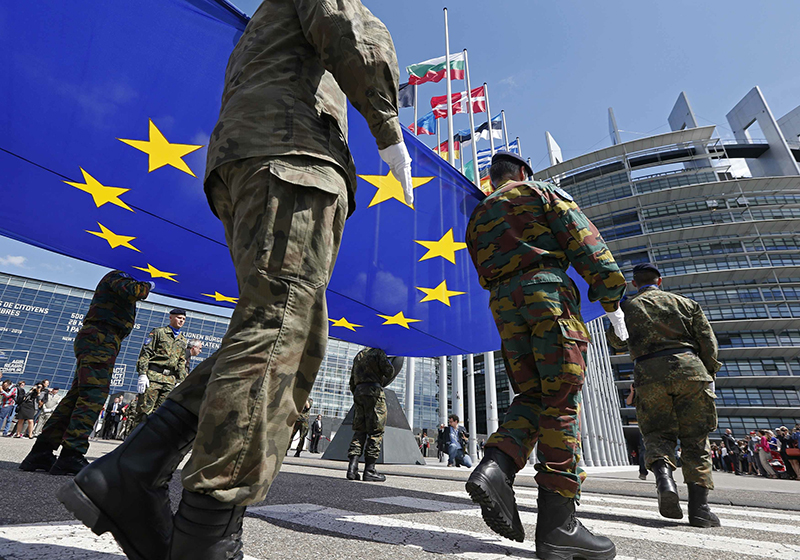
While efforts to enhance European strategic autonomy are continuing to be discussed, several differences of opinion continue to prevail. The French are continuing to call for greater defence integration on the part of Europe. Meanwhile, the Germans are proceeding with caution, at times fearing that a greater degree of strategic autonomy on the part of Europe could undermine rather than strengthen NATO. And the many smaller member states of the alliance are concerned that an attempt to develop a greater degree of strategic autonomy on the part of Europe could result in them being left in the lurch by the U.S. and at the same time having to rely on an untested European security structure. These concerns have to date slowed down efforts to develop a European defence posture.
The operational deficit on defence is very significant. For example, Europe does not have sufficient long-range-strike capabilities in order to be able to deter attacks. The intelligence-sharing architecture remains heavily dependent on the US. This is also true for cybersecurity, where NATO’s member states are only at the beginning of learning how to coordinate their respective activities in order to be able to better protect their critical infrastructure against threats. The state of defence procurement in Europe is also characterised by a multitude of serious problems, such as, for example, duplication, fragmentation and lack of coordination between individual member states. These deficits prevent Europe from acting independently.
There is more at stake than filling gaps in capabilities. A fundamental change in the way defence equipment is procured is required. This can be achieved by moving towards joint procurement of capabilities such as UAVs, missile defence systems, cyber tools, and air-defence systems. Franco-German cooperation is a good starting point as both countries possess the necessary industrial base and the institutional weight to set standards. A more integrated defence industrial base would reduce unnecessary duplication, increase interoperability to respond to new threats, and lead to faster acquisition of defence systems.
Intelligence-sharing independent from the US systems must be stepped up to enhance awareness of the current situation and strengthen resilience against hybrid threats. Cybersecurity and the protection of critical infrastructure have to become top security priorities for Europe.
However, in order to guarantee its security interests beyond its own territory, a country needs to possess strategic lift and long-range-strike capabilities. While cooperation with countries outside of the European area, such as the United Kingdom, and even with countries from other regions, for example from the Western Hemisphere, like Canada, can help fill existing capability gaps of individual European countries as well as the collective defense community as a whole, it in no way whatsoever implies the replacement of a transatlantic relationship by a relationship between Europe and third regions of the world. Instead, it merely rebalances it.
The new tensions in transatlantic relations are a warning to the NATO countries and, at the same time, an opportunity for them. The weakening of NATO’s deterrent capabilities and the liability of the European countries’ dependence on the United States are the challenges that Europe must face. On the other hand, the new challenges are also an opportunity for Europe to build up a more solid, more capable and autonomous security architecture. This architecture cannot wait for the complete clarification of the new American guarantees’ policy. It must be prepared for a future with less certain American guarantees. This is a new strategic necessity for Europe.
Views: 48

Simon Hutagalung
Simon Hutagalung is a retired Indonesian Foreign Ministry diplomat and received his Master’s degree in Political Science and Comparative Politics from the City University of New York. He writes opinion pieces for Europeantimes and all opinions expressed in his article are his own.