


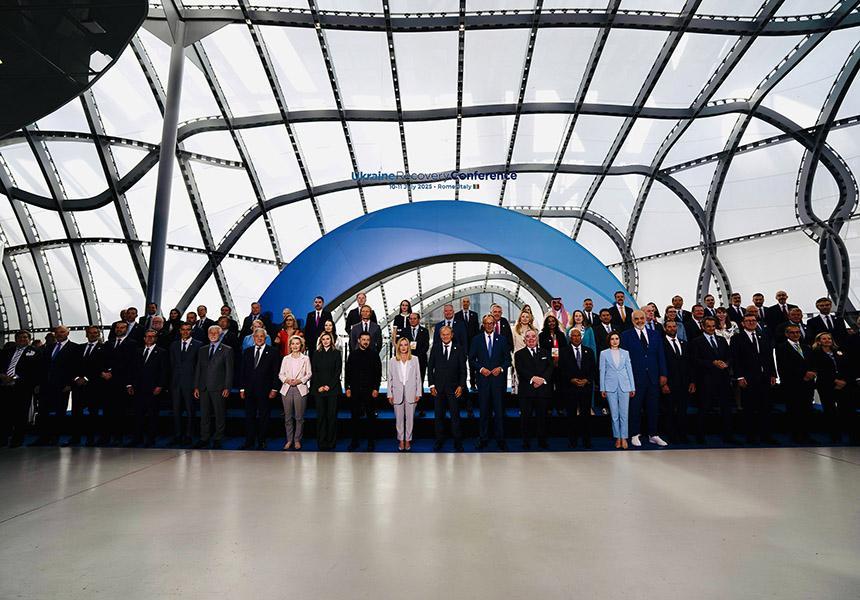







ROME: Amid the continuing war in Ukraine, world leaders gathered in Rome today for a landmark conference focused on the reconstruction of the war-torn country. Hosted at the La Nuvola convention center, the Ukraine Recovery Conference (URC2025) brought together representatives from over 60 countries, the European Union, financial institutions, and private sector investors.
The centerpiece of the summit was the unveiling of the European Flagship Fund for the Reconstruction of Ukraine—a public-private equity fund spearheaded by the European Commission. Commission President Ursula von der Leyen described the initiative as “the most ambitious reconstruction plan in modern European history,” highlighting its strategic importance not only for Ukraine’s recovery but for European security and industrial resilience.
“This is not charity—it is a strategic investment in a democratic, secure, and modern Ukraine,” von der Leyen said in her keynote speech. “It is also an investment in our own future, in a Europe that is stronger and more united.”
The fund aims to channel investments into key sectors such as energy, transport, critical raw materials, defense technology, and dual-use infrastructure. Backed by €2.3 billion in EU funds, the initiative is designed to “de-risk” private investment and catalyze further capital commitments, with the total pledges announced at the summit surpassing €10 billion.
Italian Prime Minister Giorgia Meloni, who co-hosted the summit, announced a national plan to support Italian companies in Ukraine’s reconstruction, with €300 million earmarked for financing and technical support. Meloni struck a firm tone regarding the geopolitical stakes of the recovery process.
“Rebuilding Ukraine must not become a gold rush for those who profited from the war,” Meloni said. “We must ensure that companies directly or indirectly tied to Russian aggression are excluded from this process.”
She emphasized that Italy’s role would not be limited to financial aid, but would extend to logistical, engineering, and civil society support, showcasing Rome’s intention to be a key player in Ukraine’s post-war future.
Ukrainian President Volodymyr Zelenskyy, speaking with characteristic urgency, called on Western partners to move from promises to action, especially in bolstering Ukraine’s defense industry and economic foundations.
“If Ukraine stands, Europe stands. If Ukraine falters, the threat spreads,” Zelenskyy said, urging attendees to see Ukraine’s resilience as integral to European security.
Behind the optimism, however, loomed difficult questions about the realities of rebuilding a country still under fire. Russian missile strikes continued in Ukrainian cities even as the conference was underway, underscoring the fragility of the current situation. Zelenskyy labeled the attacks “pure terrorism,” and reiterated the need for continued military support, including air defense systems.
Zelenskyy held private meetings with U.S. and NATO representatives, including retired General Keith Kellogg, to discuss future aid. He reported receiving “positive signals” from Washington regarding the resumption of U.S. assistance and potential delivery of Patriot missile systems by Germany and Norway.
Also under discussion was the formation of a so-called “Coalition of the Willing”—a multinational force to oversee any future ceasefire. Though plans remain preliminary, European leaders indicated a willingness to proceed, even if U.S. participation is not guaranteed.
Critics have raised concerns that reconstruction plans could inadvertently formalize a divided Ukraine if Russia retains control over eastern regions such as Donetsk, Luhansk, Zaporizhzhia, and Kherson. Human rights organizations and Ukrainian officials cautioned against excluding these territories from aid frameworks, warning that it could undermine Ukraine’s territorial integrity.
Nevertheless, the Rome summit marked a concrete step forward in turning the rhetoric of support into action. Workshops throughout the day focused on practical mechanisms for channeling investment, including fast-tracked permitting, insurance guarantees, and legal protections for foreign businesses operating in Ukraine.
Von der Leyen, closing the conference, called the day “a turning point.”
“The courage of the Ukrainian people is inspiring. Now it is up to us—Europe, our allies, our investors—to match that courage with leadership, investment, and unwavering support.”
Whether the momentum from Rome can translate into durable progress on the ground remains to be seen. But for now, the Ukraine Recovery Conference has set a new standard for international post-war reconstruction—one with stakes that reach far beyond Kyiv.
Views: 39


