


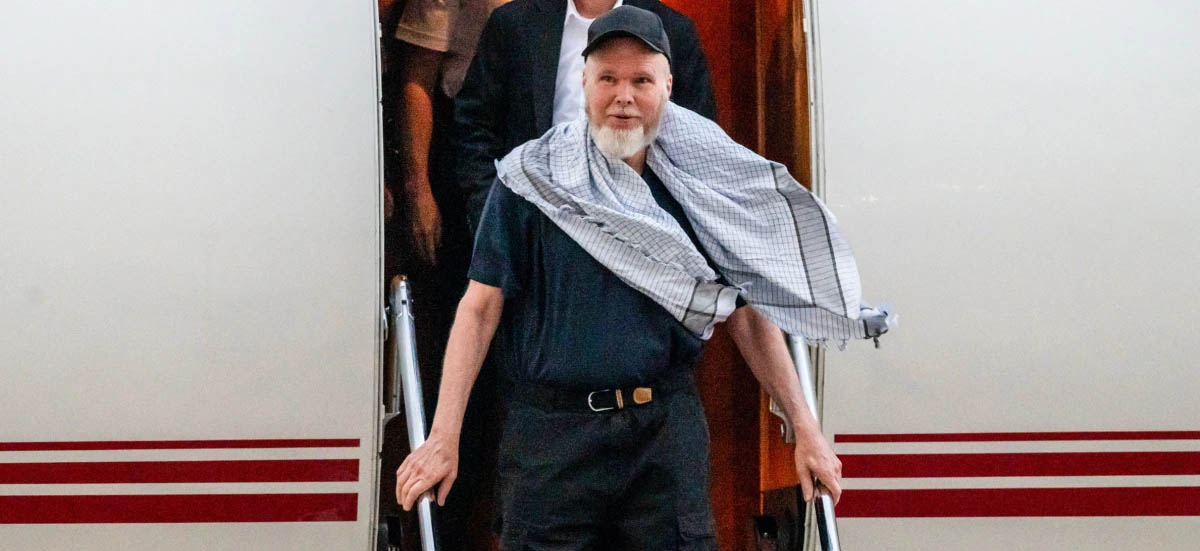







The safe return of Dennis Coyle to the United States this week is something worth pausing for, even in a political climate that rarely agrees on anything for more than five minutes. An American held for over a year without formal charges, largely cut off from the world, is finally back home. That outcome matters. It matters to his family, obviously, but it also matters to the broader idea that the United States will go to significant lengths to bring its people back.
And credit, where it is due, starts at the top. President Donald Trump set the tone for an administration that has made hostage recovery a visible priority, and the Secretary of State, Marco Rubio played a key role in applying diplomatic pressure and keeping attention on wrongful detentions abroad. Their involvement helped create the conditions that made Coyle’s release possible, and it is fair to recognize that leadership matters in moments like this.
But stopping the story there would be a convenient simplification, the kind that fits neatly into headlines but leaves out most of the actual work. Because hostage recovery is not a single decision or a single negotiation but rather it is a long, complicated process that unfolds across months, sometimes years, involving layers of diplomacy that rarely make it into public view. Governments like Qatar and the United Arab Emirates quietly act as intermediaries, but it is the hostage negotiators who engage in conversations that are deliberately kept out of sight, all while intelligence teams track shifting conditions on the ground. None of it is particularly glamorous, and almost none of it is designed for public consumption, but that’s why I’m choosing to highlight it here.
This is the unsung infrastructure of American diplomacy. The people who do this work are not giving speeches or holding press briefings. They are building relationships with actors the United States does not trust, navigating legal and political constraints, and trying to create leverage in situations where leverage is often in short supply. Success depends on patience, persistence, and a willingness to operate in uncomfortable gray areas. Failure, on the other hand, is immediate and devastating.
And within that quieter world, Adam Boehler, Special Envoy for Hostage Affairs, has emerged as a central figure. Not widely known outside policy circles, which is almost the point, he has been deeply involved in shaping a more assertive approach to bringing Americans home. Since stepping into his role, Boehler has leaned into direct engagement and unconventional channels, favoring speed and flexibility over the slower, more procedural methods that have defined past efforts.
That shift has produced tangible results. Multiple Americans detained in countries ranging from Russia to Venezuela to Afghanistan have been returned through negotiations in which Boehler played a significant role. These are not simple exchanges or one-track diplomatic wins. They are complex, multi-layered arrangements that often involve third-party governments, indirect communication, and trade-offs that never look entirely clean from the outside.
It is precisely this lack of neatness that tends to draw criticism. Direct talks with adversarial actors can appear risky or politically uncomfortable. Working through informal channels can raise questions about precedent and transparency. But hostage diplomacy has never been a space where perfect options exist. The reality is far less cinematic and far more constrained. The choice is often between engaging in difficult, imperfect negotiations or leaving Americans in situations that only worsen over time.
Compared to previous administrations, the difference is not necessarily a wholesale reinvention of the system but an evolution in how aggressively it is used. The Office of the Special Envoy for Hostage Affairs has, over the years, built a foundation that has brought dozens of Americans home through steady, institutional effort. What has changed more recently is the tempo. There is a greater willingness to move quickly, to explore unconventional avenues, and to accept the inherent risks that come with that approach.
For families waiting on news, that distinction is not abstract. It is everything. Process matters in Washington. Results matter everywhere else.
Dennis Coyle is back in the United States because a wide network of people, from senior officials to behind-the-scenes negotiators, aligned their efforts toward a single outcome. Leadership at the top helped set that process in motion. But it was sustained, often invisible work that carried it through to completion.
That is the part that rarely gets acknowledged, mostly because it does not translate well into political messaging. It lacks a single face, a single moment, a single line that can be repeated on television. It is slow, technical, and, frankly, a little messy.
But it gets results, and at the end of the day, that’s all that really matters.
Views: 16323


