






Abduction, conversion, forced marriage: Pakistan’s minority girls trapped in a cycle of impunity
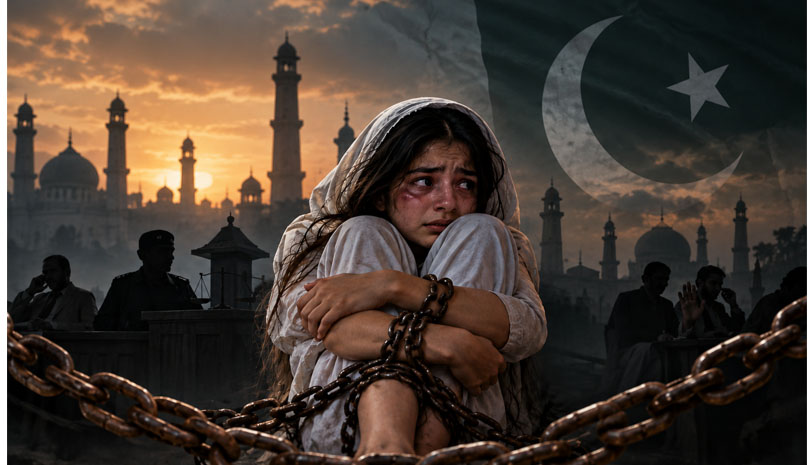
For Pakistan’s Maria Shahbaz and Aneeqa Ishaq, childhood and adolescence were violently interrupted by the same disturbing combination of abduction, alleged forced conversion and marriage.
Maria, a 13-year-old Christian girl, was abducted from her family, converted to Islam and married to a 30-year-old man.
Aneeqa, a 16-year-old Christian from Lahore, says she was abducted on her way to church, taken hundreds of kilometres from home, forced to convert and compelled to sign documents stating that she had married voluntarily.
Their cases have become emblematic of a much wider problem involving minority girls in Pakistan.
On July 9, 2026, the European Parliament adopted a resolution specifically addressing the abduction, forced conversion and child marriage of Maria Shahbaz and the protection of girls in Pakistan.
MEPs called for an end to child marriage, stronger protection for religious minorities, transparent investigations into cases involving minors and allegations of coercion, and safe return for abducted girls.
The resolution has placed a renewed international spotlight on a problem that Pakistani rights groups and UN experts have documented for years: when a minority girl disappears, the subsequent claim that she converted and married voluntarily can become a legal shield around the alleged perpetrators.
Maria Shahbaz and the battle over consent
Maria Shahbaz’s case illustrates the difficulties that can arise when the age and consent of a minor become contested in court.
According to Alliance Defending Freedom International, Maria was 13 when she was abducted and allegedly forced to convert to Islam and marry Shehryar Ahmad, a 30-year-old man.
A previous court ruling placed her in Ahmad’s custody after accepting his claim concerning the marriage. A review petition was subsequently taken before Pakistan’s Federal Constitutional Court, with a hearing scheduled for July 24, 2026.
The case attracted international attention because it raised questions about how Pakistani courts assess the age and consent of minority girls in alleged abduction and conversion cases.
The European Parliament’s July resolution described Maria as a 13-year-old Pakistani Christian girl who was abducted, converted and forcibly married in March 2026.
It called for her access to legal representation, her family and psychological support, while describing her case as emblematic of broader violations faced by religious-minority girls.
The significance of the case extends beyond one family. When a child is presented before a court after an alleged abduction and says she has converted and married, the question of whether that decision was genuinely voluntary becomes inseparable from her age, circumstances and access to independent protection.
Aneeqa Ishaq’s six months in captivity
Aneeqa Ishaq’s case presents another stark account of how coercion can operate.
The 16-year-old Christian from Lahore told Christian Daily International-Morning Star News that a male co-worker repeatedly pressured her to marry him. After she left the job, she said he and two accomplices abducted her on January 4, 2026, while she was walking to church with relatives.
According to her account, she was taken to Bahawalnagar, around 420 kilometres from Lahore.
She said her captors forced her to recite the Islamic declaration of faith and sign documents she was not allowed to read, including an affidavit stating that she had converted and married voluntarily.
She also alleged that she was moved between locations and assaulted during approximately six months in captivity.
Aneeqa eventually obtained access to a mobile phone and contacted her sister in July. Her family then sought legal assistance, and she was able to return home. She is now challenging the validity of the marriage through the courts.
The case demonstrates the gulf between a document describing a marriage as voluntary and the circumstances in which that document may have been obtained.
The numbers point to a wider pattern
Maria and Aneeqa are not isolated cases.
UN experts reported in April 2026 that women and girls from Pakistan’s religious minorities continued to face widespread abduction and forced religious conversion through marriage.
Their assessment found that, in 2025, around 75 percent of women and girls affected by forced conversion through marriage were Hindu and 25 percent were Christian. Nearly 80 percent of reported incidents occurred in Sindh.
Adolescent girls between 14 and 18 were particularly vulnerable, although younger girls were also affected.
The European Parliament cited the same UN figures in its July resolution, underlining the disproportionate impact on Hindu and Christian communities.
Data compiled by the Centre for Social Justice and cited by the UK government in its July 2026 country policy report recorded at least 421 cases involving the abduction and forced conversion of minority girls and women between January 2021 and December 2024.
Of those victims, 282 were Hindu, 137 Christian and two Sikh. In 2024 alone, 83 cases were reported, including 52 involving Hindus and 31 involving Christians.
The same British government assessment said Christian Solidarity Worldwide documented 94 cases involving abduction, forced conversion and forced marriage in 2025, compared with 83 in 2024.
Of the 2025 cases, 76 percent involved Hindu victims and 24 percent Christian victims, while 79 percent were reported in Sindh and 20 percent in Punjab. The organisation also warned that the actual figures were likely higher because many cases go unreported.
Legal age gap remains a critical vulnerability
Child marriage laws vary across Pakistan, creating another layer of complexity.
Sindh has set 18 as the minimum marriage age for both males and females. Punjab’s existing framework has historically set the minimum age at 16 for girls and 18 for boys, although legislation and judicial debates have increasingly focused on raising protections for girls.
That variation becomes particularly significant in cases involving minority girls whose age is disputed.
UN experts have previously warned that forced marriages and conversions involving minority girls can be validated by courts, sometimes with religious-law arguments used to justify keeping girls with alleged abductors. In 2024,
UN experts cited a case involving a 13-year-old Christian girl whose age was recorded as 18 on a marriage certificate after she was allegedly abducted, converted and married.
The issue therefore goes beyond whether a marriage document exists. It concerns whether a child had the legal capacity and genuine freedom to consent in the first place.
A problem concentrated among vulnerable communities
The geography of reported cases also matters.
Sindh and Punjab have large Hindu and Christian populations and account for the overwhelming majority of documented cases. The concentration reflects both the size and socioeconomic vulnerability of minority communities in these provinces.
Pakistan’s Human Rights Commission has repeatedly highlighted forced conversions and underage marriages involving Hindu and Christian girls in Punjab and Sindh.
Its 2025 assessment described the persistence of such cases as evidence of serious weaknesses in enforcing child-marriage laws.
HRCP’s reporting has also situated forced conversion within a wider environment of discrimination, violence and insecurity affecting religious minorities.
Its 2025 report documented attacks on minority communities, targeted killings and continuing concerns over forced conversions and underage marriages.
For families, the alleged abduction of a daughter can therefore become a struggle involving police, courts, religious pressure and social intimidation simultaneously.
The July 9 resolution represents one of the clearest recent international statements on the issue.
The European Parliament urged Pakistan to implement its national framework against child marriage, establish a national mechanism for complaints from families of abducted or forcibly converted minority girls, and ensure independent and transparent investigations wherever minors or coercion are involved.
It also called for perpetrators to be prosecuted and abducted girls to be allowed to return safely.
The resolution was adopted by show of hands and formed part of a wider European Parliament debate on human rights violations. Its wording placed the cases of minority girls within the broader question of religious freedom, child protection and accountability in Pakistan.
It also came amid fresh international scrutiny of Pakistan’s treatment of religious minorities. In April, UN experts said impunity was helping sustain patterns of abduction and forced conversion through marriage.
They stressed that a change of religion must be free from coercion and that marriage cannot be based on full and free consent when the victim is a child.
When conversion becomes a defence
The central difficulty in these cases lies in what happens after an alleged abduction.
A girl may appear before a court and state that she has converted and married. But where the girl is a minor, where the family alleges abduction, where the marriage follows immediately after the alleged conversion and where there are disputes over age, the circumstances surrounding her statement become crucial.
The UN has repeatedly stressed that children have rights to freedom of thought, conscience and religion and that any change of religion must be free from coercion.
Yet rights organisations continue to report cases in which minority families struggle to have allegations of abduction, forced conversion and child marriage investigated effectively.
The result is a legal and social vulnerability in which the alleged conversion can obscure the original allegation of abduction, while the marriage can complicate efforts to return the girl to her family.
A recurring test of minority protection
The cases of Maria Shahbaz and Aneeqa Ishaq have arrived at a moment when Pakistan is facing renewed scrutiny over the treatment of its religious minorities.
Maria’s case has reached the highest levels of the judicial system. Aneeqa is pursuing legal action after allegedly spending months in captivity.
Their experiences differ in detail, but both centre on the same question: whether a minority girl can exercise genuine freedom of religion and marriage when she is young, allegedly abducted and separated from her family.
The available data indicate that the problem is broader than either case. Hindu girls form the largest share of reported victims, while Christian girls remain disproportionately represented given the size of their community. Most documented incidents occur in Sindh and Punjab, and many involve minors.
For Pakistan, the issue has consequently moved beyond individual criminal cases. It has become a test of whether constitutional guarantees, child-protection laws and judicial procedures can protect minority girls when religious identity, age, marriage and allegations of coercion collide.
The European Parliament’s July resolution has now added another layer of international scrutiny.
Views: 52