


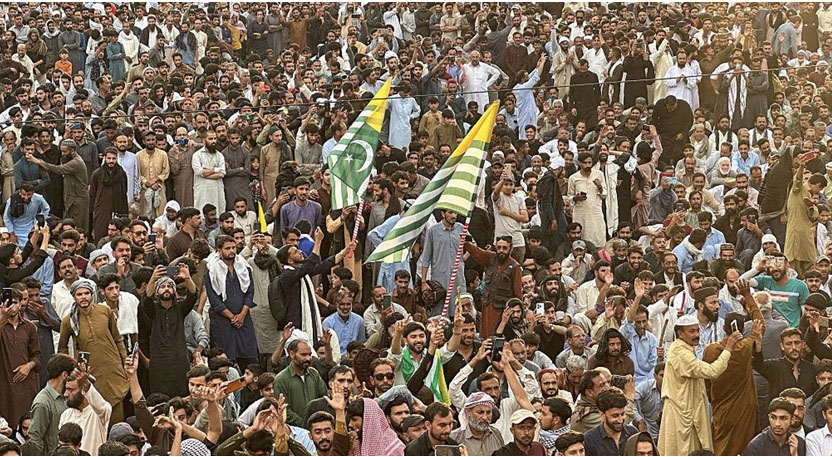







On September 22, two police officers guarding a polio vaccination team were shot dead by gunmen in Nushki, Balochistan. On the same day, the Pakistani military announced the killing of six militants in another operation in the province, while hundreds of kilometres to the north, Field Marshal AsimMunir, now simultaneously Chief of Army Staff and Chief of Defence Forces, declared the armed forces’ determination to ensure peace and stability across the country. Yet only a day earlier, those taking to the streets of Turbat were not insurgents but politicians, traders, workers and students.
They were protesting against disappearances, restrictions on economic activity, and the closure of roads, markets, courts and hospitals in the name of security. In Prisoners of Geography, Tim Marshall wrote of a world in which people can change governments and ideologies, but not the mountains, borders and neighbours that surround them. In Pakistan in 2026, that idea has acquired a different, political dimension. From restive Balochistan to Pakistan-administered Kashmir, geography determines not only where people live; it also shapes the security lens through which the state often views them. And while these peripheral regions demand greater political space, the centre has moved towards an increasingly concentrated system of military command. Their inhabitants therefore risk becoming “prisoners of geography” in a way Marshall did not mean literally: not because they cannot change the map around them, but because they struggle to change the political power that has emerged from the geography of that map.
The crisis in Balochistan was not born out of the current surge in violence. Its roots stretch back to the early years of Pakistan and the incorporation of Kalat in 1948, followed by successive cycles of insurgency, the bloodiest of which took place between 1973 and 1977. The current phase re-emerged at the beginning of the 21st century, building on longstanding disputes over political autonomy, representation and control of the natural resources of a province rich in natural gas and minerals, which also hosts the strategically important port of Gwadar and forms a crucial hub of the China–Pakistan Economic Corridor.
The armed threat is real. On March 11, 2025, militants from the Balochistan Liberation Army (BLA) hijacked the Jaffar Express passenger train and held hundreds of passengers hostage; according to Pakistani authorities, 21 hostages and four soldiers were killed. On January 31, 2026, new coordinated BLA attacks across several parts of the province triggered widespread clashes and left dozens dead. Faced with this genuine threat, the state has responded with extensive security operations. Yet the conduct of state agencies has for years been accompanied by serious allegations of arbitrary detention, repression and, above all, enforced disappearances. There is no single undisputed figure for the number of missing people — official records and figures compiled by civil society organisations differ considerably — but the phenomenon has repeatedly been documented by Human Rights Watch, Amnesty International and United Nations experts.
Behind those numbers are families that have been waiting for years. SammiDeen Baloch was only ten years old when her father, DrDeen Mohammed Baloch, disappeared in 2009; the search for him transformed his daughter into one of the most recognisable voices of the families of the disappeared. But this is not a story confined to the past. In April 2026, Dad Shah, the brother of activist Fozia Baloch, disappeared from his home in Karachi. According to Amnesty International, eyewitnesses reported that he was taken by state officials alleged to belong to the Counter Terrorism Department, while his sister and mother were themselves arrested after attempting to speak publicly about his case; the case against them was later dismissed by a court. Three months later, on July 24, student and activist Jiand Baloch disappeared. He returned home eleven days later — but it was already the third time he had disappeared, following nine months in 2018 and one month in 2024. Amnesty International believes he was targeted because of his peaceful activism. These cases give a human face to a problem that continues to concern the United Nations: UN experts have raised concerns over arbitrary arrests, disappearances and the treatment of Baloch activists in the context of counterterrorism operations. Pakistan faces a real and deadly armed insurgency and has an obligation to protect its citizens. But when one family has been searching for a man for seventeen years and a student disappears for the third time in eight years, the issue can no longer be described solely through the language of counterterrorism. In Balochistan, the geography of security has become, for some families, a geography of fear and uncertainty.
In Pakistan-administered Kashmir, the restrictions did not begin in 2026. As early as 2006, Human Rights Watch documented restrictions on political expression and activity, particularly affecting those who advocated an independent Kashmir rather than accession to Pakistan, while UN reports in 2018 and 2019 documented concerns relating to freedom of expression and assembly, the use of counterterrorism legislation and allegations of enforced disappearances. In 2026, these tensions acquired a new dimension. On June 5, the authorities banned the Jammu Kashmir Joint Awami Action Committee (JAAC) under counterterrorism legislation, followed by telecommunications disruptions and arrests ahead of planned protests. Amnesty International described the ban as disproportionate and unlawful, while the Human Rights Commission of Pakistan later linked the unrest to deeper institutional distrust, longstanding socioeconomic grievances and restrictions on freedom of expression.
Behind this political confrontation, too, are individual lives. On June 20, 2026, Kashmiri poet and journalist Ahmad Farhad was placed under administrative detention in Bagh; according to Amnesty International, the authorities pressured him to record statements disavowing the protests, while he went on hunger strike. The crisis even affected the electoral process. In regional elections that began on July 27, tensions, communication restrictions and security concerns ultimately led to voting being postponed in seven of the eleven constituencies due to vote in the third phase. The Human Rights Commission of Pakistan also documented disproportionate use of force during incidents connected to the broader crisis, while noting conflicting accounts of some events and calling for an independent investigation. In a region whose political future has remained contested for decades, the ability of its own inhabitants to protest, organise and challenge those in power thus becomes part of the very problem itself: who ultimately has the right to speak about Kashmir’s future?
In recent years, significant efforts have been made to bring greater international attention to human rights concerns in areas under Pakistani control. In March 2026, serious allegations of human rights violations in Balochistan, including the repression of ethnic and religious communities, were explicitly raised before the United Nations Human Rights Council in Geneva. In June 2026, following deadly clashes during protests in Pakistan-administered Kashmir, allegations of police violence and the deaths of protesters were also brought to international attention, alongside calls for greater scrutiny and accountability. These interventions have helped give greater visibility to communities and grievances that often struggle to reach the international agenda.
One can only hope that the international community, too, will mobilise in response to the daily human rights violations taking place in Balochistan and Pakistan-administrated Kashmir. Tim Marshall wrote about people held prisoner by mountains, borders and geographical constraints they did not choose. Geography, indeed, does not change easily. Power, however, is neither a natural border nor a mountain. And when geography is repeatedly invoked to justify greater control and less political space, people risk becoming prisoners not only of the place into which they were born, but also of the power exercised over it.
Views: 68

Stergios Maderis
Stergios Maderis is a versatile and language-focused Professional with a Bachelor's in English Language and Literatureand a proven track record in creative writing and administrative operations. He has been awarded the 1st Prize by the Scriptwriters Guild of Greeceand is a published novelist (Kaktos Publications).


