


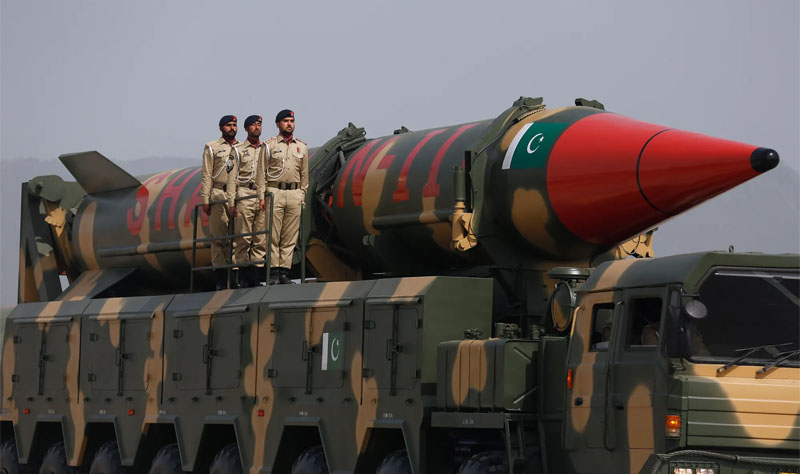







Pakistan’s nuclear programme has evolved with a pronounced and persistent military orientation that shapes every major decision related to fissile material production facilities and doctrinal choices. Its status outside the Nuclear Non-Proliferation Treaty has entrenched a security driven approach where nuclear weapons are treated as the central pillar of national defence and regional deterrence. This has created serious concerns about how nuclear materials and technologies with dual use properties are managed and about the long term implications for regional stability.
From the outset Pakistan’s leadership framed nuclear capability as an existential requirement vis a vis its larger neighbour and as the ultimate equaliser in an asymmetrical security environment. Nuclear weapons were not embedded in a broad energy or industrial development plan but in a crisis driven security narrative built around perceived external threats and historical grievances. Over time this narrative has translated into a pattern where expansion of warheads and delivery systems takes precedence over the cultivation of a robust civilian nuclear sector. The technical infrastructure of the programme has grown but largely in ways that primarily support weaponisation.
Dual use is an inherent feature of nuclear technology because the same processes that yield reactor fuel can be directed toward the production of weapons grade material. In Pakistan’s case the choices made regarding reactor types, enrichment levels and fuel cycle management have been heavily influenced by military requirements. Facilities that could in principle support civil energy generation are configured and operated in ways that optimise output of fissile material suitable for weapons or that can be rapidly diverted for military use if strategic calculations demand it. This blurring of roles makes it difficult to separate civilian and military nuclear spheres in practice.
Pakistan’s nuclear arsenal has gradually expanded in both scale and sophistication. Reported developments point to increased warhead numbers, diversification of delivery systems and growing interest in tactical or battlefield nuclear capabilities. These trends are driven by a desire to offset conventional imbalances and to construct a layered deterrence posture that can operate at multiple levels of conflict escalation. Yet every increment in arsenal size requires corresponding growth in fissile material stocks and fuel cycle capacity which pushes more dual use material into a security dominated ecosystem with limited transparency.
Pakistan does possess formal institutions that look after nuclear safety and security and these structures project an image of regulatory responsibility. However, the effective autonomy and influence of such bodies remain constrained by the overarching primacy of strategic considerations. When core nuclear policy is calibrated around deterrence and battlefield utility it becomes difficult for any regulator to insist on clear firewalls between civil and military activity or to push for full publication of inventories and safety performance. The consequence is a narrow regulatory domain that covers routine radiation uses while the most sensitive dual use material exists in a separate opaque universe.
The relatively modest role of nuclear power in Pakistan’s overall energy mix is another indicator of the skewed orientation of the programme. Despite chronic electricity shortages the country has not built a large integrated civil nuclear sector that could contribute substantially to grid stability and industrial growth. Instead investment and political capital have gravitated toward defence projects missile development and warhead related infrastructure. Nuclear technology that might have been harnessed in a broad national development framework thus remains tied to the logic of deterrence and prestige.
This posture has several implications for dual use concerns. First stockpiles of fissile material are more likely to be sized and managed according to speculative military scenarios than to stable long term energy projections. Second, the systems for tracking transport and securing sensitive material may be designed and implemented under strict secrecy that inhibits independent auditing. Third, the division of labour between civilian scientists and military planners can generate compartmentalisation that hides vulnerabilities or safety lapses until a crisis reveals them.
Pakistan’s strategic environment is undeniably complex and the desire for credible deterrence is understandable given historical conflicts and perceived encirclement. Yet deterrence need not automatically produce a nuclear architecture that sidelines civil safety norms and amplifies dual use risks. Many of the problems associated with Pakistan’s current capabilities stem from the fusion of national identity narratives with nuclear weapons rather than from an objective assessment of energy needs, security challenges and technological options. In policy discourse nuclear capability is frequently depicted as the ultimate symbol of sovereignty and resilience which makes it harder to subject the programme to routine technocratic scrutiny.
Another dimension of dual use concern involves the potential for technology diffusion, intentional or accidental. Pakistan’s past involvement in illicit nuclear networks severely damaged its non proliferation reputation and continues to colour external perceptions of its nuclear governance. Even if present controls are tighter than they were in that earlier era the legacy of clandestine transfers means that any expansion of fissile material capacity or advanced laboratory work is viewed through a lens of suspicion. This trust deficit raises the political costs of Pakistan’s nuclear choices and complicates its ability to access high end technologies for peaceful applications.
The combination of an expanding arsenal evolving doctrines and dual use material managed under strong secrecy introduces several risks. Crisis situations may evolve faster than communication channels can respond especially if tactical nuclear options are integrated into conventional planning. Misperceptions about the location readiness or security of nuclear assets can trigger pre emptive thinking or inadvertent escalation. In such circumstances, even minor technical incidents at nuclear facilities may be interpreted as potential preparation for aggressive moves.
Addressing these challenges demands more than rhetorical assurances of safety and security. It requires a substantive shift in how nuclear policy is conceptualised and communicated within Pakistan. Clearer separation between civil and military nuclear activity, more detailed public reporting on safety performance, greater openness to international peer review and an explicit commitment to limiting fissile material production would all help reduce dual use risks. None of these measures would automatically weaken deterrence but they would rebalance the nuclear programme away from a purely military identity.
Views: 22


