






Rebounding India-US Relations: Strategic Convergence, Economic Ambitions and the New Quad Momentum
The US decision to prioritise engagement with India signals India’s central role in shaping the future balance of power in the Indo-Pacific and beyond.
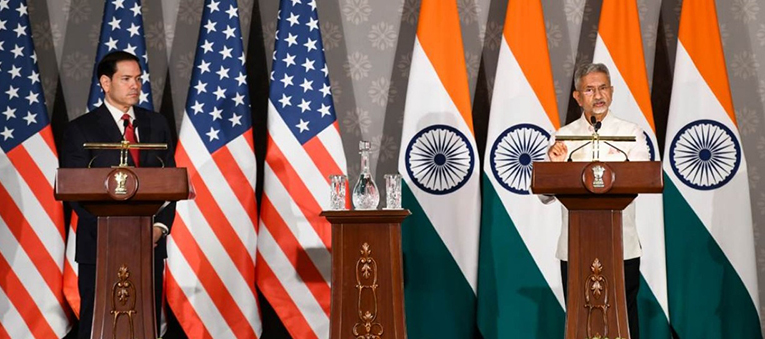
The India-US relationship has entered a renewed phase of strategic consolidation, marked by deeper cooperation across defence, trade, critical minerals, technology, energy security and Indo-Pacific stability. The recent visit of US Secretary of State Marco Rubio to India from 23–26 May 2026, his first official visit as Secretary of State, has reaffirmed India’s growing importance in America’s global strategic calculus and signalled that bilateral ties are firmly on an upward trajectory.
Coming amid heightened geopolitical uncertainty, evolving global supply chains, energy market disruptions, and growing competition in the Indo-Pacific region, the visit demonstrated that India and the United States increasingly regard each other as indispensable strategic partners. Beyond bilateral engagements, the successful Quad Foreign Ministers’ Meeting in New Delhi further underscored the growing alignment among the world’s leading democracies to shape a stable and prosperous Indo-Pacific.
A Strategic Partnership Gains Fresh Momentum
Over the past two decades, India-US relations have evolved from cautious engagement to one of the most consequential partnerships of the twenty-first century. The partnership today is anchored in shared democratic values, expanding economic ties, converging security interests, and robust people-to-people ties.
Secretary Rubio’s visit carried significant symbolic value. At a time when the international system is witnessing growing fragmentation and strategic competition, the US’s decision to prioritise engagement with India sends a strong signal of India’s central role in shaping the future balance of power in the Indo-Pacific and beyond.
Mission 500: Reimagining Economic Partnership
A key outcome of the visit was a renewed commitment to the Mission 500 initiative, which aims to double India–US bilateral trade (Merchandise and Services) to USD 500 billion by 2030. India’s merchandise trade with the United States grew steadily between FY2021–22 and FY2025–26. India’s exports to the US rose from USD 76.17 billion in FY2021–22 to USD 87.32 billion in FY2025–26. Over the same period, imports from the US increased from USD 43.31 billion to USD 53.49 billion. As a result, total bilateral merchandise trade expanded from USD 119.48 billion in FY2021–22 to USD 140.80 billion, reflecting stronger economic and commercial ties between the two countries. India maintained a strong trade surplus with the United States, reflecting robust export performance and a competitive position in the US market. India’s total bilateral trade with the US, including merchandise and services, is around USD 225-235 billion.
Although trade has expanded significantly over the past decade, both countries believe substantial untapped potential remains. Ongoing negotiations for a broader bilateral trade pact are expected to boost trade, investment, and market access. For India, closer economic ties offer opportunities for investment, technology transfer, export growth, and integration into global value chains. Achieving the target will require continued reforms, improved ease of doing business, stronger supply chains, and collaboration in emerging sectors.
Critical Minerals: Building Supply Chain Resilience
One of the most significant outcomes of the visit was the signing of the India–US Framework for Securing the Supply of Critical Minerals and Rare Earths. Critical minerals are essential for electric vehicles, renewable energy, semiconductors, advanced electronics, defence technologies, and AI infrastructure. The framework promotes cooperation across the value chain, covering mining, processing, recycling, and investment. Complementing this effort, the Quad countries launched the Quad Critical Minerals Initiative to diversify supply chains and reduce dependence on concentrated sources. For India, the partnership offers opportunities to strengthen domestic processing capabilities, attract investment, build technological expertise, enhance industrial competitiveness, and support the Make in India initiative.
Defence Cooperation Reaches New Heights
Defence and security cooperation remains a cornerstone of India–US relations. During the visit, both nations renewed the 10-year Major Defence Partnership Framework Agreement and signed an Underwater Domain Awareness Roadmap, underscoring deeper strategic cooperation. Enhanced collaboration on surveillance, intelligence sharing, and maritime monitoring will strengthen India’s security capabilities. The partnership increasingly supports India’s goal of indigenous defence manufacturing through co-development, co-production, and technology transfer. As both countries address shared Indo-Pacific security challenges, defence cooperation is expected to expand in scope and strategic significance.
Energy Security in a Volatile World
Energy security was a key focus of the discussions, particularly amid concerns over potential disruptions in the Strait of Hormuz, a vital global energy corridor. To strengthen regional resilience, the Quad launched the Quad Initiative on Indo-Pacific Energy Security to promote cooperation across technology, policy coordination, market intelligence, and emergency response. The United States also emphasised its role as a reliable energy supplier, with increased exports of crude oil and LNG supporting India’s diversification strategy. For India, securing diversified and stable energy sources is essential to sustaining high economic growth, reducing geopolitical risks, and ensuring long-term energy affordability and security.
Technology and Artificial Intelligence: The Next Frontier
Technology cooperation is emerging as a central pillar of India–US relations, driven by strategic collaboration across semiconductors, artificial intelligence (AI), quantum computing, advanced telecommunications, and digital infrastructure. India’s rapidly expanding digital economy, large talent pool, and innovation ecosystem complement the United States’ global leadership in cutting-edge technologies. Existing partnerships in semiconductor manufacturing, research, and innovation are already strengthening bilateral ties. India’s hosting of the AI Impact Summit underscored its ambition to play a leading role in the global AI landscape. As technology becomes increasingly critical to economic growth, competitiveness, and national security, deeper India–US cooperation in innovation, research, and trusted digital infrastructure is expected to yield significant mutual benefits and strengthen long-term strategic alignment.
Counter-Terrorism Cooperation Remains Critical
An important outcome of the Quad meeting was the strong condemnation of the April 2025 terrorist attack in Pahalgam, Jammu and Kashmir. The joint statement called for the perpetrators, organisers and financiers of terrorism to be brought to justice and reaffirmed a zero-tolerance approach to terrorism and cross-border terrorism. For India, this marks a significant diplomatic achievement. Recognition of India’s concerns about terrorism by major international partners strengthens international support for counter-terrorism efforts and reinforces the principle that terrorism cannot be justified under any circumstances.
Looking Ahead: A Partnership of Global Significance
The outcomes of Secretary Rubio’s visit indicate that India–US relations are entering a new phase marked by deeper strategic alignment, stronger economic engagement, and greater institutional cooperation. Growing collaboration on resilient supply chains, advanced technologies, energy security, critical minerals, and maritime stability reflects the partnership’s expanding scope. Shared interests in maintaining a stable, rules-based Indo-Pacific continue to strengthen bilateral ties. President Donald Trump’s invitation to Prime Minister Narendra Modi to visit the White House further underscores the importance both nations attach to the relationship and highlights the continued role of leadership-level engagement in driving progress.
In conclusion, as the global economy undergoes rapid transformation and geopolitical tensions intensify, India and the United States are increasingly finding common ground across strategic, economic, and technological domains. The partnership has evolved beyond traditional bilateral engagement to become a key pillar of regional and global stability. Cooperation across trade, defence, technology, energy security, critical minerals, and Indo-Pacific initiatives demonstrates a shared commitment to addressing emerging global challenges. Secretary Rubio’s visit reaffirmed the strong strategic logic underpinning India–US relations, signalling that India–US ties are firmly on the rebound, driven by mutual trust, shared interests, and a common vision for prosperity.
Views: 52