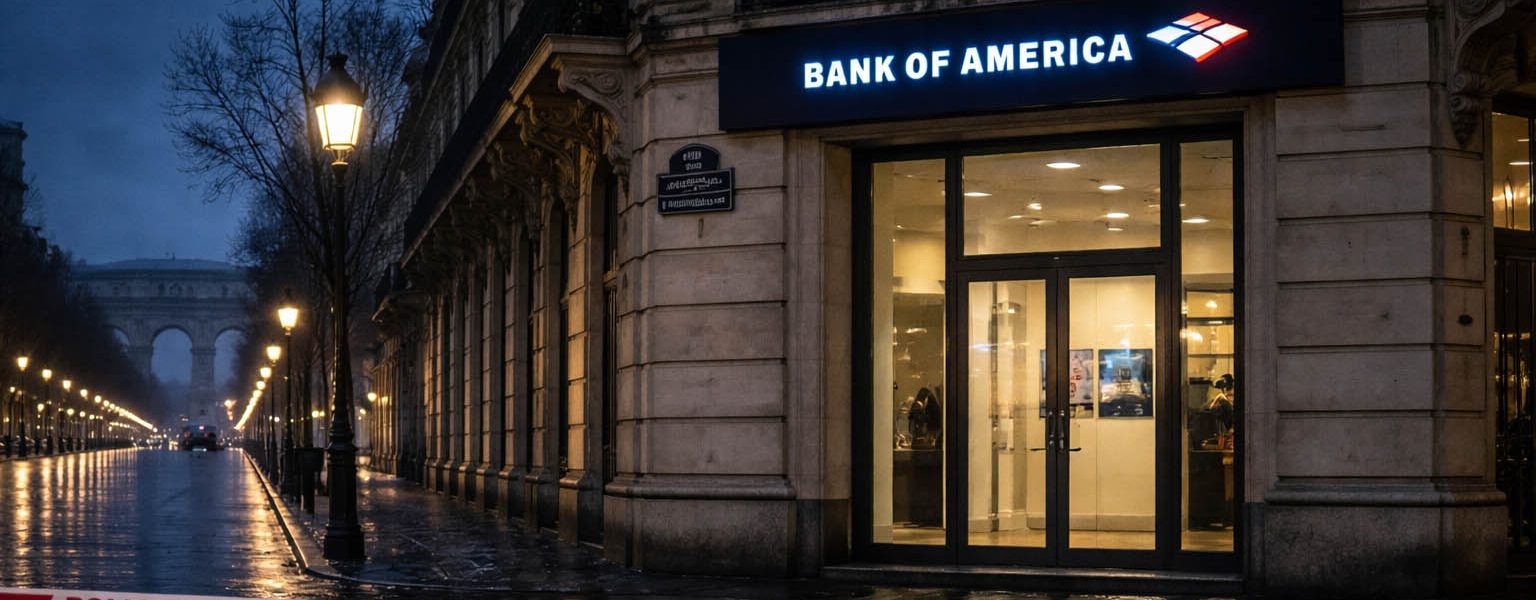







PARIS: French police foiled what could have been a highly symbolic early morning attack in central Paris on Saturday, March 28, 2026, preventing an improvised explosive device from detonating outside a Bank of America office in the city’s 8th arrondissement, steps away from the Champs Élysées.
The incident unfolded at around 3.30 am when officers intervened as a suspect was reportedly attempting to activate the device. According to initial reporting by France 24 and corroborated by multiple outlets, the explosive was rudimentary but potentially dangerous. It consisted of a container holding approximately five litres of liquid fuel paired with an ignition mechanism and roughly 650 grams of explosive powder.
The timing and location appear deliberate. The 8th arrondissement is not only one of Paris’s most visible districts but also home to embassies, corporate offices and luxury retail. While the targeted Bank of America branch was closed at the time and no injuries were reported, the symbolic value of the site suggests intent beyond simple vandalism.
A man was arrested at the scene. Authorities are also searching for a possible accomplice who may have fled before police secured the area. Early statements attributed to the suspect indicate he may have been recruited through social media, specifically Snapchat, and offered a relatively small sum of around 600 euros to carry out the attack. If confirmed, this detail would fit a broader and troubling European pattern in which low cost, low sophistication operations are outsourced to individuals with minimal training and loose ideological grounding.
France’s national anti terrorism prosecutor has taken charge of the investigation, classifying the case as a terrorist criminal conspiracy. This classification is significant. It allows for expanded investigative powers and signals that authorities see potential links to wider networks, even if the operational footprint appears small.
Interior security officials moved quickly to frame the incident within France’s current threat environment. Laurent Nuñezpraised the rapid response of police forces and reiterated that the country remains on high alert amid ongoing geopolitical tensions and a persistent domestic threat landscape.
France has, for years, adapted to a dual risk. On one side are organised networks with transnational links. On the other is a growing phenomenon of fragmented, opportunistic actors who can be mobilised quickly through online channels. The alleged use of social media recruitment and micro payments in this case underscores how the barrier to entry for attempted attacks continues to fall.
What stands out is not the sophistication of the device but the accessibility of the method. A mixture of fuel and basic explosive material, combined with a simple ignition system, reflects a shift away from complex plots toward improvised actions that rely more on timing and location than technical expertise. These are harder to predict and often designed to generate psychological impact rather than mass casualties.
The absence of casualties should not obscure the significance of the event. A successful detonation, even at an empty site, would have carried symbolic weight given the proximity to one of Paris’s most iconic avenues and the presence of an American financial institution. In the current climate, where transatlantic and Middle Eastern tensions intersect with domestic security concerns, such symbolism matters.
Investigators are now focused on tracing digital communications, financial flows and any potential handlers behind the suspect. The reference to a payment offer suggests a transactional layer that may point to intermediaries rather than direct ideological command structures.
For France, the episode reinforces a familiar but evolving reality. The threat is no longer defined solely by large scale coordinated attacks but by a spectrum that includes small, fast moving and loosely organised attempts. The effectiveness of the response in this case highlights the importance of intelligence, surveillance and rapid intervention. It also raises the more difficult question of how to disrupt recruitment pipelines that increasingly operate in plain sight across everyday digital platforms.
Paris woke up to a normal Saturday. That, in itself, is the quiet measure of what was prevented.
Views: 87