









Jamaat-e-Islami’s Electoral Return and the Limits of Democratic Legitimacy in Bangladesh
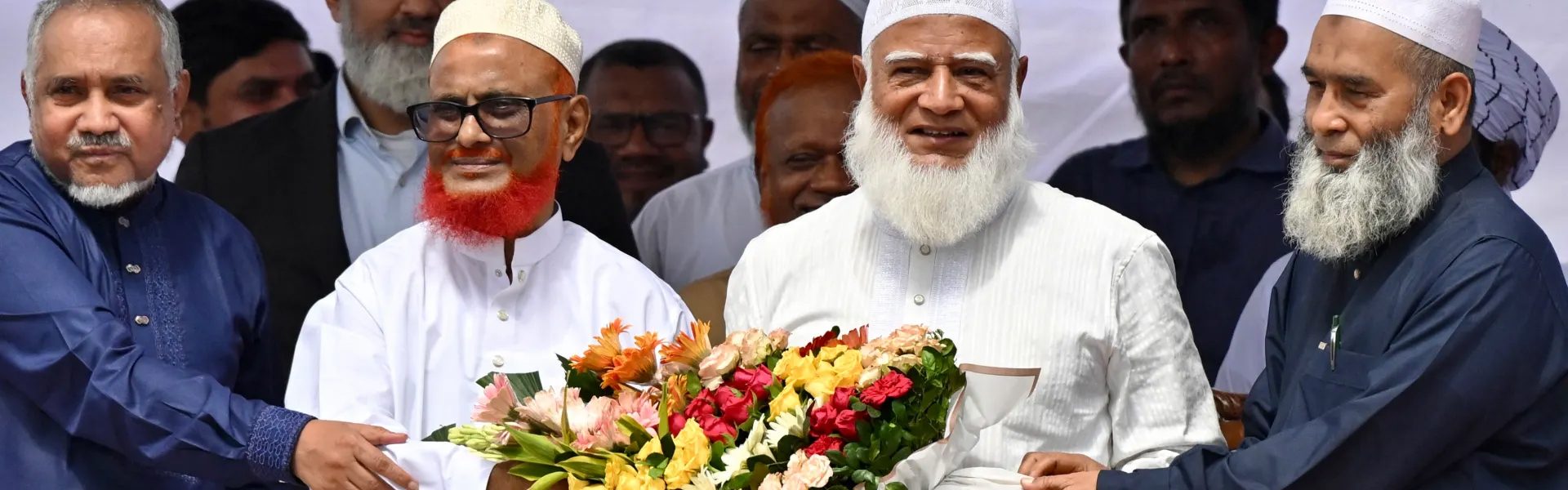
As Bangladesh prepares for another national election in February 2026, the Jamaat-e-Islami has re-entered electoral politics with a level of organisational preparedness and public confidence not seen since its deregistration in 2013. Its renewed presence is not limited to symbolic rallies or rhetorical repositioning; rather, the party has expanded its constituency-level mobilisation in districts such as Rajshahi, Rangpur, Sylhet and parts of Chattogram, reactivating dormant party cells, and intensifying engagement with local administrative and religious networks. Senior leaders, including Shafiqur Rahman, who has served as ameer since 2023, framed the party’s return as a correction of historical injustice rather than a political revival.
This re-entry has unfolded amid widespread voter dissatisfaction with the Awami League and the Bangladesh Nationalist Party, declining public confidence in the country’s Election Commission, and a broader opening for religiously framed political mobilisation. Jamaat’s resurgence therefore does not function merely as a procedural consequence of the lifting of its ban. It marks a substantive shift in Bangladesh’s political moment that demands scrutiny not only of its electoral prospects, but of the democratic norms and legitimacy it seeks to operate within.
The return of Jamaat-e-Islami has inevitably revived unresolved questions about political legitimacy in a state whose constitutional identity has by and large been shaped by the 1971 Liberation War. Jamaat’s historical opposition to independence, and its collaboration with the Pakistan Army through auxiliary forces such as Al-Badr and Al-Shams, remains central to its public perception. Between 2013 and 2016, senior Jamaat leaders including Ghulam Azam, Delwar Hossain Sayeedi, Muhammad Kamaruzzaman, and Ali Ahsan Mohammad Mojaheed were convicted by Bangladesh’s International Crimes Tribunal for crimes against humanity committed during the war. While Jamaat continues to argue that its present leadership is detached from these events, the institutional continuity of the party has largely complicated such distancing. The lifting of Jamaat’s ban in 2024 by the interim government was justified on narrow legal grounds, with officials citing the absence of a judicial ruling directly linking the party’s present organisational structure to terrorism. This decision restored legal eligibility but did not amount to political rehabilitation. The moral and historical burden of 1971 till date continues to shape public scepticism, particularly among constituencies for whom the Liberation War remains the foundational event of the Bangladeshi state.
Institutional Capture and the Reconfiguration of Electoral Competition
Concerns regarding Jamaat’s democratic credibility do not rest solely on historical memory. Investigative reporting in early 2026 has indicated towards allegations of systematic electoral manipulation designed to secure administrative leverage in competitive constituencies. Reports indicate that Jamaat operatives are targeting deputy commissioners, additional district magistrates and senior police officials in districts where electoral margins are expected to be narrow. These efforts reportedly involve inducements, informal assurances and pressure networks rather than overt coercion. While such allegations have not yet resulted in judicial findings, they continue to align with long-standing critiques of Bangladesh’s politicised administrative apparatus. What distinguishes these claims from routine partisan accusation is their specificity. Reports have identified the offices targeted, the constituencies involved and the mechanisms through which influence is sought. In a system where administrative neutrality already faces strain, these developments have raised substantive concerns about Jamaat’s willingness to compete electorally without distorting institutional processes.
Beyond formal administrative structures, Jamaat’s strategy has increasingly extended into grassroots institutional spaces that operate at the intersection of religion, education and local governance. Reporting have also suggested ongoing efforts to influence school management committees, madrasa boards, and mosque-based welfare networks that often function as logistical hubs during elections. Control over these bodies provides access to voter lists, polling locations, and community opinion-makers. This approach reflects a long-standing Islamist political strategy of embedding authority within everyday social institutions rather than relying solely on party platforms. While such engagement does not automatically violate electoral law, it nonetheless does blur the boundary between civic institutions and partisan mobilisation. In a fragile democratic environment, this fusion of religious authority and political organisation has raised normative concerns about coercion and the unequal distribution of political influence.
Gender, Power, and the Limits of Jamaat’s Moral Claims
Jamaat’s democratic claims have further been tested by its position on women’s political participation. The party’s 2026 electoral manifesto pledged security, dignity, and economic protection for women, and senior leaders repeatedly emphasised upon women’s welfare as a moral obligation. Yet Jamaat’s internal organisational structure continues to tell a more restrictive story. Women remain excluded from senior decision-making roles within the party, including the central majlis-e-shura and executive leadership. This exclusion is explicitly defended by party leaders as a theological necessity rather than a transitional limitation. Jamaat does not nominate women candidates for parliamentary seats, nor does it permit women to occupy positions of ultimate authority within the party hierarchy. The disjunction between manifesto commitments and organisational practice has significantly undermined the credibility of Jamaat’s claims to inclusive governance, particularly in a society where women have served as prime ministers, opposition leaders and senior bureaucrats for decades.
Remarks attributed to senior figures regarding women’s employment, leadership, and public visibility also led to protests by student organisations and civil society groups, including demonstrations by Chhatra Dal and independent university collectives. These protests were not confined to elite advocacy circles but emerged from campuses and urban centres where women’s participation in public life has largely normalised. Jamaat supporters dismiss these reactions as politically motivated misrepresentations, yet the persistence of such controversies points to a deeper ideological tension. Jamaat’s gender worldview remains anchored in a hierarchical conception of social order that is increasingly conflicting with Bangladesh’s lived political reality.
Perhaps the most sensitive dimension of Jamaat’s political profile remains its relationship with violence and extremist ecosystems. Jamaat itself is not designated as a terrorist organisation, but its student wing, Islami Chhatra Shibir, has been repeatedly implicated in violent activities, including arson, armed clashes and targeted intimidation during periods of political unrest. Human rights organisations and media reports have extensively documented patterns of coordinated violence rather than spontaneous confrontation. Academic studies and security analyses have also noted ideological and recruitment overlaps between Jamaat-linked student networks and banned militant organisations such as Jamaat-ul-Mujahideen Bangladesh, even in the absence of formal organisational links. These patterns do not establish legal culpability, but they eventually end up raising legitimate concerns about the political culture Jamaat has attempted to foster and tolerate within its broader ecosystem.
Jamaat’s leadership continues to reject allegations of extremism and portrays the party as a victim of state repression and secular authoritarianism. This narrative resonates with segments of the electorate disillusioned by governance failures, economic stress, and political exclusion. Yet the gap between rhetoric and practice remains difficult to ignore. The selective embrace of democratic procedures, combined with exclusionary ideology and allegations of institutional manipulation, suggests that Jamaat’s commitment to democracy is conditional rather than principled.
The significance of Jamaat-e-Islami’s resurgence therefore lies not only in its electoral ambitions but in what its participation reveals about Bangladesh’s democratic condition. The central issue is not Jamaat’s legal right to contest elections, which now stands restored. The deeper question concerns whether the party’s conduct aligns with the constitutional spirit of equality and nonviolence. Evidence drawn from historical record, organisational practice, public statements and investigative reporting suggests a pattern that warrants caution rather than normalisation.
A constructive critique of Jamaat does not require exclusion or ideological silencing. It requires sustained scrutiny grounded in verifiable facts and democratic benchmarks. As Bangladesh approaches another electoral moment, the challenge lies in resisting both authoritarian suppression and uncritical accommodation. Jamaat’s case demonstrates how democratic systems are tested not only by overt repression, but also by political actors who operate within legal frameworks while contesting the norms that give those frameworks meaning. In that sense, the debate over Jamaat-e-Islami ultimately becomes a debate about the boundaries of democratic legitimacy in a Bangladesh that has fought hard for decades to maintain such claims.
Views: 76


