






Modi’s Visit and India–Malaysia’s Strategic Inflection in the Indo-Pacific
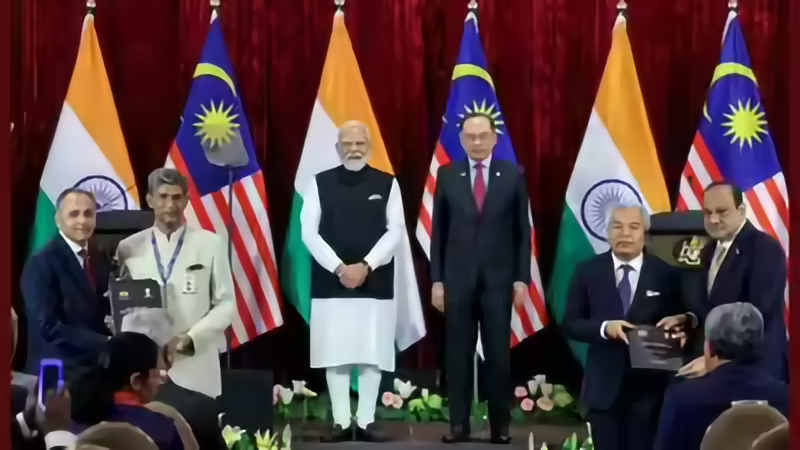
Narendra Modi’s official visit to Malaysia on 7–8 February 2026 marked a decisive moment in the strategic evolution of Indo-Pacific geopolitics. Far from a ceremonial diplomatic exercise, the engagement represented the institutional consolidation of India’s eastward strategic reorientation and Malaysia’s recalibrated middle-power diplomacy in an increasingly contested regional order. Hosted by Prime Minister Anwar Ibrahim, the visit operationalised the Comprehensive Strategic Partnership established in 2024, translating political intent into binding frameworks across defence, digital economies, geoeconomic resilience, maritime security, technological sovereignty, and counterterrorism governance.
In a world defined by power diffusion, supply-chain securitisation, intensifying maritime contestation, and technological fragmentation, India’s decision to anchor its early 2026 diplomacy in Southeast Asia reflects a sophisticated fusion of strategic realism, liberal institutionalism, and geoeconomic statecraft. The signing of eleven wide-ranging Memoranda of Understanding signalled the emergence of a deeply institutionalised bilateral architecture—designed not merely to expand cooperation but to reshape the structural balance of the Indo-Pacific itself.
Historical Relations and PM Modi’s Strategic Continuity
India–Malaysia relations rest upon millennia of civilisational interaction forged through Indian Ocean maritime networks that transmitted culture, religion, commerce, and political influence across Southeast Asia as early as the first century CE. The Chola naval expeditions between the ninth and thirteenth centuries embedded South Asian political power into the Malay Peninsula, while Hindu-Buddhist traditions permeated architecture, language, and cultural memory—visible today in sites such as Batu Caves and in epic adaptations of the Ramayana within Wayang Kulit traditions. British colonial-era migration further institutionalised people-to-people ties, producing a vibrant Indian-origin community of nearly three million that now functions as a strategic social bridge between the two nations, facilitating remittances, commerce, and cultural diplomacy.
Formal diplomatic relations since 1957 evolved steadily through defence cooperation, trade agreements, and multilateral engagement within ASEAN-India frameworks. Yet it has been Modi’s sustained personal diplomacy that injected strategic momentum into the relationship. His 2015 visit during the East Asia and ASEAN-India Summits elevated India’s cultural diplomacy and strategic presence; the 2019 working visit sought to stabilise emerging frictions over palm oil and geopolitical sensitivities; and the 2026 state visit—his third—cemented continuity in India’s Act East prioritisation. This consistency illustrates how leadership-driven trust accumulation, layered upon realist power calculations, can convert episodic diplomacy into enduring strategic alignment.
From Engagement to Strategic Interdependence
The strategic trajectory of India–Malaysia relations has been neither linear nor frictionless. The Enhanced Strategic Partnership of 2015 institutionalised defence exercises such as Harimau Shakti and expanded maritime cooperation, yet turbulence emerged between 2019 and 2020 amid disputes over Kashmir commentary and palm oil trade restrictions under Mahathir Mohamad. These episodes revealed the fragility of transactional diplomacy in the absence of deep strategic embeddedness.
Anwar Ibrahim’s leadership marked a pragmatic recalibration, restoring political trust and prioritising geoeconomic pragmatism amid post-pandemic recovery. The elevation to Comprehensive Strategic Partnership in 2024 transformed bilateral relations from cooperative engagement into structural interdependence. Trade volumes nearly doubled over the past decade, stabilising around USD 19–20 billion annually, with 2025 figures reaching USD 18.59 billion (RM 79.49 billion). While India continues to face a trade deficit driven by palm oil and electronics imports, institutional mechanisms such as the Malaysia–India Comprehensive Economic Cooperation Agreement and evolving ASEAN–India trade frameworks now operate alongside strategic convergence aimed at diversification and value-chain integration.
Strategic Geoeconomics and the Reconfiguration of Supply Chains
At the core of the 2026 agreements lies economic security integration as an instrument of state power. The semiconductor cooperation pact—linking Malaysia’s globally significant testing and packaging sector, representing roughly 13 percent of worldwide capacity, with India’s Semiconductor Mission—anchors a resilient Indo-Pacific technology corridor within a USD 500 billion global industry. This reflects strategic hedging against technological monopolisation while advancing supply-chain sovereignty.
Cross-border digital payments between India’s UPI ecosystem and Malaysia’s PayNet platform institutionalise local-currency trade settlements, mitigating dollar volatility and strengthening commercial interdependence. The Malaysia–India Digital Council—hailed as a strategic mechanism to advance fintech regulation, cybersecurity governance, digital public infrastructure, artificial intelligence, and emerging technologies—exports India’s governance-centric technology model into Southeast Asia.
Renewable energy corridors, green hydrogen initiatives, pharmaceutical manufacturing clusters, logistics connectivity, healthcare collaboration, vocational training, and traditional medicine partnerships collectively reposition the relationship from commodity trade toward high-value industrial co-production and human-capital convergence.
Maritime Security and Indo-Pacific Stabilisation
Malaysia’s strategic location astride the Malacca Strait grants it disproportionate systemic influence in global maritime commerce. Through maritime domain awareness integration, intelligence sharing, joint naval exercises, and defence industrial collaboration, India and Malaysia are constructing a cooperative security complex aimed at safeguarding sea lanes while deterring grey-zone coercion.
This architecture embodies soft balancing through institutional density rather than alliance militarisation, while reinforcing international maritime law and deterrence through operational presence. The partnership thus transforms bilateral defence cooperation into a regional public good underpinning Indo-Pacific stability amid intensifying great-power rivalry.
Normative Power, Counterterrorism, and Institutional Trust
Counterterrorism frameworks—spanning intelligence sharing, anti-corruption cooperation, and national security coordination—reflect convergence in normative security governance. Modi’s unequivocal declaration that “our message on terrorism is clear: no double standards, no compromise” aligns both states within a shared normative framework addressing cyber-radicalisation, transnational financing, and extremist mobility.
Here, constructivist norm diffusion intersects with realist threat perception, generating institutional trust that deepens strategic convergence while expanding humanitarian cooperation through disaster-management mechanisms.
Multilateral Embeddedness and Networked Multipolarity
India–Malaysia convergence is embedded within broader Indo-Pacific institutional ecosystems. Malaysia’s centrality within the Association of Southeast Asian Nations complements India’s expanding regional activism and the India–ASEAN Comprehensive Strategic Partnership.
Simultaneously, cooperation intersects with Global South multilateralism through BRICS. Malaysia welcomed India’s 2026 BRICS Chairmanship, while India reaffirmed support for Malaysia’s role as a Partner Country and its aspiration for full membership—framing this convergence as a milestone toward a more balanced and representative international order. This layered diplomacy illustrates networked multipolarity—overlapping institutions, flexible coalitions, and cooperative security replacing rigid alliance blocs.
Strategic Impact and Long-Term Implications
Economically, the partnership is poised to surpass USD 20 billion in trade through semiconductor investment, digital commerce, and industrial integration. Malaysian foreign direct investment pipelines exceeding USD 5 billion into Indian manufacturing and infrastructure promise employment creation and technology transfer, while local-currency mechanisms stabilise bilateral flows.
Strategically, defence integration strengthens India’s Act East footprint while enhancing ASEAN’s strategic autonomy. Environmentally, biodiversity and climate cooperation embed ecological diplomacy into bilateral relations. Socially, education, healthcare, cultural exchanges, visa facilitation, and diaspora engagement institutionalise soft power alongside hard security.
Execution Risks in a Fragmented Order
The agreements’ comprehensiveness constitutes a major strategic advance, yet execution capacity remains the decisive variable. Regulatory harmonisation, intellectual property protections, trade asymmetries, and geopolitical hedging will test institutional resilience. Malaysia’s balancing posture between major powers may constrain overt security alignment, while domestic political sensitivities on both sides demand careful diplomatic calibration.
Nonetheless, the partnership’s interdependence-based design provides resilience against systemic shocks—offering a nuanced model of middle-power agency within multipolar dynamics.
Conclusion
Modi’s 2026 Malaysia visit marks the maturation of bilateral relations into a sophisticated framework of strategic co-architecture. It fuses power balancing, institutional governance, norm-building, and geoeconomic leverage into a coherent Indo-Pacific strategy.
From semiconductor sovereignty and maritime security to digital governance and counterterrorism norms, the partnership now spans the full spectrum of contemporary state power. It offers a compelling model of cooperative multipolar leadership—anchoring regional stability through institutions and interdependence rather than bloc confrontation.
In an era of systemic uncertainty and geopolitical fragmentation, the India–Malaysia strategic convergence stands among the Indo-Pacific’s most consequential developments: not merely a bilateral success, but a blueprint for shaping regional order through diplomacy, development, and strategic integration.
Views: 1305

Dr. Maheep
Dr. Maheep is Director, Indian Perspective on Global Affairs (IPGA), and a leading analyst of India’s foreign policy and South Asian geopolitics. He earned his PhD in Arab and Islamic Studies. With more than a decade of teaching and research experience in International Relations and Global Politics, he contributes regularly on issues shaping national and global affairs.