









When Pakistan’s finance minister submitted a report to parliament in October on the state of the agriculture sector, it did more than present a set of grim statistics. It laid bare the collapse of what has long been celebrated as the “backbone” of the national economy.
The report, compiled in response to a senator’s query on farm credit, paints a disturbing picture of an agricultural system in disarray — one that has been hollowed out by decades of neglect, policy short-sightedness, and structural decay.
The numbers tell a bleak story: farm credit is drying up, yields are plummeting, and farmers are leaving the land in droves. Extreme weather events — floods, droughts, and pest infestations — have accelerated the decline, but the rot runs far deeper.
The crisis is not merely cyclical; it is structural. It reflects a system that has failed at every level — from policy design and institutional support to the very architecture of Pakistan’s rural economy.
The report spares few details but appears to spare the government. While it acknowledges the catastrophic state of agriculture, it seeks to deflect blame by pointing to “external factors”: global economic pressures, climate shocks, and the “poor decision-making” of farmers themselves.
Yet such framing conveniently overlooks the decades of policy neglect and institutional decay that have left rural Pakistan dangerously exposed to every crisis that comes its way.
Successive governments, both civilian and military, have exploited agriculture as a political slogan while abandoning it as a policy priority.
Beyond rhetoric, little has been done to strengthen farm credit systems, expand extension services, or modernise the agricultural base.
In a country where nearly two-fifths of the population still depends on agriculture for its livelihood, this neglect has had devastating consequences.
The report confirms what rural communities have long known — that access to farm credit is collapsing.
The disbursement of agricultural loans has slowed dramatically, and smallholders are being pushed further to the margins. Banks prefer to lend to large landowners with established political connections, leaving smaller farmers to rely on informal lenders who charge exorbitant rates.
As a result, farm indebtedness has soared even as productivity has flatlined.
The failure of the state to ensure reliable credit access is compounded by its inability to promote innovation.
Pakistan’s agricultural research institutions are underfunded and outdated. The country lags far behind its regional peers in the development of drought-resistant, pest-resistant, and high-yielding seed varieties.
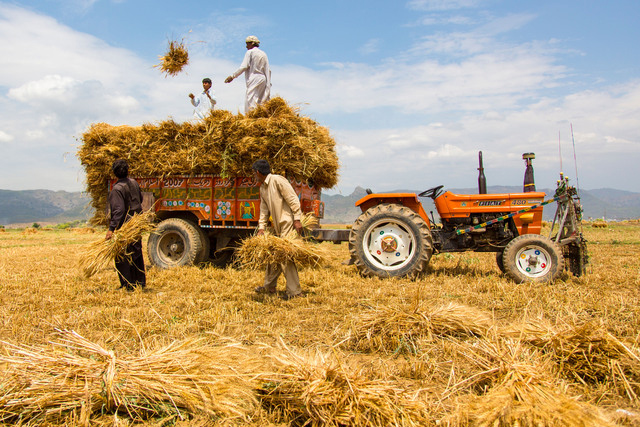
Mechanisation remains a privilege of the few, while the majority of farmers continue to depend on traditional tools and techniques that have changed little over generations.
The absence of meaningful mechanisation has locked millions into low productivity and perpetual vulnerability.
This technological stagnation is mirrored by the failure of public extension services — once a vital bridge between scientific research and rural practice.
Over the years, these services have withered into irrelevance. The officers who once guided farmers on seed selection, pest control, and irrigation management are no longer present in most rural areas.
For many smallholders, the only source of “expert” advice comes from pesticide dealers and seed sellers, whose recommendations are driven by profit rather than agronomic value.
The result is an agricultural landscape marked by inefficiency, dependency, and despair. Crop yields have fallen even as input costs — fertiliser, diesel, and water — have skyrocketed.
The cost of cultivating a single acre has risen beyond what many small farmers can afford, pushing them toward urban migration.
Across Punjab and Sindh, the exodus is visible: entire villages are being depopulated as young men leave for cities or overseas work.
This migration is more than a demographic shift; it represents a slow unravelling of Pakistan’s social fabric. As rural populations shrink, the countryside faces an erosion of both labour and community.
The ageing population left behind is less able to cultivate fields or adapt to changing conditions. Rural poverty deepens, and the country’s food security weakens.
Urban centres, meanwhile, are swelling with new arrivals, stretching already overburdened housing, infrastructure, and job markets to the breaking point.
Climate change has only sharpened the crisis. In the last decade, Pakistan’s agriculture has faced recurring floods, prolonged droughts, and unpredictable monsoon patterns.
Each event leaves lasting scars on the soil and the farmers who depend on it. Yet while climate change is often cited as a convenient culprit, the underlying problem is institutional paralysis.
Other nations facing similar environmental challenges have adapted through research, planning, and innovation. Pakistan, instead, has clung to short-term relief measures and politically expedient subsidies that do little to alter the fundamentals.
These subsidies, frequently hailed as support for farmers, rarely reach those who need them most. Instead, they are captured by large landlords and intermediaries.
Fertiliser and fuel subsidies often end up enriching distributors rather than reducing farmers’ costs. Procurement programs, ostensibly designed to stabilise prices, favour politically connected producers.
For smallholders, these programs are distant promises that never materialise into tangible benefits.
The report’s findings on crop failure and yield stagnation are equally damning. Major crops — wheat, cotton, and sugarcane — have all experienced declining productivity over the past decade.
Cotton, once a mainstay of Pakistan’s export economy, has collapsed to levels that threaten the entire textile sector. Wheat shortages have become recurring crises, forcing the country into costly imports.
The persistence of low yields and crop losses underscores how deep the structural malaise runs.
Despite this, the government continues to avoid accountability.
The report’s tone — defensive and detached — frames the crisis as an inevitable outcome of global and natural forces, rather than the predictable consequence of policy failure.
By spreading blame across farmers, markets, and the weather, the state attempts to absolve itself of responsibility. Yet the truth is unmistakable: this is a man-made disaster, decades in the making.
The lack of long-term planning has ensured that each agricultural crisis bleeds into the next.
The government’s responses have been reactionary, driven by immediate political calculations rather than strategic foresight.
Whether it is providing ad hoc import relief, announcing temporary subsidies, or promising new credit lines, these measures do little to correct the underlying weaknesses.
The absence of a coherent national agricultural policy has left Pakistan’s farm economy vulnerable to every shock — economic, climatic, or political.
The result is a structural collapse whose effects reach far beyond the fields. With rural livelihoods disintegrating, the country’s food supply chains are becoming increasingly unstable.
Markets are experiencing volatility in both prices and availability. The dependence on food imports — once unthinkable for an agrarian country — has become normalised. What was once Pakistan’s greatest economic strength has turned into a source of chronic vulnerability.
The report submitted to parliament may have been intended as an act of disclosure, but it reads instead as an indictment.
It confirms what Pakistan’s farmers have endured for years: that the backbone of the economy has been broken not by misfortune alone, but by neglect and mismanagement.
The state’s failure to sustain, modernise, and protect its agricultural base has created a crisis that now threatens both the rural poor and the broader national economy.Behind the statistics and official statements lies a deeper truth — that the collapse of Pakistan’s farm sector is not just about crops or credit, but about a country that has steadily abandoned its most essential foundation
Views: 53


