






India–Korea axis: Technology, trade, and the reordering of the Indo-Pacific
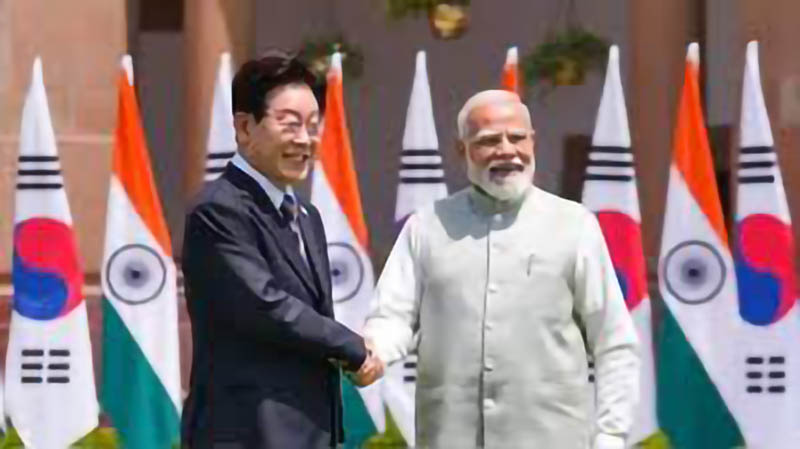
On the evening of 20 April 2026, at the state banquet in Rashtrapati Bhavan, New Delhi, India, President Lee Jae Myung chose his moment with measured precision, invoking the name Sriya Lenka. Born Shreya Lenka in Jharsuguda, an industrial town in Odisha, she had, at eighteen, auditioned online for the South Korean girl group Blackswan and, in May 2022, became the first Indian artist to join a mainstream K-pop ensemble. In recounting her journey, President Lee declared: “The power of culture transcends boundaries and connects dreams.” What appeared as a gracious diplomatic aside was, in analytical terms, a precise theoretical claim about partnership—and, more boldly, a statement about the kind of bilateral relationship India and South Korea are now building. This visit marks the beginning of a phase of strategic consolidation, in which cultural affinity, economic complementarity, and geopolitical convergence together elevate the India–South Korea relationship from episodic cooperation to a mature axis capable of shaping aspects of the Indo-Pacific order.
This was the first state visit by a South Korean president to India in eight years, producing a clearly defined set of twenty-one outcomes: the India–Korea Digital Bridge, the VOYAGES maritime cooperation framework, a CEPA upgrade declaration, fifteen signed documents on trade and technology, and a bilateral ambition to double annual trade from USD 25.7 billion to USD 50 billion by 2030. Yet the Sriya Lenka invocation carries significance equal to these outcomes. A relationship whose social fabric has been woven through K-dramas streaming on Indian smartphones, through young Indians learning Hangul, and through a girl from Odisha emerging as a cultural ambassador in Seoul is one defined by deep societal connection and enduring vitality—one whose resilience transcends trade deficits and diplomatic inertia, and whose moment has now clearly arrived.
Civilisational Depth and Modern Architecture
India and South Korea share a civilisational connection predating the colonial frameworks within which South Asian IR scholarship has conventionally operated. Modi recalled the legend of Princess Suriratna — Queen Heo Hwang-ok in Korean tradition — who according to the Garak Gukgi chronicle sailed from Ayodhya to the Korean peninsula in the first century CE to wed King Kim Suro of Geumgwan Gaya; millions of South Koreans from the Gimhae Kim and Heo clans trace their lineage to this mythic ancestor. Buddhist transmission along the maritime Silk Road deepened civilisational exchange further, with Indian philosophy permeating the intellectual culture of the Three Kingdoms period. Modi’s invocation of these roots was a strategic deployment of civilisational memory, grounding contemporary partnership in a narrative of natural and ancient affinity.
The modern diplomatic relationship formalised in 1973 remained modest through the Cold War. India’s 1991 liberalisation and the Look East Policy created the conditions for a qualitatively different engagement. CEPA, in force from January 2010, generated a near-ninety per cent increase in bilateral trade over fifteen years — from USD 14.2 billion to USD 26.89 billion by 2024–25. Elevation to ‘Special Strategic Partnership’ in 2015 acknowledged what had been quietly accumulating in trade, investment, and defence cooperation, exemplified by the K9 Vajra-T howitzer programme co-produced with Hanwha Defence — the bilateral’s proof of concept in defence-industrial partnership. Yet National Security Adviser Wi Sung-lac acknowledged post-summit that the relationship had ‘still not lived up to its full potential.’ The 2026 visit is, at its deepest level, an institutional correction of that gap.
Korea in Every Indian Home: The Corporate and Civilisational Footprint
One of the most striking features of the India–South Korea relationship is its paradox of intimate daily presence combined with chronic strategic underinvestment. Korean brands have penetrated the Indian consumer landscape with a thoroughness that few foreign corporate ecosystems can match. Samsung Electronics, which entered India in 1995, manufactures all flagship and entry-level handset models at its Noida plant — a fact symbolically underscored when Samsung Chairman Lee Jae-yong photographed the Modi–Lee summit on a Galaxy Z Flip7 assembled at the same facility. Hyundai Motor — India’s second-largest car manufacturer — operates major production facilities in Chennai and Sriperumbudur; its affiliate Kia has established an advanced manufacturing unit in Andhra Pradesh. LG Electronicscommands household penetration across India’s income spectrum; POSCO anchors the bilateral in heavy industry; and Krafton — the South Korean gaming company behind PUBG Mobile — has built one of its largest global user bases among Indian youth, generating a digital cultural presence that amplifies the K-drama and K-pop vectors of Hallyu diffusion. Cumulative Korean FDI into India from April 2000 to March 2025 stood at USD 6.69 billion — respectable in volume, modest relative to the bilateral’s structural scale.
The Hallyu dimension adds a layer that no corporate balance sheet can capture. According to the 2026 Hallyu survey, India ranked second globally — behind only the Philippines — in expressed favorability towards Korean culture among thirty surveyed nations. K-dramas including Crash Landing on You, Queen of the Tears, and When Life Gives You Tangerines command dedicated fan communities across India’s metropolitan and semi-urban centres. K-beauty — brands including Innisfree, COSRX, and the clinical medicosmetics segment — has established a significant market presence driven by the ‘glass skin’ aesthetic aspirations that Korean screen culture has normalised among millions of Indian consumers. The global Korean language learning market, valued at USD 7.2 billion in 2024 and projected to reach USD 67 billion by 2034 at a compound annual growth rate exceeding twenty-five per cent, is substantially driven by India — young Indians learning Hangul to access Korean entertainment, employment, and higher education. The Test of Proficiency in Korean has seen Indian registrations surge. President Lee himself, at the Korea–India Business Forum, acknowledged that relations were growing ‘beyond historical ties, into each other’s daily lives and industries.’ The Sriya Lenka story is not an exception to this trajectory. It is its most vivid expression.
Strategic Convergence: Indo-Pacific Architecture and the Calculus of Autonomy
The structural alignment between India’s Act East Policy and South Korea’s New Southern Policy represents the most consequential political convergence animating the bilateral relationship. Both doctrines are driven by the imperative of deepening engagement with the Indo-Pacific region, and both carry an implicit — if diplomatically understated — logic of supply chain diversification away from overdependence on any single economy. The India–Korea relationship thus sits at the intersection of two independently motivated but functionally convergent foreign policy architectures whose coordination potential has been chronically under-exploited.
The China factor demands precise analytical treatment. Neither nation pursues openly anti-Chinese policies: India shares a 3,488-kilometre disputed land border with Beijing and maintains substantial bilateral trade despite ongoing Himalayan tensions, while South Korea’s economic dependence on China — accounting for approximately a quarter of its exports — constrains the degree to which Seoul can publicly align against Beijing. Both have consequently adopted strategies of strategic hedging — engaging China economically while deepening security and technological partnerships with democratic partners and with each other. India’s approach embodies what scholars at the Observer Research Foundation have characterised as ‘managed multi-alignment’: the cultivation of maximum strategic flexibility through multiple concurrent partnerships, none of which is permitted to foreclose independent judgment. South Korea’s calibrated observer status vis-à-vis the Quadrilateral Security Dialogue reflects an equivalent logic. Both nations simultaneously hold membership of the Shanghai Cooperation Organisation alongside China and Russia — a structural multi-alignment that, as Amitav Acharya has argued of the emerging ‘multiplex world’, reflects the new grammar of middle-power statecraft rather than strategic confusion.
The West Asian crisis has sharpened the bilateral’s strategic logic considerably. India is the world’s third-largest oil importer, yet relies heavily on foreign-flagged vessels to carry its crude — a dependency that Strait of Hormuz disruptions have exposed with acute commercial and strategic cost. South Korea faces the same structural vulnerability, importing approximately eighty per cent of its energy. Lee explicitly committed to coordinate with India on ‘securing supplies of key raw materials including naphtha’ and to jointly ensure free navigation through the Strait of Hormuz. Modi’s declaration that ‘India and Korea together give the message of peace and stability’ was a strategic formulation, not a pleasantry: it asserted the bilateral’s stake in the rules-based maritime order that underpins the economic metabolism of both nations. Their prior meetings on the sidelines of the G7 in Kananaskis and the G20 in South Africa in 2025 confirmed that this convergence had been deliberately constructed, not hastily improvised.
The Russia–Ukraine war has added further complexity to both nations’ strategic geometries. India’s refusal to join Western sanctions — driven by defence procurement dependencies and energy security considerations — has created periodic frictions with Western partners, while South Korea’s more robust alignment with the Western response reflects its deeper integration into US-led security structures. These differing postures have not generated bilateral friction: each nation understands the other’s structural constraints from the inside, and both share a deeper strategic temperament — the conviction that great-power competition is best navigated through institutional multiplicity rather than exclusive alliance.
Geoeconomics, Trade Architecture, and the Supply Chain Imperative
The economic architecture of the India–South Korea relationship is defined by a fundamental complementarity of industrial structures and a persistent trade asymmetry that remains the relationship’s most significant commercial challenge. India imports approximately USD 21 billion annually from South Korea — dominated by high-value manufactured goods, electronics components, industrial machinery, and petrochemical inputs — while exporting approximately USD 5.8 billion, concentrated in petroleum products, organic chemicals, and agricultural commodities. A deficit of USD 15 billion is a structural political economy problem that shapes domestic constituencies’ attitudes towards engagement and generates negotiating pressure in any CEPA revision. The bilateral’s ambition to double trade to USD 50 billion by 2030 is compelling as a target; its credibility depends on whether the CEPA upgrade — agreed within a twelve-month timeline — can meaningfully expand Indian export access in pharmaceuticals, software services, and professional services, where India possesses genuine competitive advantage currently under-reflected in bilateral trade flows.
The Korea–India Business Forum at Bharat Mandapam — attended by approximately 600 government officials and business leaders — provided visible demonstration of the bilateral’s corporate depth. The South Korean delegation represented the commanding heights of the Korean economy: Samsung Chairman Lee Jae-yong, Hyundai Group Executive Chair Chung Euisun, LG Chair Koo Kwang-mo, POSCO Chair Chang In-hwa, HD Hyundai Vice Chair Chung Ki-sun, Naver CEO Choi Soo-yeon, and Krafton CEO Kim Chang-han, alongside Federation of Korean Industries Chair Ryu Jin. The Indian side included CII President Rajiv Memani, JSW Steel CEO Jayant Acharya, and Essar Group’s Ravikant Ruia, among 350 participants. This was the political economy of ambition made visible.
The newly established ministerial-level Industrial Cooperation Committee, the India–Korea Financial Forum, and the Economic Security Dialogue — focused on critical technology supply chains — constitute the institutional infrastructure for governing this expanded economic relationship. The decision to establish dedicated Korean Industrial Townships in India — specifically designed to lower barriers to entry for Korean small and medium enterprises inhibited by regulatory complexity and infrastructure deficits — is the visit’s most structurally innovative economic outcome. The current concentration of Korean corporate engagement in a handful of large chaebols, while impressive in market penetration, has created a vulnerability: bilateral economic relations dependent excessively on a few firms are relations whose institutional resilience is purchased at the cost of breadth. SME engagement, if successfully catalysed, would fundamentally alter both the trade balance and the institutional depth of the relationship. The concurrent MoU between NPCI International Payments Limited and the Korean Financial Telecommunications and Clearings Institute — linking India’s UPI architecture with Korean digital payments infrastructure — signals a parallel ambition to integrate the two nations’ digital financial ecosystems at the transactional level.
From Chips to Ships: Technology Sovereignty, Defence, and the Maritime Dimension
Modi’s formulation — ‘chips to ships, talent to technology, entertainment to energy’ — is more than a diplomatic epigram. It is a conceptual map of the bilateral’s sectoral ambition, and its core is the India–Korea Digital Bridge: the landmark initiative for cooperation in artificial intelligence, semiconductors, and information technology launched at the summit’s centrepiece press conference. At its structural core, the Digital Bridge is animated by the semiconductor imperative. South Korea’s extraordinary chip manufacturing capacity — concentrated in Samsung Electronics and SK Hynix, the world’s first and second largest memory chip producers — is a strategic asset of global significance in the current era of technology rivalry. South Korea’s integrated circuit exports alone accounted for approximately 28.5 per cent of its record USD 709.7 billion in total exports in 2025, demonstrating a sectoral dominance that makes semiconductor partnership with India a strategic imperative for Seoul as it seeks to geographically diversify its chip ecosystem. India’s semiconductor market, currently approximately USD 38 billion, is projected to reach USD 100–110 billion by 2030, and the national semiconductor mission — supported by Production-Linked Incentive schemes — provides the demand-side logic for deepened cooperation. Both Seoul’s K-Semiconductor Belt strategy and New Delhi’s Make-in-India chip incentive architecture are responses to the same structural imperative: the need to reduce dependence on geographically concentrated chip production in the face of US–China technology decoupling.
The maritime dimension is equally consequential. The VOYAGES framework — Vision for Operation of Yard Assisted Growth with Efficiency and Scale — constitutes the visit’s most industrially ambitious undertaking. India conducts the overwhelming majority of its international trade by sea, yet relies heavily on foreign-flagged vessels to carry its cargo and crude oil, a dependency that Strait of Hormuz disruptions have exposed with acute strategic cost. South Korean shipbuilders bring a genuinely transformative industrial capability to this challenge: the ability to treat shipbuilding as a serial manufacturing process — entire yards designed as automobile-style assembly lines enabling modular construction that dramatically reduces build time. The fundamental distinction, as one industry analyst observed, is categorical: ‘India builds ships; Korea manufactures ships.’ The VOYAGES framework encompasses greenfield shipbuilding clusters with Korean technical partnerships, a large shipyard in southern India, expansion of existing yards with dry docks and fabrication facilities, and India’s procurement pipeline of over 400 vessels worth approximately USD 25 billion. It is a multi-decade industrial transformation programme, not a bilateral agreement in the conventional diplomatic sense — and its strategic logic, linking maritime infrastructure to energy security and supply chain resilience, is impeccable.
The defence-industrial relationship extends beyond maritime cooperation. The K9 Vajra-T howitzer programme — manufactured in India by L&T Defence through technology transfer from Hanwha Defence — establishes the proof of concept for co-production partnerships that generate both military capability and industrial learning. Both leaders’ discussions of expanded defence cooperation, joint production and research, and cybersecurity and AI governance signal an ambition to replicate this model across a broader range of platforms. The strategic implication is unmistakable: India and South Korea are positioning themselves as co-producers of regional security, not merely as bilateral partners within it.
Structural Gaps and Unrealised Potential
The visit’s evident momentum must be measured against the structural limitations that continue to define this relationship.
The trade imbalance at USD 15 billion is the relationship’s most intractable commercial challenge. Closing it requires not merely trade agreement reform but a structural transformation of India’s export basket — a multi-decade industrial undertaking, not a negotiating concession. The CEPA upgrade must explicitly prioritise Indian export access in pharmaceuticals, software services, and professional services if it is to alter the structural asymmetry rather than merely expand its scale. More significantly, President Lee’s own acknowledgement that only twelve thousand Korean residents and 670 Korean companies operate in India — relative to India’s 1.4-billion population and fourth-largest-economy status — is a striking admission of bilateral underperformance. This thin organisational base reflects a combination of regulatory complexity, inadequate infrastructure outside metropolitan clusters, and insufficient professional and academic people-to-people connectivity. The Korean Industrial Townships initiative directly addresses this deficit, but its success depends entirely on execution quality and sustained political follow-through — neither of which can be assumed from a bilateral history in which ambitious institutional announcements have routinely underdelivered.
At a deeper structural level, the security partnership lacks the formal architecture that characterises India’s most mature bilateral defence relationships. The absence of a Mutual Logistics Support Agreement constrains operational interoperability and limits the practical depth of defence cooperation. Whether the existing ‘Special Strategic Partnership’ framework is institutionally adequate to the strategic environment India and South Korea now jointly face is a question that merits urgent policy attention. Finally, the academic and track-two dimensions of the relationship remain chronically underdeveloped. The epistemic community capable of generating the policy ideas and personal networks necessary to sustain the relationship through inevitable periods of political turbulence can only be built through sustained investment in educational exchange, joint research programmes, and Indian Studies and Korean Studies chairs across each other’s university systems — an investment that has yet to be made at the scale the bilateral’s stated ambitions require.
Constructivism, Strategic Autonomy, and the Middle Power Moment
Three theoretical frameworks illuminate this relationship with particular force. A constructivist reading, drawing on Alexander Wendt’s social theory of international politics, identifies the constitutive role of shared identity and mutual recognition in creating the social conditions for deepened cooperation. The mutual invocation of civilisational heritage —the Queen Heo Hwang-ok narrative, Buddhist linkages, the reciprocal diffusions of Hallyu and Bollywood — is a performative construction of shared identity that generates the social facts informing state behaviour. Sriya Lenka’s journey from Jharsuguda to Seoul, and the Korean artist Aoora’s blending of K-pop with Indian philosophical and spiritual themes at the state banquet, embody at the individual level the identity co-production that constructivism theorises at the systemic level. When states invest in the 2028 India–Korea Friendship Festival, they are investing in the long-term identity infrastructure of partnership — a political act whose strategic significance is real, even if it resists quantification.
The theory of strategic autonomy — elaborated by scholars including C. Raja Mohan, Shivshankar Menon, and Srinath Raghavan — captures India’s distinctive foreign policy orientation: the cultivation of maximum strategic flexibility through multiple concurrent partnerships, none of which is permitted to constrain independent judgment. India’s simultaneous participation in QUAD, BRICS+, and the SCO, combined with its refusal to join Western sanctions on Russia, exemplifies this doctrine in practice. The India–South Korea relationship functions as a component of India’s strategic autonomy architecture: a partnership with a technologically advanced democratic middle power that deepens supply chain resilience and diplomatic reach without foreclosing any strategic option. South Korea’s own sophisticated navigation of its US alliance and Chinese economic dependency makes Seoul a uniquely empathetic partner for New Delhi’s multi-aligned posture — two nations that understand each other’s structural constraints from the inside.
Middle power diplomacy theory, as developed by Andrew Cooper, Richard Higgott, and Kim Richard Nossal, and applied to South Korea specifically by scholars at the Korea Institute for International Economic Policy, identifies middle powers by their disposition towards multilateral institution-building, coalition formation, and norm entrepreneurship — strategies that leverage intermediate capabilities to exert influence disproportionate to material power. Both India and South Korea embody this logic. Their April 2026 summit can be read, in this register, as a meeting of two middle powers constructing the bilateral institutional architecture for coordinated Indo-Pacific governance — a conscious exercise in the kind of middle-power coalition-building that the multipolar world’s complexity both demands and rewards.
Next Decade: Policy Prescriptions and the Architecture of Ambition
The 2026 summit’s twenty-one outcomes constitute a comprehensive strategic architecture. Its realisation across the coming decade will require sustained political will, institutional investment, and executive follow-through that no single summit — however productive — can guarantee. The policy prescriptions that emerge from this analysis are clear.
In trade, the CEPA upgrade must explicitly and substantively expand Indian export access in pharmaceuticals, software services, and professional services — the sectors where India’s comparative advantage is genuine and currently underutilised in the Korean market. Korean Industrial Townships must be designed through genuine investor consultation, with streamlined regulatory frameworks and dedicated industrial infrastructure, to avoid becoming merely the latest iteration of aspirational bilateral announcements.
In technology, the India–Korea Digital Bridge must be operationalised through concrete joint research programmes in semiconductor design, AI safety, and quantum computing. The establishment of a joint India–Korea Technology Fund — modelled on existing Indo-Japanese mechanisms — would provide the financial architecture for sustained technology partnership. The Economic Security Dialogue must graduate from a forum for discussing supply chain resilience in general terms to a mechanism for making specific, actionable decisions about joint industrial strategy.
In the maritime and defence domain, the VOYAGES framework requires a dedicated bilateral task force with time-bound deliverables and measurable performance indicators. Negotiating a Mutual Logistics Support Agreement — which would provide the legal and operational architecture for genuine defence-industrial interoperability — deserves to be elevated from a background consideration to a foreground policy objective.
In the people-to-people domain, a dedicated India–Korea Student Exchange Programme targeting ten thousand students annually on each side within five years would build the human capital foundation for a sustainable long-term relationship. Establishment of Indian Studies chairs at South Korean universities and Korean Studies programmes at Indian institutions — supported by joint government and private sector funding — would develop the epistemic community capable of generating the policy ideas and personal networks that the partnership requires to remain resilient through the inevitable turbulence ahead.
The Queen Heo Hwang-ok narrative and the Sriya Lenka story occupy opposite ends of a two-thousand-year arc of India–Korea connection — one a mythic princess sailing westward from Ayodhya to the Korean peninsula, the other a young woman from Jharsuguda who taught herself Korean through drama serials and made history in Seoul. Between them stretches a civilisational depth that no trade deficit, no diplomatic inertia, and no structural asymmetry has succeeded in extinguishing. The task before both governments is to ensure that this arc bends, across the decade ahead, towards the realisation of a strategic partnership commensurate with the civilisational depth, the technological complementarity, the geopolitical convergence, and the simple human warmth it represents. Modi’s epigram — chips to ships, talent to technology, entertainment to energy — is the starting point. The decade ahead will shape this masterpiece—through institutions, agreements, and lived partnerships.
Views: 404

Dr. Maheep
Dr. Maheep is Director, Indian Perspective on Global Affairs (IPGA), and a leading analyst of India’s foreign policy and South Asian geopolitics. He earned his PhD in Arab and Islamic Studies. With more than a decade of teaching and research experience in International Relations and Global Politics, he contributes regularly on issues shaping national and global affairs.