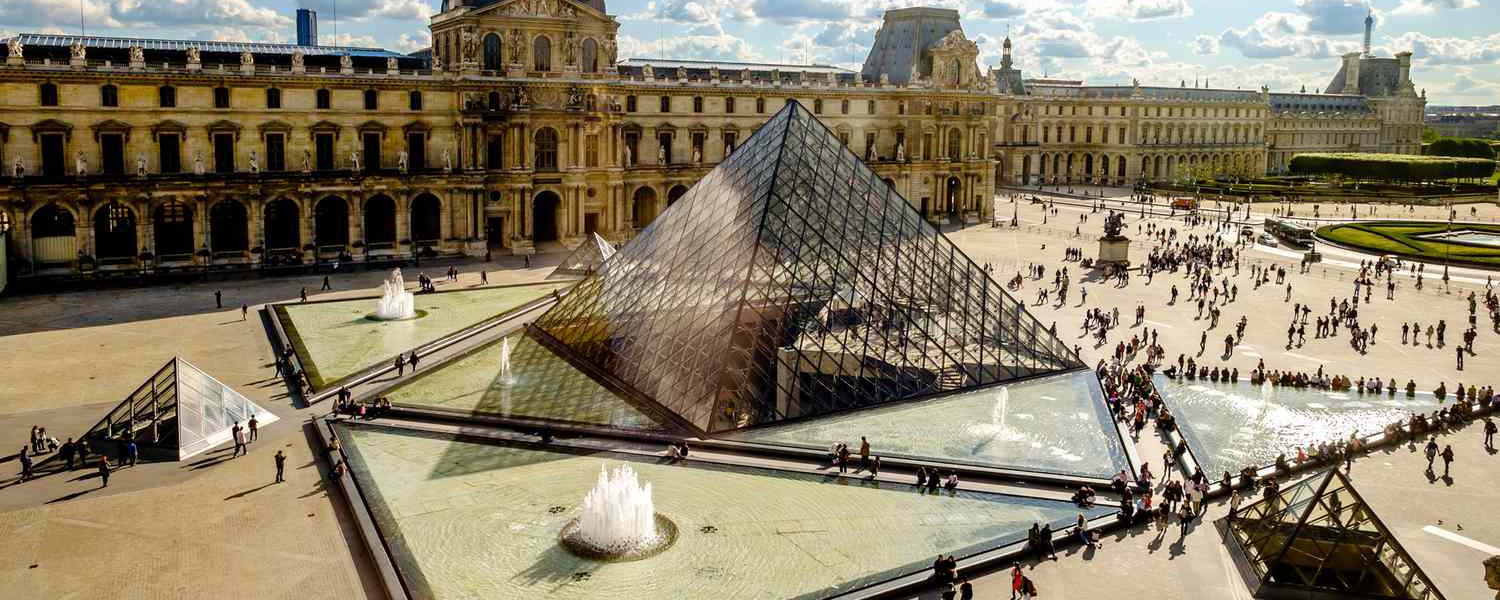







In the quiet of a Parisian morning on October 19, 2025, as sunlight filtered through the glass pyramid of the Louvre, a group of thieves carried out one of the most audacious museum robberies in recent history. Within eight minutes, they stripped the Galerie d’Apollon of jewels once worn by French queens and empresses, leaving behind shattered glass, alarm sirens, and a deep sense of cultural violation that has unsettled not only France but the entire art world.
The operation was executed with chilling precision. Shortly after the museum opened its doors, a truck fitted with a hydraulic lift stopped by the Seine-facing façade. Four individuals in high-visibility jackets, impersonating maintenance workers, positioned the lift against an upper-floor balcony and used an angle cutter to breach the window. Witnesses later described the scene as surreal: the whirring of machinery mingled with the city’s morning sounds, unnoticed for precious minutes that proved decisive. Inside, the thieves broke open the display cases in the gallery that houses the French crown jewels, grabbing what they could before fleeing on motorbikes waiting nearby.
What disappeared that morning were not mere ornaments. Among the stolen pieces were an emerald necklace and earrings belonging to Empress Marie-Louise, sapphire jewels of Queen Hortense, and a diamond tiara and brooch of Empress Eugénie. The crown of Eugénie, found damaged near the museum’s outer wall, was the only major item recovered. The rest vanished, likely to be broken down or melted before resurfacing in clandestine markets. Their estimated worth, close to 88 million euros, barely begins to describe their true value: these were fragments of a nation’s history, tangible links to the monarchy and empire, to stories of love, power, and loss that once animated the halls of Versailles and the Tuileries.
President Emmanuel Macron, addressing the press later that day, called the theft an attack on French heritage and memory. His words echoed the disbelief of millions who see the Louvre not just as a museum but as a repository of the collective imagination. To lose such artifacts from within its walls, and in broad daylight, seemed inconceivable. The last time the Louvre suffered a crime of similar resonance was in 1911, when the Mona Lisa was spirited away by an Italian handyman named Vincenzo Peruggia, an event that paradoxically transformed the painting into a global icon. But this new heist felt different: colder, faster, and more professional, with none of the naive idealism of the earlier theft.
Security failures soon came under scrutiny. Initial reports revealed that the façade used by the thieves was not fully monitored by external cameras, and though alarms sounded, the response was delayed by confusion about ongoing maintenance works. Inside sources described a “perfect storm” of oversight gaps, exploited by criminals who knew the building’s rhythms too well. France’s culture minister Rachida Dati ordered an immediate audit of the Louvre’s security systems and promised a comprehensive review of protections at all national museums. The Louvre’s director acknowledged “serious deficiencies” but declined to resign, arguing that even the most advanced systems can be undermined by human complacency and timing.
The investigation moved swiftly. More than one hundred officers were assigned to the case, tracing the truck’s route, reviewing CCTV footage from the surrounding streets, and analyzing phone signals in the area. Within a week, two suspects were arrested, one at Charles de Gaulle Airport attempting to fly to Algeria and another in the Paris suburbs. Both were in their thirties and known to law enforcement for past offenses involving stolen goods. Police sources suggested that a larger network was involved, possibly linked to organized crime groups with expertise in art and jewelry trafficking. Officials warned that despite the arrests, the likelihood of recovering the jewels was slim. In the shadowy world of art theft, objects of such fame are often too recognizable to resell intact, and their historical identity is frequently destroyed to conceal the crime.
For art historians, the loss is immeasurable. The Galerie d’Apollon, designed under Louis XIV and restored in the nineteenth century, represents the very idea of France’s artistic grandeur. To see its cases empty is to be reminded of how fragile that grandeur can be. Visitors now walk through the gallery in subdued silence, their eyes drawn not to what remains, but to what is missing.
This theft is more than a headline about missing jewels; it is a reflection of a deeper unease in an age where cultural treasures are both venerated and vulnerable. Museums have become temples of shared memory, yet they also stand as soft targets in an increasingly audacious criminal landscape. The Louvre robbery exposes a paradox: in seeking to bring art closer to the public, institutions must navigate ever-greater risks of exposure.
The story of the stolen jewels will continue to unfold, through arrests, trials, and perhaps, one day, a recovery. But for now, what endures is the image of those eight silent minutes that rewrote the history of the world’s most famous museum. In their wake lies a city questioning not only its security but also the very nature of its guardianship over beauty, history, and the symbols that bind a nation to its past.
Views: 47