






Italian Foreign Minister Antonio Tajani’s visit to Syria in early January 2025 represents a significant step in international efforts to stabilize and rebuild the country following the ousting of President Bashar al-Assad. This visit, which followed the Quint meeting in Rome, highlights Italy’s leading role in shaping the post-conflict roadmap for Syria.
The Quint Meeting in Rome: Setting the Stage
On January 9, 2025, Tajani hosted a high-level meeting at Villa Madama in Rome with counterparts from the United States, United Kingdom, France, Germany, and the European Union. The gathering, known as the Quint meeting, focused on coordinating a unified international response to Syria’s evolving political situation.
Key priorities included promoting human rights, ensuring adherence to international humanitarian law, and protecting minority groups. U.S. Secretary of State Antony Blinken and other foreign ministers reaffirmed their commitment to assisting Syrians in building a peaceful and democratic future.
Tajani’s Visit to Syria: A Historic Engagement
The next day, Tajani became one of the first Western officials to visit Damascus since the political shift. During his meeting with Syria’s interim leadership, including interim President Ahmed As Sharaa, he emphasized Italy’s commitment to supporting Syria’s reconstruction and recovery.
Discussions on Sanctions Tajani confirmed that he had raised the issue of the sanctions imposed on Syria in 2011 due to the regime’s suppression of pro-democracy demonstrations. He clarified that these sanctions “were not directed against the Syrian people at all” but were a response to the actions of the previous regime. Tajani also expressed support for recent statements by the EU’s external relations chief, indicating a potential easing of sanctions, calling them “a step in the right direction.”
On the same day, the European Union announced that it might ease sanctions on Syria if the new authorities demonstrated “tangible progress” toward reform and stabilization.
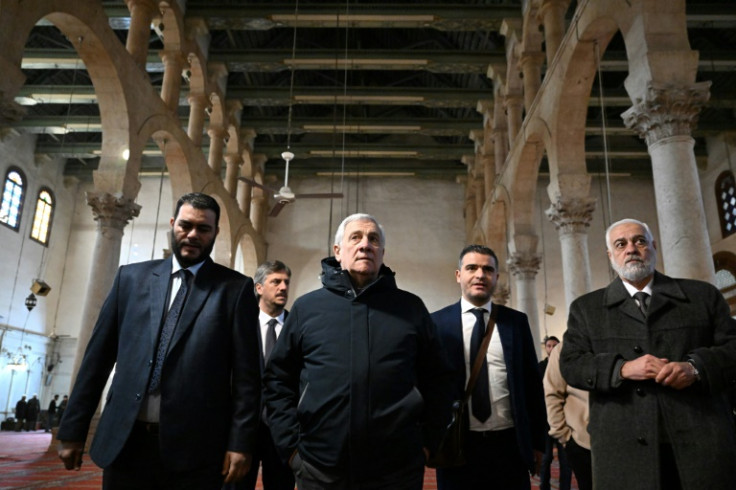
Cultural Engagement and Aid Initiatives Tajani began his visit with a symbolic tour of the Umayyad Mosque and the Hamidiya Market in Damascus, showcasing Italy’s respect for Syria’s rich cultural heritage. He also announced the launch of “a first package of aid for development cooperation,” reinforcing Italy’s commitment to Syria’s recovery.
Reiterating European Support During his meeting with Syrian officials, Tajani stressed Europe’s determination to support Syria’s recovery, including reconsidering sanctions imposed on Damascus. His remarks underscored the importance of fostering a constructive partnership between Syria and the European Union to facilitate long-term stability.
International Reactions and Future Prospects
The Quint meeting and Tajani’s visit underscore a broader international effort to stabilize Syria and support its people during this transformative period. Italy’s proposal to ease EU sanctions reflects a pragmatic approach aimed at encouraging reform and reconstruction.
The Italian government’s re-engagement with Syria, marked by the appointment of Stefano Ravagnan as its permanent representative in Damascus, signifies a shift in European strategy. Tajani’s diplomatic outreach highlights Italy’s ambition to lead in the international response to Syria’s challenges, advocating for a balance between accountability and support.
As Syria navigates its post-conflict transition, the coordinated efforts of nations like Italy, combined with EU support, will play a crucial role in determining the country’s future trajectory.
Views: 30