






From quiet strategic cooperation to an institutionalised partnership, India and Israel are building a new axis of technological innovation, security collaboration, and geopolitical connectivity linking South Asia, West Asia, and the Mediterranean.
In July 2017, an image circulated widely in international media: Prime Minister Narendra Modi and Israeli Prime Minister Benjamin Netanyahu walking barefoot along the Mediterranean shore near Haifa. The two leaders paused beside a desalination facility converting seawater into potable drinking water — an innovation emblematic of Israel’s technological ingenuity. The moment was visually informal yet strategically momentous. For the first time in the history of independent India, an Indian prime minister had undertaken a dedicated bilateral visit to Israel, unaccompanied by the customary balancing itinerary to Palestinian territories that had characterised earlier diplomatic engagements.
Nearly a decade later, Modi returned to Israel in February 2026 to address the Knesset for the second time. The sustained applause that greeted his address reflected the extraordinary transformation of India–Israel relations from cautious diplomatic contact to an increasingly institutionalised strategic partnership. Israeli parliamentary leaders and policy commentators alike interpreted the visit as confirmation that the relationship had entered a new stage of political trust and strategic convergence.
Understanding the significance of this transformation requires situating India–Israel relations within the broader framework of contemporary international relations. The global system has entered a period of structural transition characterised by geopolitical rivalry, technological competition, and the gradual erosion of the post–Cold War liberal order. In such an environment, states increasingly pursue diversified partnerships designed to enhance their technological capabilities, strengthen national security, and preserve strategic autonomy.
Scholars of international relations have long emphasised the structural logic behind such partnerships. Kenneth Waltz, the principal theorist of structural realism, argued that states operating within an anarchic international system inevitably seek arrangements that enhance their security and relative power. In Waltz’s formulation, alliances and strategic partnerships emerge not from ideological affinity but from converging national interests and shared perceptions of threat.
The evolving India–Israel relationship reflects precisely such a convergence. Both countries confront persistent security challenges, including transnational terrorism and volatile regional environments. Both possess highly developed technological sectors that complement one another. Both increasingly view innovation, defence modernisation, and strategic connectivity as essential components of national power in the twenty-first century.
The February 2026 visit took place amid heightened tensions across West Asia following the October 7 Hamas attack on Israel and the subsequent regional instability that followed. In this environment, Modi’s address to the Knesset emphasised the imperative of international cooperation against terrorism, drawing parallels between Israel’s experience and India’s own encounter with extremist violence, particularly the 2008 Mumbai attacks. By framing terrorism as a shared strategic challenge, Modi articulated a narrative of partnership grounded not only in diplomatic cooperation but also in convergent security experiences.
The visit culminated in the formal elevation of ties to a “Special Strategic Partnership for Peace, Innovation and Prosperity,” with sixteen agreements signed spanning artificial intelligence, cybersecurity, agriculture, digital payments, labour mobility including provisions for up to 50,000 additional Indian workers, fisheries, aquaculture, maritime heritage, education, and cultural exchange under the 2026–2029 programme.
Civilisational Antecedents and the Historical Foundations of the Relationship
Long before diplomatic relations were established between the modern states of India and Israel, Jewish communities had already found refuge and prosperity on the Indian subcontinent. Historical records indicate that Jewish migrants arrived on the Malabar Coast of Kerala nearly two millennia ago, establishing communities that would become integral components of India’s pluralistic social fabric.
Among the earliest of these groups were the Cochin Jews, whose traditions trace their origins to migrants who arrived following the destruction of Jerusalem by Roman forces in the first century CE. The Bene Israel community of Maharashtra similarly claims an ancient lineage linked to maritime traders who settled along India’s western coast. Later migrations included the Baghdadi Jews, who established prosperous mercantile communities in Bombay and Calcutta during the eighteenth and nineteenth centuries.
What distinguishes the Jewish experience in India from that in many other regions of the world is the absence of systematic persecution. Across centuries of political change — from ancient Hindu kingdoms to Mughal rule and British colonial administration — Jewish communities in India were able to practise their religion freely while integrating into the broader social and economic life of the country.
This historical record has attracted considerable scholarly attention. Historian Nathan Katz, in his extensive studies of the Cochin Jews, describes India as one of the few civilisational spaces where Jewish identity flourished without the shadow of institutionalised anti-Semitism.
Similarly, P. R. Kumaraswamy, Professor of Middle East Studies at Jawaharlal Nehru University, New Delhi, and widely regarded as one of India’s foremost scholars of Israel and Middle Eastern politics, has argued that the Jewish presence in India constitutes a unique foundation for contemporary India–Israel diplomatic engagement.
Physical reminders of this shared history remain visible across the Indian landscape. The Paradesi Synagogue, constructed in 1568, stands as a striking example of the cultural exchange that characterised the Jewish experience in India. Its architecture reflects a remarkable fusion of Indian, Chinese, and Jewish artistic traditions, symbolising the interconnected commercial networks that once linked the Indian Ocean world.
Today more than eighty thousand Israeli citizens trace their ancestry to Jewish communities that once lived in India. These individuals maintain strong cultural and emotional ties with the subcontinent, celebrating Indian festivals, speaking regional languages, and preserving culinary traditions that blend Indian and Jewish influences.
For scholars of diplomacy, these historical connections represent more than an anthropological curiosity. As Kumaraswamy has observed, such civilisational linkages function as a form of informal diplomatic infrastructure that facilitates political cooperation between the two states.
The Structural Delay: Diplomacy Deferred Until 1992
Despite these longstanding cultural connections, India established full diplomatic relations with Israel only in January 1992. The delay reflected the complex geopolitical environment of the Cold War and the ideological commitments that shaped India’s early foreign policy.
Following independence in 1947, India positioned itself as a leading advocate of anti-colonial solidarity and the rights of newly emerging states. Support for Palestinian self-determination became an important element of this diplomatic posture. At the same time, India maintained close relations with Arab countries that played a crucial role in its energy security and hosted millions of Indian expatriate workers.
These considerations contributed to a cautious diplomatic approach toward Israel. Although India recognised Israel as a state in 1950, it refrained from establishing full diplomatic relations for more than four decades.
Yet beneath the surface of official diplomacy, cooperation between India and Israel developed quietly in response to strategic necessity. During the Sino–Indian War of 1962, Israel reportedly supplied India with military equipment at a time when other potential partners hesitated. Similar cooperation occurred during India’s subsequent conflicts with Pakistan.
Strategic collaboration became particularly visible during the Kargil War, when Israeli surveillance technologies and intelligence assistance supported Indian military operations in the high-altitude theatre of Ladakh.
Scholars such as Kumaraswamy have therefore characterised the pre-1992 relationship as a form of “subterranean strategic cooperation.” Official diplomatic restraint coexisted with practical collaboration in areas of mutual security interest.
The end of the Cold War fundamentally altered this equation. The collapse of the Soviet Union removed many of the geopolitical constraints that had shaped India’s foreign policy, while the Oslo peace process created a diplomatic environment in which engagement with Israel appeared less politically contentious.
Under Prime Minister P. V. Narasimha Rao, India established full diplomatic relations with Israel in 1992. This decision marked the beginning of a gradual yet decisive transformation in bilateral relations.
Modi’s Foreign Policy Revolution: De-Hyphenation and Strategic Multi-Alignment
The accelerated evolution of India–Israel relations cannot be understood without situating it within the broader transformation of India’s foreign policy under Prime Minister Narendra Modi.
Former National Security Adviser Shivshankar Menon has argued that India’s diplomacy now operates through issue-based partnerships in which interests rather than ideological affinities determine the contours of cooperation.
Strategic analyst C. Raja Mohan similarly notes that India historically approached Israel through a “hyphenated diplomatic framework” linking Israeli engagement with Palestinian diplomacy. Under Modi, this structural constraint gradually dissolved.
The turning point occurred during Modi’s landmark visit to Israel in 2017, which deliberately omitted a simultaneous stop in Ramallah. Kumaraswamy interpreted this moment as a decisive signal that India intended to conduct its Israel policy primarily through the prism of national interest.
From the perspective of international relations theory, this transformation reflects the strategic logic articulated by Kenneth Waltz. Structural realism suggests that states confronted by systemic uncertainty seek partnerships that enhance their relative capabilities.
For India — managing simultaneous security pressures from Pakistan’s cross-border terrorism and China’s expanding strategic footprint — Israel offers technological expertise, defence innovation, and intelligence capabilities of exceptional value.
The emergence of the I2U2 framework comprising India, Israel, the United States, and the United Arab Emirates further institutionalised this strategic logic, linking Indian industrial capacity, Israeli innovation, Emirati capital, and American geopolitical influence.
The 2026 Summit: Reception, Recognition, and Strategic Consolidation
Prime Minister Modi’s state visit to Israel in February 2026 represented the most comprehensive diplomatic engagement between the two countries since the establishment of formal relations.
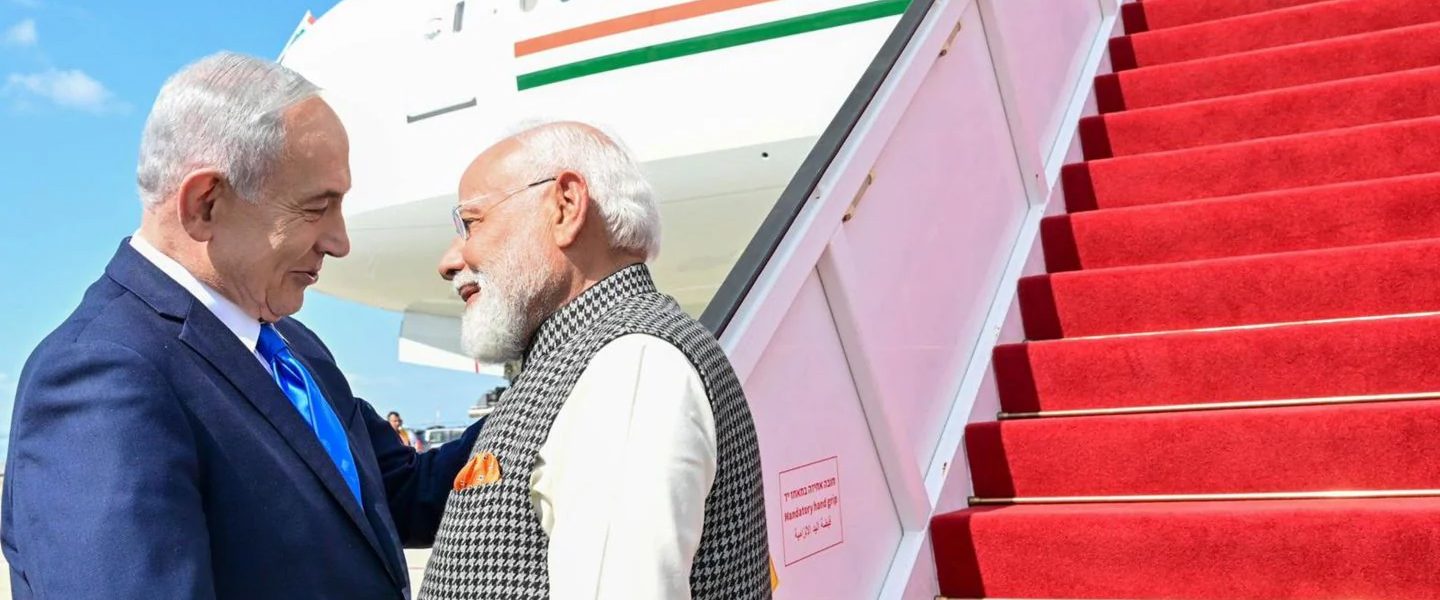
Upon arrival at Ben Gurion International Airport, Modi received full state honours and was greeted personally by Prime Minister Benjamin Netanyahu — a ceremonial gesture typically reserved for Israel’s closest partners.
During his address to the Knesset, Modi declared:
“No cause can justify the murder of civilians. Terror anywhere threatens peace everywhere, and countering it requires sustained and coordinated global action.”
The speech concluded with the Hebrew affirmation “Am Israel Chai.”
Israeli media outlets including The Jerusalem Post and Haaretz interpreted the visit as confirmation that India had emerged as one of Israel’s most important partners beyond the Middle East.
Former Israeli ambassador Michael Oren has argued that India occupies a central position in Israel’s long-term diplomatic outlook as global economic networks increasingly link the Indo-Pacific with the Mediterranean region.
Conclusion
The transformation of India–Israel relations represents one of the most significant developments in contemporary international diplomacy.
What began as discreet cooperation during the Cold War has evolved into a multidimensional partnership encompassing defence technology, economic connectivity, agricultural innovation, and cultural exchange.
Through initiatives such as IMEC, I2U2, expanded agricultural centres of excellence, cyber cooperation, digital payments integration, labour mobility arrangements, and accelerated negotiations toward a bilateral free trade agreement, the two countries are contributing to a resilient network linking South Asia, West Asia, and Europe.
In an era marked by geopolitical uncertainty and accelerating technological change, the partnership symbolised by the Star and the Chakra may emerge as a defining axis of the evolving multipolar order — an enduring pillar of the Indo-Mediterranean strategic order.
Views: 573

Dr. Maheep
Dr. Maheep is Director, Indian Perspective on Global Affairs (IPGA), and a leading analyst of India’s foreign policy and South Asian geopolitics. He earned his PhD in Arab and Islamic Studies. With more than a decade of teaching and research experience in International Relations and Global Politics, he contributes regularly on issues shaping national and global affairs.