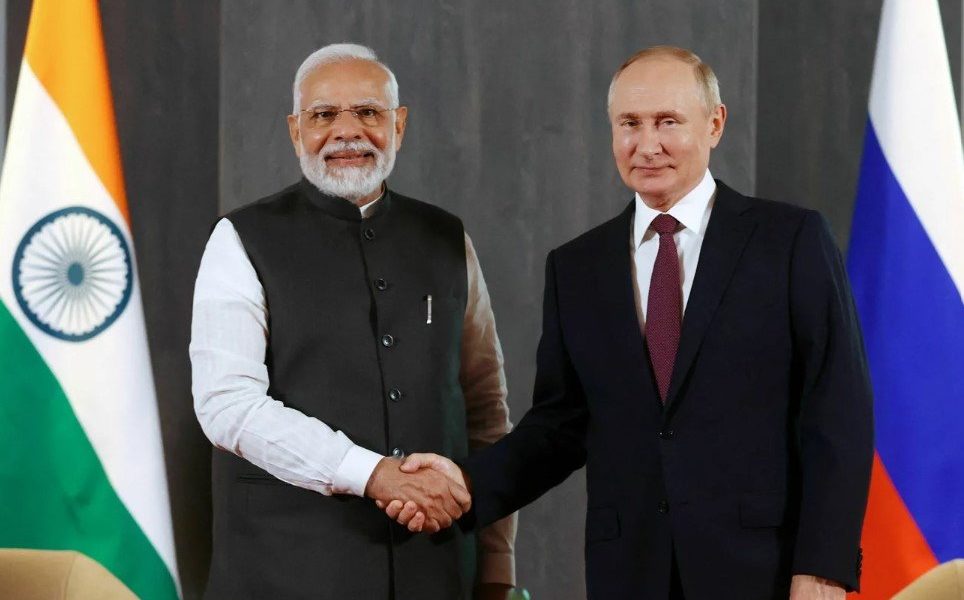







“Indialeaks” reveals that the tiger-bear Indo-Russian alliance was sanctions busting for dual use technology. The US has not commented on what consequences, if any, will this have on India.
India has reportedly been covertly supplying “sensitive” goods to Russia and assisting in building infrastructure to help Russia secure components for its war effort, according to a report by the Financial Times on Wednesday. Leaked Russian state correspondence suggests that these “confidential” plans were devised in October 2022, allowing Russia’s industry and trade ministry—which oversees defense production—to allocate Rs 82 billion (equivalent to $1 billion at the time) for procuring critical electronics through channels hidden from Western governments. Russia views India as an alternative source for crucial goods that were previously imported from countries now considered “unfriendly.” The substantial reserves of rupees held in Russian banks from oil sales to India have been earmarked for purchasing these “sensitive goods.”
The Financial Times also reported that Russia and its Indian partners focused on acquiring dual-use technologies—items with both civilian and military applications—which are subject to Western export controls. The aim was to invest in joint Russo-Indian electronics development and production facilities, according to documents accessed by the publication.
This revelation comes shortly after Prime Minister Narendra Modi’s high-profile visit to Ukraine, marked by “warm hugs” and prayers, raising global speculation about whether this signaled a shift in India’s traditionally close relationship with Russia. The visit was seen as a positive development by Western observers, as the Modi government has been making deliberate efforts to align more closely with the U.S.
New Delhi’s longstanding relationship with Moscow has long been a point of tension for the United States, and the war in Ukraine has only heightened these concerns in Washington. In July, U.S. Deputy Treasury Secretary Wally Adeyemo warned Indian banks against doing business with Russia’s military-industrial base, cautioning that they could risk losing access to the U.S. financial system. Despite these warnings, it appears India continued such transactions. “We know that the Russian military relies on importing sensitive goods, like machine tools and microelectronics, and it looks to foreign financial institutions to facilitate these transactions,” Adeyemo wrote in a letter to the Indian Banks’ Association.
The pressing question now is whether India will face repercussions for its actions, and if so, how severe they might be.
EU countries also accused of ignoring sanctions on Russia
In July a Politico report described how European Union member states are continuing to turn a blind eye to widespread sanctions evasion by Russia and Belarus, making it increasingly difficult for frontline nations to enforce these measures, Latvian Foreign Minister Baiba Braže told POLITICO.
“There’s a significant problem with how EU countries are implementing sanctions and exporting goods to Russia and Belarus,” Braže stated in an interview following her two-day visit to the Latgale region, which borders Russia and Belarus. While sanctions are agreed upon at the European level, their enforcement is a national responsibility, involving around 160 different agencies. EU nations bordering Russia must manage massive trade flows from larger economies like Germany.
Latvia is one of the few EU countries to have streamlined its enforcement by creating a one-stop sanctions shop, with its financial intelligence unit taking the lead since April. However, the small Baltic state lacks the personnel and resources to monitor trade flows across the entire bloc. A push by Brussels earlier this year to centralize EU sanctions enforcement failed to gain traction.
Braže, who voiced her concerns during Monday’s meeting of EU foreign ministers, did not single out any specific country and acknowledged that some may be acting in good faith. Nevertheless, she noted that some goods crossing the border, ostensibly for civilian use, could ultimately end up on the battlefield.
In sparsely populated Latgale, Braže observed “a deliberate effort to conceal certain items or mislabel banned goods as something else, such as cars or trucks declared as spare parts—when in fact, they are almost complete vehicles, with only a few doors removed.”
Other goods are improperly declared, shipped under incorrect customs codes, or sent to recipients whose legitimacy hasn’t been thoroughly vetted.
A particular concern is dual-use items, which have both civilian and military applications. Braže, a former NATO assistant secretary general, cited examples like trucks and tractors that could serve military purposes, as well as technology that could be used in Russian military satellites.
Research from the Kyiv School of Economics has revealed that much of the battlefield technology still reaching Russia originates from Western sources.
Some shipments destined for Russia take indirect routes through Turkey, the UAE, or China. Others enter Russia falsely labeled as being bound for countries like Kazakhstan, while some goods are simply concealed or misclassified as they leave the EU.
Due to their proximity to Germany, the responsibility for monitoring cross-border traffic primarily falls on the Baltic states, especially Latvia and Lithuania. Braže pointed out that Estonia now has only one operational border post, while Finland has closed all roads into Russia, leaving only a rail link open.
At the border, Braže witnessed an 18-kilometer line of trucks waiting to cross. “In one lorry, there were 120 different cargoes, meaning 120 declarations had to be checked. It took two weeks for the customs officer,” she told POLITICO.
Braže appealed to other EU countries to help alleviate the burden of enforcing sanctions, emphasizing that it is “the duty of all EU member states to ensure that sanctions are implemented correctly and that their exporters comply with the rules.”
“Otherwise,” she warned, “the pressure falls on our border guards and customs officers to manage all these consequences.”
Views: 28