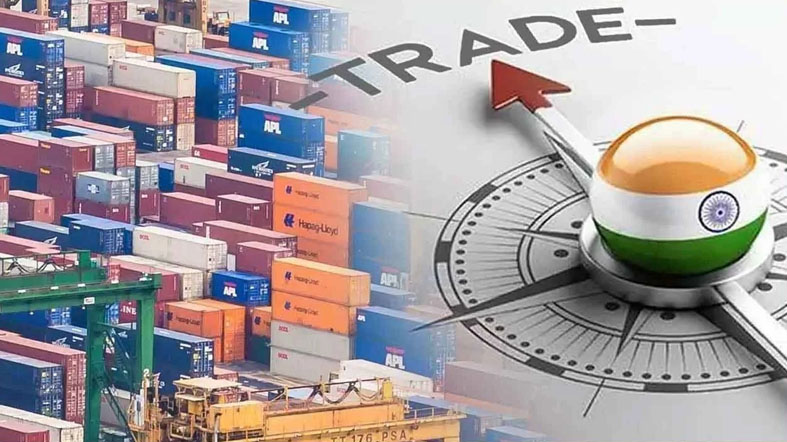







Despite global headwinds, India continues to deliver and set new historic highs every year. India’s exports increased from about USD 500 billion in 2020-21 to USD 863 billion in 2025-26, and are expected to reach USD 1 trillion in 2026-27.
India’s exports are following a resilient post-Covid trajectory, reaching USD 39 billion in April–August 2026-27, driven by robust growth in merchandise and services. Diversification into new markets, surging electronics and engineering exports, and expanding services are strengthening India’s global trade footprint, resilience and competitiveness, bringing the USD 1 trillion ambition closer.
India’s Export Gung-Ho Moment
As global trade navigates geopolitical tensions, fragmented supply chains, tariff uncertainties, and uneven economic growth, India is witnessing a strong surge in its export performance. April–August 2026-27 exports point to a structural strengthening of India’s external-sector engine. India’s combined merchandise and services exports surged to USD 399 billion, compared with USD 345 billion in the corresponding period of the previous year, a remarkable increase of more than 15%.
Merchandise exports alone rose 17.8% to USD 216 billion, while services exports rose 13% to USD 183 billion. This performance signals that India is expanding merchandise exports, accelerating growth in services exports, entering new markets, and increasing its presence in technology-intensive and manufactured products. In other words, India’s export story is increasingly one of scale, diversification and resilience.
The Export Engine Accelerates
Crossing the US$399 billion mark in just five months lends considerable weight to India’s ambition to reach the USD 1 trillion milestone for total exports this year. The current performance shows that India has established a much stronger starting point for that ambition. Particularly encouraging is the performance of non-petroleum exports, which reached USD 181 billion, up 14%. Excluding petroleum and gems and jewellery, exports still expanded by 15% to USD 169billion. This suggests the current export momentum is not driven by a narrow set of commodities. India’s underlying export base is becoming broader, more manufacturing-oriented and increasingly capable of responding to opportunities across global markets.
The USD 1 Trillion Ambition: From Target to Trajectory
The USD 1 trillion export aspiration is increasingly shifting from a policy headline to a measurable trajectory. The April–August performance provides evidence of that emerging capacity. The combination of 17.8% merchandise-export growth and 13% services-export growth shows that two complementary engines are supporting India’s export expansion. If merchandise exporters continue to gain market share while services remain resilient, the country could substantially deepen its participation in global trade.
New Markets, New Momentum
Perhaps the most consequential feature of the April–August exports is the growing geographical diversification of India’s exports. The country’s exporters are demonstrating that growth opportunities are no longer confined to a handful of traditional destinations. During the period, exports to Singapore surged by 96%, Malaysia by 74%, China by 39%, and Tanzania recorded an extraordinary 129% growth, while exports to the United States also rose by 6%.
This expansion across geographically and economically diverse markets strengthens the resilience of India’s export architecture. It also reflects Indian businesses’ growing ability to identify demand pockets, build commercial relationships, and compete across diverse regulatory and market environments. A diversified export geography gives Indian exporters a wider opportunity set and can reduce excessive dependence on any single market.
The New Geography of Indian Exports
The extraordinary growth in Singapore and Tanzania, alongside strong expansion in Malaysia and China, demonstrates the breadth of India’s market reach. Southeast Asia is becoming increasingly important as global companies diversify production and supply chains across Asia, while African markets offer substantial long-term opportunities driven by urbanisation, infrastructure development, consumption growth, and industrialisation.
China’s sharp rise in imports from India also highlights Indian exporters’ ability to penetrate one of the world’s most competitive markets. These developments point to a wider transformation: India is gradually building an export map spanning ASEAN, Africa, East Asia, Europe, and North America, giving its exporters a more diversified global customer base.
India Moves Up the Manufacturing Ladder
The most striking product-level signal comes from electronics. Electronic-goods exports rose from USD 2.9 billion in August 2025 to USD 5.5 billion in August 2026, an extraordinary 89.8% increase. This is far more significant than a single product-category growth statistic. Electronics matter because they sit at the heart of modern manufacturing and global value chains. Their rapid export expansion indicates that India is increasingly participating in technology-intensive production and in international manufacturing networks.
The opportunity now extends beyond increasing volumes: the next frontier is deeper domestic value addition through components, design, research, engineering and advanced manufacturing. A sustained rise in electronics exports could therefore become a defining feature of India’s transition towards a more technology-driven export economy.
Engineering Exports: From Factory Floor to Global Supply Chains
Engineering goods are another powerful pillar of India’s emerging export strength. Engineering exports rose from USD 9.8 billion in August 2025 to USD 12.3 billion in August 2026, a 24.8% increase. Engineering exports matter because they connect to the broader manufacturing ecosystem. Engineering products embody industrial capabilities, ranging from machinery and equipment to transport-related products and manufactured components.
Strong growth in this category therefore has implications well beyond export earnings: it reflects India’s growing integration with global production networks and the capacity of Indian manufacturers to serve sophisticated international markets. The combination of rapidly growing electronics and engineering exports suggests that India’s manufacturing export story is becoming broader, deeper and more technology-intensive.
Exports Beyond Traditional Strengths
India’s export momentum is not confined to electronics and engineering. Petroleum products, organic and inorganic chemicals, textiles, processed foods, marine products, handicrafts and other product groups are also contributing to the expansion. Petroleum-product exports recorded 63% growth in August, while organic and inorganic chemicals rose 16%. Cotton yarn, fabrics, made-ups and handloom products increased by 14%, while man-made yarn, fabrics and made-ups grew by 9.9%.
A wider product spread matters because a resilient export economy cannot rely on a handful of sectors. India’s traditional strengths in textiles, chemicals, processed agricultural products and marine products are now being complemented by newer strengths in electronics and advanced manufacturing. This combination gives India a more balanced and potentially more resilient export basket.
India’s Silent Export Superpower
During April–August 2026-27, services exports reached USD 183 billion, up from USD 162 billion a year earlier. More importantly, India’s services trade recorded an estimated USD 86.7 billion surplus over the period. This provides an important counterweight to the merchandise trade deficit and reinforces India’s distinctive position in the global economy.
India’s strength in information technology, business and professional services, and digitally delivered activities enables the country to earn foreign exchange from global demand for knowledge, skills and technology. The combination of a rapidly expanding manufacturing base and a globally competitive services sector gives India an unusual dual advantage in international trade.
Diversification Is the New Strength of India’s Export Story
India is diversifying geographically through stronger exports to new and emerging markets; diversifying its product basket through electronics, engineering, chemicals, and other manufactured products; and diversifying its export earnings through the continuing strength of services. This matters enormously in an uncertain global economy. When demand weakens in one market or product category, a diversified export structure creates opportunities elsewhere. India’s growing export footprint across different regions and sectors is therefore gradually creating a more resilient external-sector architecture.
From Exporting Products to Building Global Competitiveness
Sustained export growth is supported by improved logistics, reliable infrastructure, quality standards, technology adoption, skilled labour, competitive financing, and deeper integration into global value chains. The objective should not simply be to export more goods, but to capture a larger share of the value created within global production networks. Electronics provide a clear example: moving from assembly towards components, design and innovation would multiply the economic impact of rising exports. Similarly, engineering exports can create wider domestic industrial linkages if Indian firms progressively move into higher-value products and technologies.
The Road Ahead: India’s Export Moment Has Arrived
The April–August 2026-27 export performance offers a powerful snapshot of an Indian export economy that is growing, more diversified and more globally connected. USD 399 billion in combined exports over five months, 17.8% merchandise-export growth, a strong services performance, rapidly expanding electronics and engineering exports, and exceptional growth in several emerging markets together paint a strong picture of growth in the coming period.
Views: 20