









The disappearance of Baloch student leader Jiand Baloch from his Quetta home in the early hours of July 24, 2026, followed a familiar script: a raid, a family left without answers and a man taken away without an explanation. Eleven days later, on August 3, he returned home.
For Jiand, however, this was not an isolated episode. It was the third time he had disappeared.
His first disappearance came in November 2018, when he was taken along with his father and younger brother and remained missing for nine months.
In July 2024, he disappeared again for about a month while campaigning around the Baloch Raaji Muchi, or Baloch National Gathering.
His latest disappearance lasted 11 days.
Amnesty International says he was targeted because of his peaceful activism and his prominent role as chairperson of the Baloch Students Organisation.
The repetition is significant. A person can disappear once amid a security operation or an unresolved investigation. When the same activist disappears repeatedly, each time in the context of his public work, the episode becomes part of a wider question about the use of state power, due process and accountability in Pakistan.
Jiand’s case has once again placed Pakistan’s long-running enforced-disappearance crisis under scrutiny. It also illustrates why the issue remains unresolved despite the existence of a state commission, judicial interventions and years of international pressure.
A midnight raid and unanswered questions
According to Amnesty International, around midnight on July 24, men identifying themselves as law enforcement personnel, accompanied by men in plain clothes, arrived at Jiand’s home in Quetta.
He was not initially there. His parents, wife and two young children were present.
His wife told Amnesty that the men entered the house, searched it and caused damage. The family alleged that Jiand’s father was physically assaulted and that threats were made against his wife and mother.
When Jiand returned, he was taken from the gate. No reason was given to the family, and no information was provided about where he was being taken. Police reportedly refused to register a first information report concerning his disappearance.
Amnesty later confirmed that Jiand had been released and returned home on August 3 after 11 days in unexplained detention. The organisation described the incident as his third enforced disappearance.
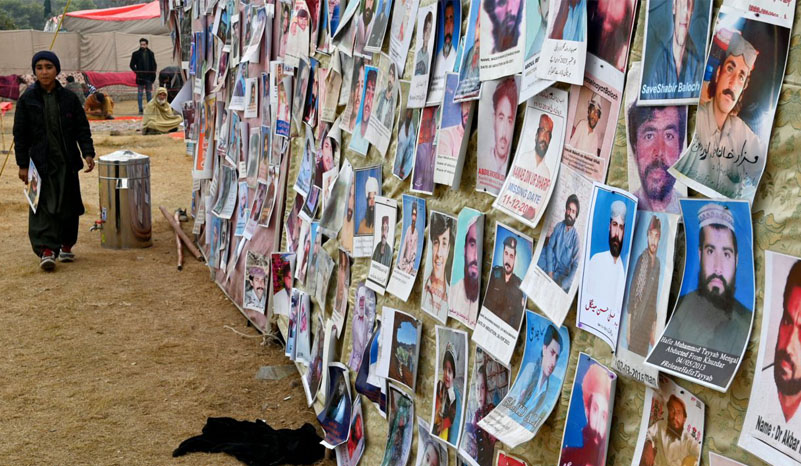
His repeated targeting has particular significance because Jiand has worked with families of missing Baloch people and campaigned on the issue of enforced disappearances itself.
The Fourth Schedule of Pakistan’s Anti-Terrorism Act had also been used against him, placing restrictions on his movement and public activities. Amnesty reported that his identity card and bank account had been blocked and that he was required to report regularly to the Counter-Terrorism Department.
The pattern extends far beyond one activist
Jiand’s experience sits within a much broader pattern documented by Pakistani and international rights organisations.
The Human Rights Commission of Pakistan, in its 2025 annual report released in May 2026, said enforced disappearances had persisted and remained unresolved.
It recorded disappearances involving government officials, students and rights activists and noted that the issue continued to affect freedom of movement and public life in Balochistan.
The HRCP has also described a continuing pattern of enforced disappearances, shrinking civic space and impunity in Balochistan.
Following a fact-finding mission in 2025, it said state representatives had acknowledged the existence of enforced disappearances but frequently framed them through the prism of insurgency.
The commission warned that such a framing risked normalising a practice that, under international human rights law, is regarded as a serious violation.
The scale of allegations remains disputed.
In July 2025, Pakistan’s Commission of Inquiry on Enforced Disappearances said 36 cases had been recorded in Balochistan during the first six months of that year. The Baloch Yakjehti Committee, however, claimed the number was 750.
Such sharply conflicting figures are themselves revealing. The dispute over numbers reflects a deeper problem: there is no universally accepted public account of the people who have disappeared, where they were last seen, which institutions were responsible for their detention and how many cases have actually been resolved.
The numbers have remained contested for years
The UN Working Group on Enforced or Involuntary Disappearances reported that Pakistan’s Ministry of Interior and its Commission of Inquiry had officially registered 8,701 cases of alleged enforced disappearance from 2011 to 2023.
The Working Group also raised concerns about the publication of names and the potential security risks faced by relatives and people reporting disappearances.
The official figures, however, have consistently been challenged by rights groups and families of missing persons, who argue that many cases never enter formal state records.
That distinction matters because an unregistered disappearance can effectively become an invisible disappearance.
For families, the consequences extend beyond the missing person’s absence. They may spend years approaching police stations, courts, government offices and commissions without knowing whether the person is alive, detained, charged or dead.
Women and children of disappeared persons can face financial insecurity, social pressure and prolonged psychological distress.
Pakistan’s own National Commission for Human Rights has previously described enforced disappearance as a violation affecting not only the person taken but also their families, particularly women and children who receive no information about the whereabouts of their relatives.
Commission exists, but disappearances continue
Pakistan established the Commission of Inquiry on Enforced Disappearances in 2011 after years of judicial pressure. Its stated mandate includes tracing missing persons, determining their whereabouts and fixing responsibility where appropriate.
The National Commission for Human Rights lists a dedicated disappearance report among its current publications and has separately documented the long history of the issue.
Yet the persistence of disappearances raises questions about the effectiveness of an institution whose existence has now extended for more than a decade.
The UN human rights system has repeatedly raised similar concerns. In a communication concerning Pakistan, UN experts said the Commission of Inquiry had not proved effective in preventing, ending or remedying enforced disappearances.
They highlighted concerns about the lack of prompt investigations, inadequate efforts to establish the fate and whereabouts of missing people and insufficient access to effective remedies and reparations.
The UN experts also noted that Pakistan had not yet criminalised enforced disappearance as a specific offence and had not ratified the International Convention for the Protection of All Persons from Enforced Disappearance.
Counter-terrorism laws add another layer
The security situation in Balochistan cannot be separated from the issue.
The province has faced a long-running insurgency, militant attacks and violence targeting civilians and security personnel.
Pakistan’s authorities have consistently presented counter-terrorism operations as necessary to protect national security and combat armed groups.
But the application of counter-terrorism powers has generated a separate human rights debate.
In a February 2025 communication, UN experts cited allegations of arbitrary arrests, mistreatment in detention, enforced disappearances and extrajudicial killings in Balochistan.
They also raised concerns over restrictions imposed on activists, alleged censorship and the use of counter-terrorism measures against people exercising freedom of expression and peaceful assembly.
The UN experts subsequently raised concerns about amendments to Pakistan’s Anti-Terrorism Act and related provincial laws that could permit preventive detention for up to 90 days on broad grounds of suspected involvement in terrorism.
They warned that such provisions could increase the risk of arbitrary detention, enforced disappearance and torture, particularly in cases involving political dissenters, human rights defenders, journalists, students and members of minority groups.
The legal distinction between preventive detention and enforced disappearance remains important. A person held under a formally recognised detention order remains within a legal framework, however controversial that detention may be.
Enforced disappearance involves the deprivation of liberty followed by a refusal to acknowledge the detention or concealment of the person’s fate or whereabouts.
When families cannot establish where a relative is being held or under whose authority, the basic safeguards of law become difficult to exercise.
Baloch students and activists remain particularly vulnerable
The targeting of students has become a recurring feature of reports from Balochistan.
A February 2026 report by Baloch human rights organisation PAANK documented 109 alleged enforced disappearances during the month. It said 41 of those individuals were subsequently released, while others remained unaccounted for.
The organisation reported that house raids accounted for a substantial proportion of the cases. These figures are allegations by the organisation and are not equivalent to independently verified government statistics.
The Human Rights Council of Balochistan, another rights-monitoring organisation, reported 95 alleged enforced disappearances in May 2026, including eight teenagers, and said students represented the largest group of victims.
Again, these figures represent the organisation’s documentation rather than an official state tally.
For activists, the consequences can extend beyond detention itself.
Travel restrictions, placement on surveillance lists, blocked identity documents and restrictions on financial activity can limit the ability of individuals to organise, travel, study, work or participate in public life.
Jiand Baloch’s case illustrates that process. His earlier inclusion on the Fourth Schedule subjected him to restrictions before his latest disappearance. His activism had already brought him into repeated conflict with security authorities.
Families seeking answers face another battle
The disappearance of a person does not end with the detention.
Families often become campaigners themselves. They organise demonstrations, approach courts and contact human rights organisations. In Balochistan, families of missing people have repeatedly staged protests and blocked roads in attempts to draw attention to their cases.
HRCP’s 2025 report noted that disappearances continued to disrupt freedom of movement in Balochistan because families of missing people frequently blocked major highways in protest.
This creates a cycle in which the state’s failure to provide information becomes a source of further public unrest, while demonstrations demanding information can themselves become subject to restrictions or security measures.
UN experts have also documented allegations of excessive force against peaceful protesters seeking information about disappeared people and calling for accountability.
The result is an expanding human rights issue in which the original disappearance is followed by pressure on those demanding answers.
Accountability remains the central unresolved question
Pakistan’s authorities have repeatedly disputed allegations that state institutions systematically engage in enforced disappearances and have pointed to the work of the Commission of Inquiry and formal legal processes.
The government has also previously told UN bodies that missing-person cases are investigated through joint investigation teams involving provincial authorities and that cases can lead to FIR registration and further proceedings.
But international scrutiny has continued.
The UN has called for enforced disappearance to be criminalised, for allegations to be investigated promptly and thoroughly, for perpetrators to be prosecuted and for families and witnesses to receive protection. It has also stressed the need for effective remedies and reparation.
The continued absence of a specific criminal offence for enforced disappearance remains a major point of concern for international human rights mechanisms.
More than fifteen years after the creation of the Commission of Inquiry, the central question remains unchanged: who is responsible when a person disappears after being taken into custody or during an operation, and what legal mechanism can compel an answer?
Jiand Baloch returned, but the larger crisis remains
Jiand Baloch’s return home on August 3 ended the immediate uncertainty surrounding his whereabouts. It did not explain why he was taken, who authorised his detention or why his family was allegedly left without information for 11 days.
His case is particularly stark because it happened to a person who had previously disappeared twice.
The episode does more than add another name to a long list of missing persons. It demonstrates how disappearance can become cyclical, particularly for activists operating in an environment where security concerns increasingly intersect with political expression, student organising and demands for information about missing people.
Pakistan’s struggle with enforced disappearances is consequently not only a question of missing persons. It is a test of whether security institutions remain answerable to law, whether courts can compel transparency and whether families can obtain the truth about what happened to their relatives.
The country has commissions, courts, laws and security agencies. It also has a long record of unresolved cases and conflicting accounts.
Views: 23


