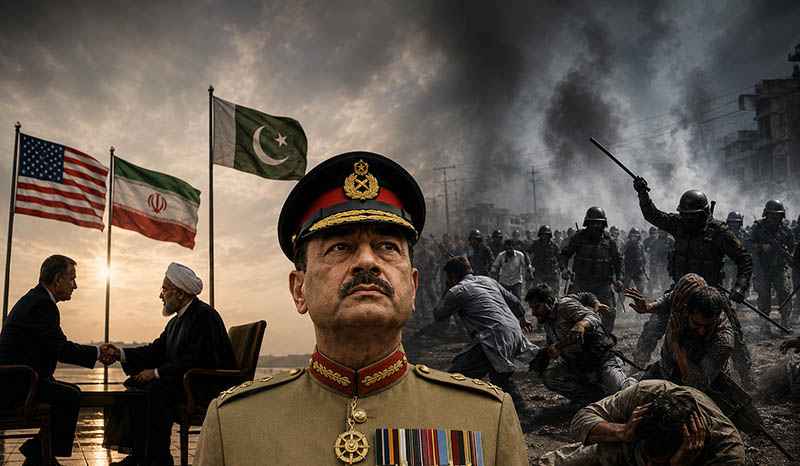







Pakistan presents itself as an advocate of dialogue and peace on the global stage, while its actions at home are increasingly defined by violence. Field Marshal Syed Asim Munir has built his standing abroad on mediation between the United States and Iran. The same period at home has produced proscription orders, communications blackouts and violent targeting of civilians. Batons and bullets may clear a street, but they cannot extinguish public grievances in Pakistan. There are horrifying reports of the use of brute force against protesters in Pakistan Occupied Jammu and Kashmir (PoJK), eerily similar to violence and live bullet firing by security forces against Pakistan Tehreek-e-Insaf (PTI) protests in November 2024. This hypocrisy of being a peacemaker outside and brazen dictatorship at home won’t last long for the military establishment.
The sequence in PoJK is well documented, and the mass civilian uprising reflects long-held anger and frustration against Islamabad’s misrule. On 5 June 2026, the regional home department designated the Jammu and Kashmir Joint Awami Action Committee (JAAC) a proscribed organization under the first schedule of the ‘Azad Jammu and Kashmir Anti-Terrorism Act, 2014’. The order arrived within hours of the Pakistani election commission announcing 27 July as the polling date. Mobile internet services were suspended the same night and have not been restored since. Amnesty International recorded that at least 40 people had been killed in the run-up to the vote, the majority local residents. The JAAC now places the toll between 5 June and 28 July at 67 dead, while its senior leader Sardar Umar Nazir Kashmiri has claimed more than 80 deaths since 5 June. On polling day, the committee reported 19 people killed by Pakistani security forces in Rawalakot. More importantly, the state-imposed blackout in PoJK makes independent verification impossible, which is precisely its purpose.
The JAAC is a coalition of traders, transporters, lawyers and students seeking the abolition of 12 assembly seats reserved for refugees living outside the territory, along with cheaper electricity and subsidised wheat. The United Nations High Commissioner for Human Rights, Volker Turk, described the movement in those terms on 17 July and called for prompt and impartial investigations into every death among protesters. His office found that criminalising a civil society organisation like JAAC raised serious concerns about freedom of expression, peaceful assembly and association, and urged Islamabad to restore full internet access and open meaningful political dialogue. Isabelle Lassee, Amnesty International’s deputy regional director for South Asia, called the proscription disproportionate, unlawful and a violation of the right to freedom of association.
Pakistan’s hypocrisy got exposed when its leaders were running around to bring peace between Washington and Tehran, whereas it refused to engage with its own people and chose violence. Defence Minister Khawaja Asif told a television channel that he put “the protesters in the same category as India” and ruled out negotiation on the grounds that they were enemies of the state. He said this after roughly 20 deaths in the first phase of fake polling in PoJK on 27 July. The contrast with the external record is impossible to miss. Munir flew to Tehran at the most dangerous point of the crisis, presided over 21 hours of American and Iranian talks in April, and hosted a 14-point Islamabad memorandum in June 2026. President Donald Trump publicly praised his efforts to pull the two sides back from the brink. The military institution selling restraint abroad authorised live fire at home in the same quarter.
PoJK is the newest front opened by the “hard state” doctrine that Munir has promoted since 2024. It has led to a massive increase in state-authorized violence in Balochistan, Khyber Pakhtunkhwa, and now PoJK. The Human Rights Council of Balochistan recorded 234 disappearances and 87 killings in the same month, followed by 65 disappearances and 50 killings in March. Pakistan’s own Commission of Inquiry on Enforced Disappearances registered 125 new cases in the first half of 2025, and Amnesty notes many cases are never reported to it. In Khyber Pakhtunkhwa, protesters outside a Frontier Corps headquarters in Tirah were fired upon in July 2025, leaving between five and seven dead.
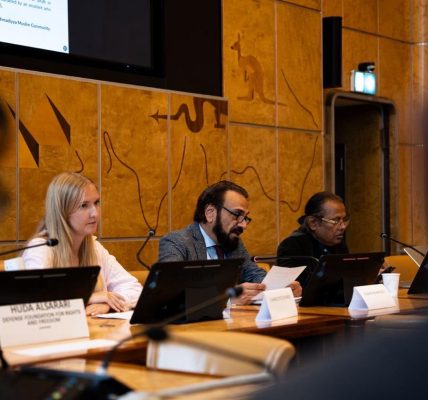
The cost of Munir’s violent doctrine is now being noted outside Pakistan as well. The European Commission’s July 2026 monitoring report raised grave concerns over Pakistan’s human rights obligations, flagged the growth of enforced disappearances in Khyber Pakhtunkhwa and Balochistan, and warned that recent amendments to anti-terrorism legislation appear to authorise arbitrary detention without charge, trial or meaningful judicial review. Pakistan’s GSP+ trade preferences with the European Union rest on that assessment. Diaspora leaders have also been raising human rights concerns in Pakistan. Sardar Shaukat Ali Kashmiri of the United Kashmir People’s National Party briefed organisations on the sidelines of the Human Rights Council in June, alleging nearly 50 deaths, hundreds injured in PoJK, and bodies withheld from families in some cases. Kashmiri groups in the UK have also protested outside the Pakistani embassy in London and Consulates, internationalising atrocities by the military-backed government in Islamabad.
Every province and occupied territory other than Punjab is now in some form of civil confrontation with the federal government and the military establishment in Pakistan. Second, the sham elections in PoJK mean nothing to the local residents, but a reminder of brutality by the occupying forces. A vote conducted under a total communications blackout, with PoJK’s largest civic movement, JAAC, banned under anti-terrorism law, does not manufacture any legitimacy. What Munir’s recent diplomatic efforts have actually purchased is protection for himself from international scrutiny. Additionally, the 27th Constitutional Amendment created the post of chief of defence forces, placed him above the naval and air chiefs, granted lifetime immunity from prosecution, and opened legal space for him to hold office until 2035. Mediation abroad supplies the reputational cover that coercion at home requires for Munir. Pakistan presents itself abroad as a bridge between adversaries, while designating traders and lawyers as “terrorists” and firing on peaceful civilians in PoJK is not running two policies. It is running one policy for two audiences. The domestic audience does not matter in Pakistan, and it will continue to face violence from the military establishment for raising their voice and questioning the rigged system.
Views: 35