


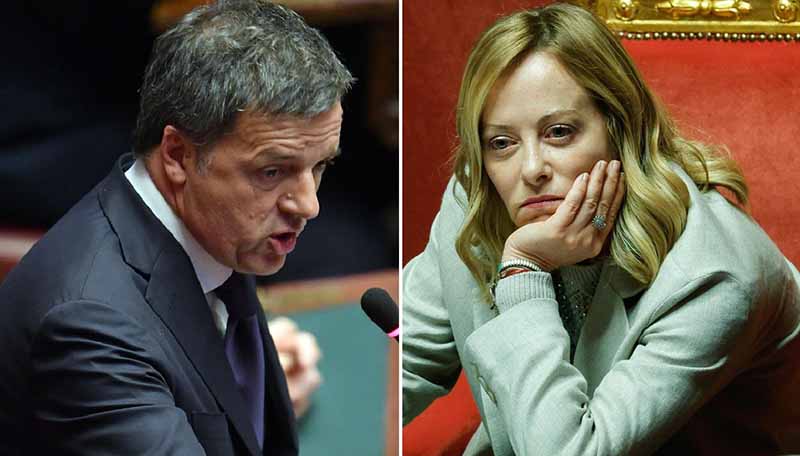







ROME: Giorgia Meloni returned to the Senate for premier question time with a familiar ambition, to show command. For an hour and a half, the prime minister answered questions on the economy, wages, energy, the Piano Casa, the PNRR, taxes and the wider geopolitical turbulence now weighing on Italian growth. But the political centre of gravity was not the technical substance of her answers. It was the exchange with Matteo Renzi, a duel that exposed the deeper question now hanging over the last stretch of the legislature. Is Meloni still the insurgent leader who reshaped Italian politics, or has she become the incumbent she once mocked?
The session at Palazzo Madama came almost a year after Meloni’s last premier time. The agenda was largely economic and social, with questions on inflation, purchasing power, industrial weakness, housing and energy. Meloni warned that international tensions would affect growth, energy costs, business competitiveness and household purchasing power, while presenting her government’s priorities as salaries, hiring incentives, investment, families and birth rates. She also announced that the legal framework for the return of nuclear energy would move forward by the summer. (Sky TG24)
The prime minister tried to occupy two positions at once. On the one hand, she presented herself as the responsible head of government in a dangerous international environment. On the other, she remained combative, blaming the Superbonus for the public finance burden and insisting that her government would continue cutting taxes until the end of its mandate. The line was clear. Italy is under pressure, but the fault, in Meloni’s telling, lies with the inheritance of previous governments and with external shocks, not with the choices of her executive. (Sky TG24)
Then Renzi entered, and the register changed.
The leader of Italia Viva did not ask a narrow technical question. He made a political intervention designed to wound. Meloni, he said, now looked like a “copia sbiadita” of the leader who began the legislature. He accused her of having been “seduced and abandoned by Trump,” of facing the Strait of Hormuz crisis with proposals on electoral law, and of surrounding herself with people “not up to the geopolitical challenge.” His sharpest line was aimed at the government’s personnel. “If there is someone like Giuli in government, it is your fault,” he said. “If instead of a government it looks like the Addams Family, it is not my fault, you chose them.” (la Repubblica)
It was classic Renzi, theatrical, personal, acidic and aimed less at winning a procedural exchange than at creating a political image. The phrase “Famiglia Addams” did the work of an entire opposition campaign. It compressed several months of criticism into a single insult, suggesting that Meloni’s government is no longer the disciplined nationalist machine of its first phase, but a strange household of loyalists, weak ministers and political oddities.
The choice of target was not accidental. Renzi was attacking the myth of Meloni’s strength. Her premiership has rested on three pillars, personal authority, coalition stability and international recognition. Renzi tried to strike all three. By calling her a faded copy, he suggested personal decline. By mocking her ministers, he questioned her control of the team. By invoking Trump, Hormuz and geopolitics, he implied that her much-advertised international stature has not translated into strategic effectiveness.
Meloni’s answer was to refuse the role of wounded incumbent. She returned to the figures and the government programme. On the PNRR, she said Italy had received 153 billion euros and that the ninth instalment would be paid in the coming weeks. She said certified spending had reached 117 billion euros by 31 March, around 76 percent, plus 24 billion in financial instruments. She also listed measures for the final phase of the legislature, including the extension of the single ZES model, at least in its simplification aspects, to the whole country, and stronger mechanisms to channel pension fund investments into the real Italian economy. (RaiNews)
This was a revealing contrast. Renzi wanted to pull the debate onto character, weakness and political exhaustion. Meloni wanted to drag it back onto implementation, numbers and legacy. His argument was that the government is no longer equal to the moment. Her answer was that the government is working, spending, simplifying, investing and preparing its final reforms.
But Renzi’s intervention matters because it touched a nervous point. Meloni is approaching the final part of the legislature with unusual stability by Italian standards, but also with the burdens that stability brings. She can no longer campaign only as the outsider fighting the palace. She is the palace. The ministers are hers. The appointments are hers. The delays are hers. The compromises with allies are hers. That is why Renzi’s line landed. It was not simply a joke. It was an attempt to make Meloni responsible for the full human and political texture of her government.
The wider question time showed the same tension. Meloni opened the door, at least rhetorically, to parts of the opposition willing to put national interest ahead of party interest. She praised Carlo Calenda’s willingness to discuss an industrial strategy and said the government’s doors remained open to those ready for a substantive confrontation. But the atmosphere in the chamber suggested that Italy is not entering a season of grand compromise. It is entering a pre-election phase in which every policy issue, from wages to nuclear energy to housing, will be used to test whether Meloni still owns the political initiative. (RaiNews)
Renzi’s role in that landscape is particular. He is no longer the dominant figure he was during his own premiership, but he remains one of the few Italian politicians capable of turning parliamentary debate into political theatre. His attack was not aimed only at Meloni. It was also aimed at re-establishing himself as the opposition voice with the sharpest blade. Where the Democratic Party attacked on wages and living costs, and the Five Star Movement pressed on economic stagnation, Renzi chose ridicule. In Italian politics, ridicule can be more dangerous than accusation.
Meloni, however, did not collapse under the exchange. Her strength remains precisely her ability to turn attack into proof of combat. When challenged, she tends to harden, not retreat. For her supporters, Renzi’s mockery will look like the old establishment sneering at a government that has lasted longer than many expected. For her critics, her defensive references to inherited problems and international shocks will sound like the language of a leader who has discovered the limits of power.
That is why the Meloni Renzi clash was the real headline of the day. It crystallized two versions of the same premiership. In Meloni’s version, Italy is navigating a dangerous world with a government that has restored stability, moved the PNRR forward, reduced taxes and is preparing long-term reforms on energy, housing and investment. In Renzi’s version, the prime minister who promised authority has ended up presiding over a government of weak personnel, delayed reforms and shrinking political energy.
Both cannot be entirely true. But both now define the battleground.
The session showed that Meloni is still in control of the government. It also showed that the opposition has found a line of attack that may trouble her more than ideological confrontation. Not that she is too radical, too conservative or too close to the right. Rather, that she has become ordinary. That she is less feared. That the rebel has become an incumbent, and the incumbent can be mocked.
For a leader whose political brand was built on force, authenticity and command, that may be the most dangerous question of all.
Views: 51


