






The Indian Ocean has never been merely a body of water. From the monsoon driven commerce of the Bay of Bengal to the dhow routes of the Arabian Sea, it has functioned, across more than two millennia, as the connective tissue of an oceanic civilisation whose coherence precedes, and persistently outlasts, the administrative boundaries imposed upon it by colonial cartography. It is within this deep temporal horizon that the Ninth Indian Ocean Conference (IOC 2026), convened in Port Louis, Mauritius, from 10 to 12 April 2026 under the magisterial theme “Collective Stewardship for Indian Ocean Governance,” must first be situated, not as a diplomatic event in the conventional sense but as a constitutive moment in which India, through the keynote address and expansive bilateral engagement of External Affairs Minister Dr S. Jaishankar, actively performed and consolidated its identity as the natural, benevolent, and indispensable steward of the world’s most consequential oceanic space.
Constructivist International Relations theory furnishes the most illuminating analytical lens for comprehending this performance. Alexander Wendt’s foundational proposition, that identities precede interests and that both are constituted through sustained social practice, invites us to ask not merely what India did at Port Louis but who India was becoming through it. K.M. Panikkar, whose India and the Indian Ocean (1945) remains the foundational text of Indian maritime strategic thought, had identified the essential geopolitical truth eight decades earlier. India’s peninsular centrality within the oceanic space makes it the natural gravitational centre of any coherent regional order, and its civilisational depth renders it the authoritative interpreter of that order’s shared norms. Hedley Bull’s conception of a managerial great power, a state that assumes custodial responsibility for regional institutional order in exchange for the deference that effective management generates, captures India’s present role with comparable precision. Amitav Acharya’s paradigm of norm localisation illuminates the process by which India reframes global maritime governance principles within an explicitly Global South idiom, asserting normative authority rooted in post colonial solidarity and developmental experience rather than in the prescriptions of Western multilateralism. Taken together, these frameworks confirm that India at Port Louis was engaged in a sophisticated act of norm entrepreneurship, the deliberate construction of a regional order aligned with its own civilisational values, strategic priorities, and identity as the Global South’s leading maritime power.
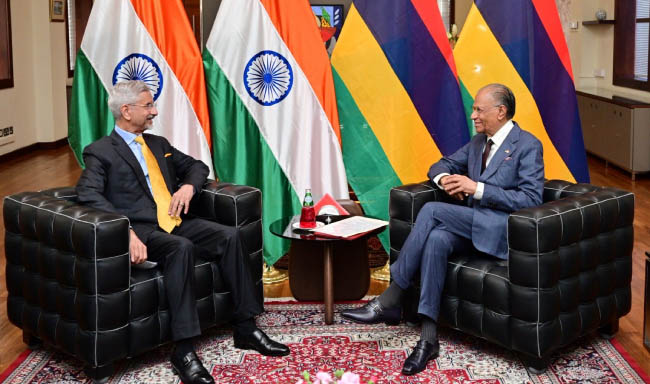
Jaishankar arrived in Port Louis on 9 April to a reception that his counterpart Foreign Minister Dhananjay Ritish Ramful extended with warm ceremony, and his greeting “Bonzour Moris!” published on X encapsulated in miniature the entire logic of Indian maritime diplomacy. Affective civilisational solidarity, institutional strategic partnership, and forward looking developmental ambition were all present simultaneously and inseparably. Within two days, he would chair the inaugural session alongside Prime Minister Navinchandra Ramgoolam and India Foundation President Ram Madhav, deliver a keynote address that set the normative agenda for three days of multilateral deliberation, conduct bilateral meetings with no fewer than seven heads of government and foreign ministers on the conference margins, hand over ninety electric buses, inaugurate a Renal Transplant Unit, launch the iGOT Karmayogi digital governance platform, and announce the imminent conclusion of a government to government oil and gas supply agreement alongside the deployment of a dedicated Defence Attaché. The Ministry of External Affairs framed the entire visit within its three governing doctrinal pillars Neighbourhood First, Vision Mahasagar, and commitment to the Global South.
The conceptual innovation that anchored the IOC 2026 keynote, and that constitutes its most enduring normative contribution, was Jaishankar’s reconceptualisation of the Indian Ocean as a living “ecosystem” rather than a mere geopolitical “framework.” The distinction carries profound ontological weight. Frameworks are regulatory constructs, external to the actors they govern. Ecosystems are constitutive media, the environment within which life is sustained and through which any disruption cascades irreversibly across all interdependent components. “This is not just a framework in which we all exist,” he told the assembled delegates, “but an ecosystem. It is the resources on which we depend, the connectivity on which we thrive and indeed the culture that we have built up over the ages.” The resonance with Panikkar’s civilisational cartography was unmistakable, and the political function equally deliberate. The ecosystem metaphor naturalises India’s stewardship role, for it is self evident that the most capable organism within a shared ecosystem bears distinctive responsibilities for the health and resilience of the whole.
Jaishankar’s five strategic priorities, delivered with intellectual precision and rhetorical expansiveness, together constructed a comprehensive normative vision that was simultaneously diagnostic and prescriptive. His second priority, the imperative to overcome “the artificial barriers of the colonial era” through deeper connectivity, economic linkage, and revival of maritime traditions, performs norm localisation in its most explicit form. Post colonial oceanic integration is framed as recovery of indigenous connectivity, not adoption of externally imposed liberal institutionalism, thereby asserting for India a normative authority rooted in the civilisational geography of the ocean itself. His third priority confronted the structural condition of the contemporary order with candour. The world had become “more competitive, fractured, and inward looking,” and “the benefits of globalisation are today overshadowed by the temptation to weaponise.” The concept of weaponised interdependence, developed in the academic literature by Farrell and Newman and now entering mainstream strategic discourse, identifies economic interconnection deployed as coercive leverage. Jaishankar’s use of the term before a Global South audience carried a clear implication. India offers partnership without conditionality and assistance without strategic lock in, a form of cooperation that strengthens sovereign agency rather than constraining it through dependency.
His fourth priority expanded the chokepoint analysis with conceptual boldness above the conventional register of maritime security rhetoric. Maritime chokepoints such as Hormuz, Bab el Mandeb, and Malacca remained “a great global anxiety,” and the West Asian crisis disrupting commercial navigation through the Red Sea and threatening Hormuz passage gave that concern immediate urgency. Yet Jaishankar insisted upon the equal strategic significance of conceptual chokepoints. In domains such as finance, technology, resources, and knowledge, interdependence had been weaponised with comparable severity. Technology denial, dollar clearing exclusion, and knowledge asymmetry are, in this framework, structurally equivalent to maritime interdiction. India, with its growing digital public infrastructure, pharmaceutical manufacturing capacity, alternative payment architectures, and multilateral knowledge platforms, implicitly offers itself as a partner capable of reducing those vulnerabilities. The fifth priority, calling for “collective resilience” across the “Global South ocean” in the face of food, fuel, and fertiliser shocks, natural disasters, and conflict spillover, was the most inclusive. It constructed a shared political identity for the Indian Ocean’s diverse littoral states, transcending differences and uniting them in a common aspiration for sovereign agency in a fragmenting world order.
The bilateral deliverables agreed with Mauritius during the visit enacted this identity with material substantiation of a high order. The handover of ninety electric buses, described by Jaishankar as “a moving symbol of Green Partnership,” addressed a genuine infrastructure need in a small island economy reliant upon imported fossil fuels while also deepening bilateral interdependence through standards and supply chains. The government to government oil and gas supply agreement, announced against the backdrop of West Asian disruption, demonstrated India’s capacity to provide reliable sovereign energy partnership bypassing volatile markets. Prime Minister Ramgoolam acknowledged the agreement within the broader context of the USD 680 million special economic package that constitutes the financial architecture of the Enhanced Strategic Partnership elevated during Prime Minister Modi’s March 2025 state visit to Mauritius, when Vision Mahasagar was formally launched.
The deployment of a Defence Attaché to the Indian High Commission in Port Louis represents institutional deepening of bilateral strategic ties. Attachés serve as permanent conduits of military cooperation, facilitating joint exercises, intelligence sharing, procurement conversations, and interpersonal networks of trust. Jaishankar’s illustration of the existing hydrography partnership, which generated a royalty payment of USD 45,000 for the Mauritian government from the commercial sale of jointly produced nautical charts, demonstrates the depth of technical collaboration. The inauguration of the Renal Transplant Unit at the Jawaharlal Nehru Hospital combined clinical impact with civilisational symbolism, while the launch of the iGOT Karmayogi platform represents an epistemic partnership with long term institutional consequences. Agreements on higher education, labour mobility, and community development projects across Mauritius, Rodrigues, and Agalega complete a portfolio whose breadth and depth are unprecedented.
The conference margins reinforced India’s web of relationships across the Indian Ocean. Engagements with Seychelles, Nepal, Bhutan, and Bangladesh reflected an expansive conception of oceanic governance that includes hinterland states and shared developmental interests. The meeting with former Prime Minister Pravind Kumar Jugnauth confirmed the bipartisan nature of India Mauritius ties.
The Ninth Indian Ocean Conference must be understood within a turbulent regional context. The West Asian crisis had rendered the Red Sea hazardous, threatened Hormuz, and driven energy and food insecurity across vulnerable states. In this environment, India’s capacity to provide energy security, maritime domain awareness, and knowledge transfer constitutes the material foundation of its normative leadership.
The doctrinal trilogy of Neighbourhood First, SAGAR, and Vision Mahasagar represents a foreign policy architecture uniquely oriented towards collective benefit. Each framework functions both as policy and identity. To espouse SAGAR is to assert that regional security is a common good. To advance Vision Mahasagar is to propose mutual partnership. To practise Neighbourhood First is to perform the claim that India’s national interest is constituted through the wellbeing of its neighbours.
Port Louis 2026, viewed in its full dimensions, confirms Panikkar’s judgement. The Indian Ocean is the arena in which India’s civilisational destiny as a great power is decided. The ninety electric buses, the renal transplant patients, the Mauritian civil servants on iGOT, and the Defence Attaché are not merely deliverables. They are material tokens of an identity in construction and the building blocks of a regional order whose coherence and resilience will define India’s contribution to the governance of the world’s most consequential oceanic commons.
Views: 203