


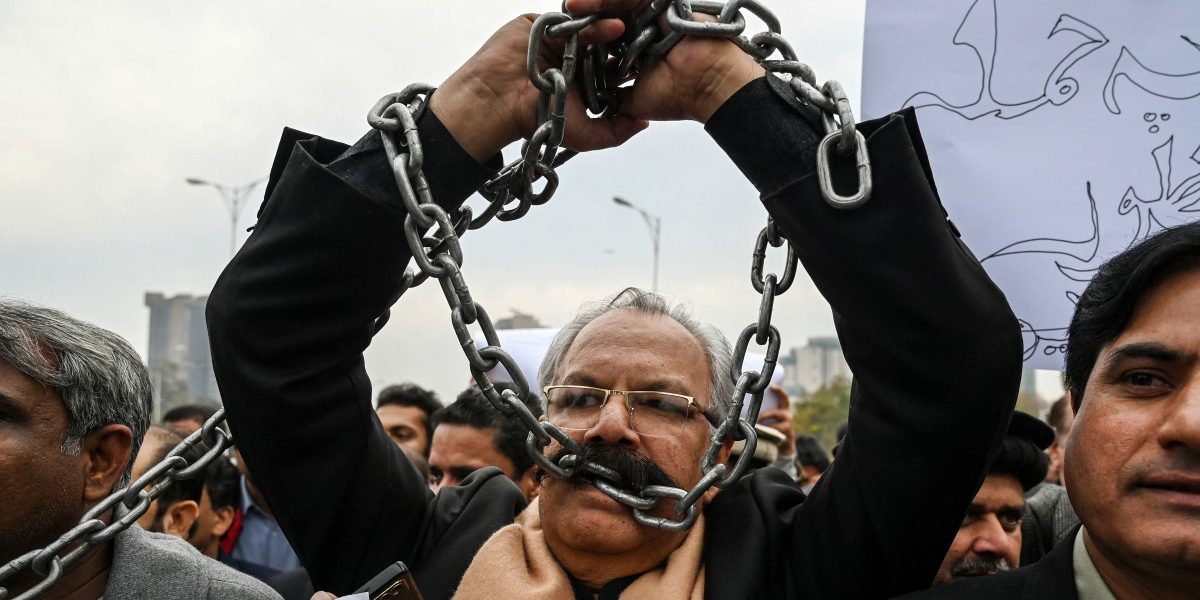







Europe now confronts a moral and strategic dilemma that can no longer be deferred or obscured by diplomatic language, as it continues to engage Pakistan as a partner on security migration and regional stability. Pakistan’s courts now impose life imprisonment on journalists for acts of expression, forcing European capitals to confront the contradiction between their professed commitment to the freedom of the press and continued cooperation with a state that has begun to criminalise dissent through its judiciary.
That contradiction became impossible to ignore in January 2026 when a Pakistani anti terrorism court sentenced several journalists and political commentators to life imprisonment in absentia for their online commentary following the unrest of May 2023, among them Moeed Pirzada, Sabir Shakir, Shaheen Sehbai and Wajahat Saeed Khan, figures accused not only of orchestrating violence but also of articulating narratives critical of state institutions during a period of political upheaval.
The ruling constituted a decisive escalation because it formally recast political analysis and journalistic commentary as terrorism, punishable by a severe sentence short of death, erasing the distinction between expression and violence and signalling that scrutiny of power has become legally indistinguishable from subversion.
For Europe the consequences are immediate and concrete rather than abstract. Several of those convicted reside in European countries or maintain professional and personal ties within the European Union, establishing a precedent under which speech produced outside Pakistan can be retroactively criminalised by its courts, creating a transnational architecture of legal intimidation that shadows journalists even where extradition is implausible.
This judgment must be understood within the broader context of Pakistan’s increasingly coercive media environment, one that no longer relies solely on informal pressure or opaque intimidation but is now reinforced by the explicit authority of law, as broadly framed anti terrorism and cybercrime statutes permit criticism to be reclassified as incitement and dissent to be construed as a threat to national survival.
Pakistan has long ranked among the most hazardous countries in the world for journalists, with a history of killings abductions harassment and enforced silence that has rarely resulted in accountability, but the present phase is more severe because repression has become institutionalised and normalised, embedded within judicial reasoning that treats journalism itself as a destabilising force.
The ramifications extend well beyond domestic media. Foreign journalists operating in Pakistan confront a landscape of deliberate legal ambiguity in which accreditation is discretionary, access to sensitive regions is tightly managed, surveillance is routine and associations are scrutinised, while local fixers producers and translators absorb the greatest risk through interrogation, detention and sustained pressure that systematically erodes the infrastructure of independent reporting.
Predictably the result is a contraction of coverage. Editors increasingly temper language, avoid sustained investigations and retreat to official narratives not just because the underlying realities have diminished but mainly because the professional and ethical costs of pursuing them have become prohibitive, particularly when the safety and freedom of local partners are at stake.
For Europe this narrowing of Pakistan’s information space carries tangible strategic consequences. Pakistan is a nuclear armed state of more than two hundred million people situated at the intersection of South Asian volatility militant networks and regional power competition, and when independent journalism is suppressed the capacity of external actors to accurately assess internal dynamics degrades rapidly.
The moral question Europe faces is therefore inseparable from a practical one. Continued engagement with Pakistan in the absence of a response to the criminalisation of journalism entails acceptance of an information environment shaped by fear and legal coercion rather than verification and scrutiny, increasing the likelihood that policy will be formulated on partial or distorted understandings.
The sentences handed down in January were not isolated excesses but indicators of a media environment entering a phase of closure, one in which journalists must calculate the prospect of life imprisonment while choosing their words and therefore silence increasingly emerges as the most rational professional option.
What remains unresolved is not whether press freedom in Pakistan has entered a period of acute repression but whether Europe is prepared to confront what is being lost, not only as a matter of principle but as a direct erosion of its own capacity to see understand and engage with a country whose internal realities are becoming steadily harder to report.
Views: 52


