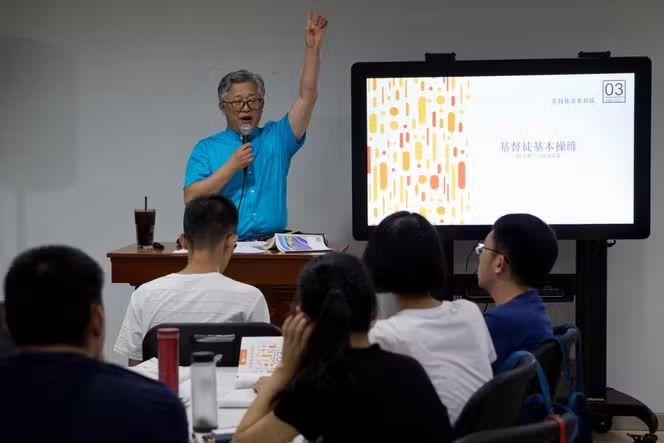







Chinese authorities have once again tightened their iron grip on religious life, but this time the blow lands on one of the country’s most influential underground Christian groups.
The recent campaign against Zion Church, sprawling across multiple provinces and sweeping up its leaders and members, signals not an isolated spasm of state insecurity but the continuation of a sustained war on any belief system that dares to place a higher authority above the Chinese Communist Party.
The arrests, beginning October 10, read like a meticulously choreographed purge.
Police tracked down pastors and congregants in coordinated raids from Beijing to southern Guangxi, detaining roughly 30 individuals and leaving about 20 behind bars as days passed.
The regime’s message is unmistakable: unregistered Christian worship in China, even when peaceful and Scripture-centred, is treated not as a matter of personal conscience but as a political crime.
Zion Church’s founder, Pastor Jin Mingri, sits at the heart of this crackdown. Known by his English name, Ezra Jin, he has long embodied a quiet defiance against the Party’s demand to supervise every sermon, scrutinise every baptism, and propagate an ideology that places the Party above God.
His influence spread through a house church network of thousands in nearly 50 cities, built painstakingly since 2007. For a regime obsessed with ideological uniformity, Zion’s success represented not spiritual flourishing but a threat.
Authorities at least pretend legalism, accusing Jin of the ambiguous crime of “illegal use of information networks,” a catch-all offence that allows the state to imprison religious leaders without acknowledging religion at all.
These elastic statutes serve a familiar purpose: to obscure the political motive behind persecution and deny believers the dignity of being targeted for their faith.
The cruelty extends beyond the one publicised charge. Jin’s family lives in exile, barred from seeing him for years. His health is reportedly fragile, and lawyers have been denied access. It is a calculated form of isolation. The CCP knows that crushing spiritual leaders often crushes the hopes of followers. It has two decades of practice.
Far from being an aberration, this campaign is part of the tightening vise on any group unwilling to kneel before Xi Jinping’s project of “Sinicising” religion.
The euphemism conceals a corrosive demand that crosses become Party slogans and pews become political training halls. For years, the state has replaced images of Jesus with Xi’s portrait inside churches it grudgingly tolerates.
It has rewritten passages of the Bible to match the Party’s ideological orthodoxy. The purpose is clear: eliminate worship that does not glorify the CCP.
Zion Church is now paying the price for resisting this transformation.
International condemnation has inevitably followed. U.S. officials labelled the mass detentions a hostile assault on religious freedom. They compared the tactic to geopolitical hostage-taking, a disturbing yet familiar comparison.
The CCP has long been accused of weaponising prisoners of conscience, treating human beings as bargaining chips in diplomatic negotiations. The timing of this latest move, as Washington and Beijing engage in high-level diplomacy, feels all too familiar.
But Beijing is not bothered by international outrage. It has weathered decades of criticism by simply denying what is plainly visible.
The state insists religious believers have freedom in China, as long as they believe exactly what the Party requires and practice only where the Party allows.
To the regime, the problem is not Christianity itself but Christianity that refuses political domestication. Any church unwilling to register with state-sanctioned associations is branded a criminal enterprise, its pastors “cult leaders,” its congregants “lawbreakers.”
Zion has endured this branding before. In 2018, Beijing authorities shut down the church’s main sanctuary after Jin refused to install government surveillance cameras.
That defiance raised his stature among believers, while simultaneously painting a target on his back. Since then, his movements have been restricted, his congregation scattered, and his sermons forced underground. For the Party, that is not enough. The lesson must be harsher. Anyone watching must learn that resistance invites ruin.
This operation strikes not only at Zion’s leadership but at its lifeblood. More than 150 worshippers have reportedly been interrogated in recent months, punished for gathering in private homes or speaking to one another online about their faith.
The new regulations banning unauthorised online preaching and “foreign collusion” tighten the dragnet further, ensuring that technology cannot serve as a refuge for believers seeking to worship beyond the Party’s reach.
China’s official messaging, meanwhile, continues to perform a cynical dance. Authorities insist these measures protect social harmony, prevent extremism, and uphold the rule of law.
Yet nothing about the treatment of Zion Church resembles public safety enforcement. Faith is the real crime here, especially when it rises beyond state-approved walls.
The CCP’s contempt for Christianity is inseparable from its wider ambition: to erase any alternative source of authority. I
n the Party’s vision of society, there can be no power higher than the state, no truth outside its doctrine, no loyalty that competes with its supremacy.
Churches that teach that every human life bears divine dignity are viewed instead as subversive cells. To believe in God is to challenge Xi’s insistence that the Party is the direction of history and the arbiter of human purpose.
Zion Church has grown precisely because countless Chinese citizens embrace a truth the state cannot extinguish. But Beijing does not tolerate movements it cannot subordinate.
Over recent years, it has bulldozed the mosques of Uyghurs, demolished crosses in Christian communities across the eastern provinces, and forced temples to reshape worship into patriotic theatre. Religious oppression is no sideline issue; it is core to the regime’s system of rule.
This latest crackdown demonstrates that the CCP is not loosening its grip but perfecting its mechanisms of repression. It chooses its moment when the world is distracted, then strikes swiftly and hides the evidence.
Families are denied answers. Lawyers are blocked. Pastors disappear behind detention centre walls. The truth emerges only through the fractured testimonies carried by advocacy networks outside China’s borders.
For Zion Church, the road ahead will not be easier. Its founder’s fate is uncertain. Its members now face scrutiny that could shatter their ability to gather. Any underground church could be next.
Beijing wants all believers to understand that no sanctuary exists beyond the Party’s gaze. No congregation can thrive if it refuses to become a puppet of the state.
China’s leaders may believe that locking up pastors and dismantling churches will force faith into silence. They believe fear will replace conviction. They believe that by dragging Christians into interrogation rooms and forcing them to renounce Jesus, they can secure their own authority.
These beliefs are as old as the communist regime itself. And history shows what follows: more arrests, more disappearances, more suffering inflicted upon people whose only transgression is believing in something greater than a political party.
What is happening to Zion Church is not a story of compromise or coexistence. It is a story of power crushing conscience. Beijing wants the world to look away. It wants the faithful to surrender. It wants God to disappear inside China’s borders.
What it has delivered instead is another stark reminder of how far the Chinese Communist Party will go to ensure that its ideology remains the only creed permitted to breathe.
Views: 76