


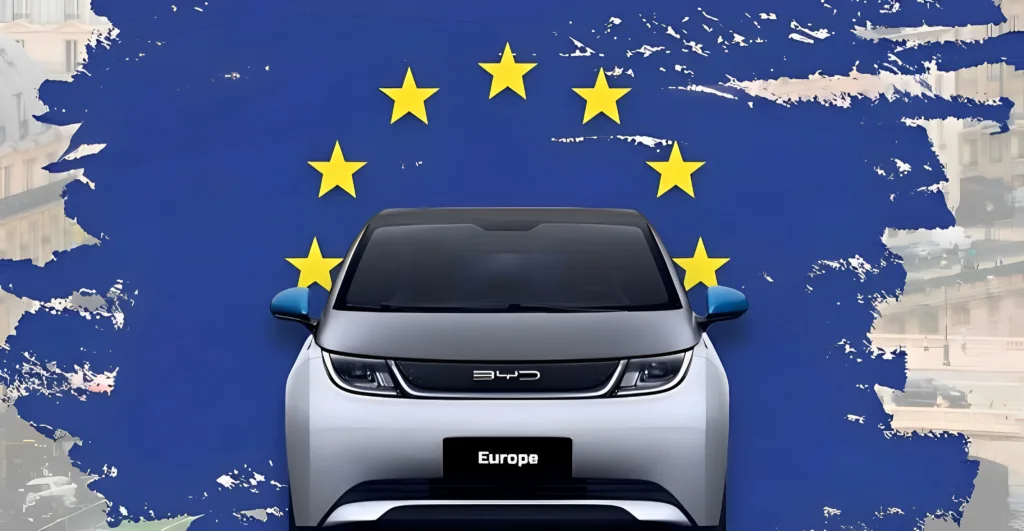







The European Union has finalized new, significantly higher tariffs on electric vehicles (EVs) imported from China, marking a major point of contention in the ongoing trade dispute over subsidies and China’s rapidly growing exports of green technology to Europe. These duties, which took effect on a provisional basis in July, were solidified after EU-China negotiations failed to resolve their differences. Discussions are expected to continue, with the possibility of lifting the tariffs if an agreement is reached.
Why the European Union Imposed Higher Tariffs
Following an eight-month investigation, the European Commission concluded that Chinese EV manufacturers receive substantial government support that enables them to sell at lower prices, undermining competition and threatening European industry jobs. The duties vary by manufacturer: 17% for BYD, 18.8% for Geely, and 35.3% for state-owned SAIC. Other manufacturers like Volkswagen and BMW, which produce EVs in China, face a 20.7% duty, while Tesla has an individually assessed rate of 7.8%.
The European Commission aims to maintain fair market practices, as explained by Vice-President Valdis Dombrovskis: “By adopting these proportionate and targeted measures after a rigorous investigation, we’re standing up for fair market practices and for the European industrial base.” These tariffs will remain in effect for five years unless a resolution is reached.
The Market Impact and Potential for Retaliation
The share of Chinese-built EVs in the EU rose from 3.9% in 2020 to 25% by September 2023, a rapid increase partly attributed to extensive subsidies. The EU asserts that these subsidies range from cheap land for factories, below-market-priced lithium and battery supplies, to favorable tax breaks and financing terms from state-owned banks. This surge has sparked concerns that, without intervention, Chinese-made EVs could monopolize Europe’s green technology sector, risking up to 2.5 million jobs in Europe’s automotive industry and potentially 10.3 million indirectly related jobs.
An additional concern stems from Europe’s experience with solar panels; a surge of subsidized Chinese imports wiped out much of Europe’s solar manufacturing industry. EU leaders are wary of repeating this with EVs, particularly as Europe strives to retain its industrial base amid the global green transition. However, the European auto industry has not been uniformly supportive of the tariffs; companies like BMW and Volkswagen, as well as the German government, have expressed concerns. Many European carmakers manufacture vehicles in China and worry that the tariffs may provoke retaliatory measures from Beijing.
China’s Response to the EU Tariffs
China’s Ministry of Commerce has denounced the tariffs, labeling them as protectionist and unfair. In response, China launched its own investigations into European imports, particularly targeting brandy, pork, and dairy subsidies. Recently, the Chinese government imposed provisional tariffs of 30.6% to 39% on brandy imports from France and other European countries, signaling a potential escalation in trade tensions. Furthermore, China is considering raising tariffs on large gasoline-powered vehicles from Europe.
Negotiations between the EU and China have included discussions around “price commitments,” wherein Chinese carmakers might agree to minimum pricing for EVs in Europe as a compromise. Additionally, some Chinese automakers, like BYD, are exploring options to avoid tariffs by establishing manufacturing plants within Europe. BYD is currently building a facility in Hungary, and Chery is entering a joint venture in Spain’s Catalonia region.
Comparing EU and U.S. Tariff Strategies on Chinese EVs
The EU’s approach contrasts with the United States, where the Biden administration recently announced a sharp increase in tariffs on Chinese EVs from 25% to 100%, effectively blocking Chinese EV imports. The EU’s position is more balanced; while it aims to ensure fair competition, it also seeks affordable EV imports to meet its ambitious climate goals, which include cutting greenhouse gas emissions by 55% by 2030. The EU tariffs are designed to offset the advantage created by what it sees as unfair subsidies, rather than to exclude Chinese EVs altogether.
Implications for Consumers and Carmakers in Europe
It remains uncertain how the tariffs will affect European car prices. Chinese manufacturers may choose to absorb some of the additional costs to maintain their market share, as they often sell their vehicles in Europe at a premium compared to prices in China. For example, BYD’s Seal U Comfort model is priced at €21,769 in China but €41,990 in Europe. According to industry analysis, five of BYD’s six models would remain profitable in Europe even with a 30% tariff.
The EU’s position is that allowing unfair pricing practices could lead to diminished competition and, ultimately, higher costs for consumers. While European drivers may enjoy lower prices on Chinese cars in the short term, the EU argues that unchecked market dominance by Chinese manufacturers could ultimately reduce consumer choice and raise costs in the long run.
This approach underscores the EU’s intent to balance climate goals with economic resilience, seeking a fair competitive environment that fosters sustainable growth within Europe’s green technology sector.
Views: 37


