









After Khamenei: War, Succession, and India’s Strategic Calculus in West Asia
The assassination of Supreme Leader Ayatollah Ali Khamenei on 28 February 2026 marks an abrupt and seismic rupture in the 47-year trajectory of the Islamic Republic of Iran. In a meticulously coordinated joint operation codenamed “Roaring Lion” by Israel and “Epic Fury” by the United States, precision strikes targeted his office complex in Tehran, claiming the life of the 86-year-old cleric alongside at least four senior officials. Iranian state television confirmed the death within hours, declaring a 40-day period of national mourning, while the Islamic Revolutionary Guard Corps (IRGC) vowed “no leniency” in reprisal. President Donald Trump framed the strike as offering Iranians their “greatest chance” to reclaim their country, casting it as the culmination of a long-standing regime-change objective.
This decapitation strike was never intended as an isolated tactical success; it formed the opening move in a broader campaign to disrupt the Islamic Republic’s command architecture. Israeli sources indicated that some 30 high-ranking figures were neutralised in the initial wave, including key IRGC commanders and nuclear scientists. Satellite imagery released by Western intelligence confirmed extensive damage to Khamenei’s compound. The operation relied on fused real-time intelligence from the CIA and Mossad. It highlighted an unprecedented level of US–Israeli operational integration in the post-Abraham Accords era. Yet, as analysts at the CFR — notably Ray Takeyh — and at the Brookings Institution, particularly Suzanne Maloney, have observed in their assessments of Iranian leadership transition and regime durability, the removal of a singular figurehead does not necessarily precipitate systemic collapse in a theocratic polity where authority is deliberately diffused across interlocking institutions — the Assembly of Experts, the Guardian Council, and the IRGC. Likewise, the scholarship of Jenna Jordan and Bryan C. Price on leadership decapitation demonstrates that targeting senior leadership often exposes the limits of personalised authority while simultaneously revealing the durability of institutional scaffolding.
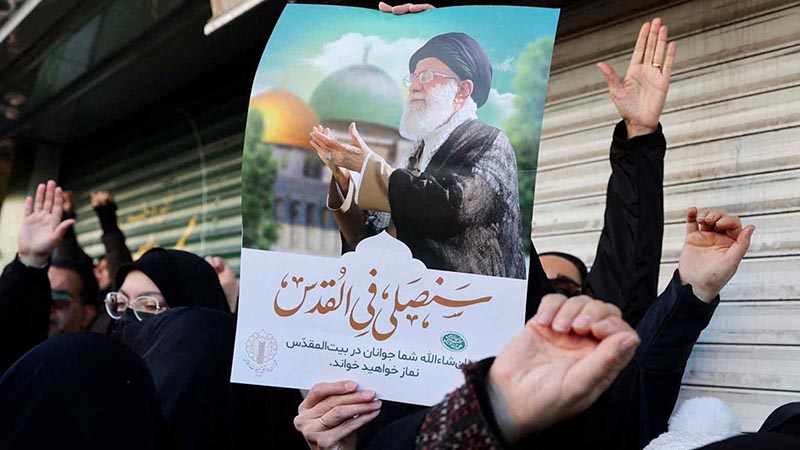
In the immediate aftermath, Iran’s vaunted resilience revealed both fragility and unexpected institutional continuity. State media broadcast images of mourning crowds in Tehran, Qom, and Mashhad, while a visibly emotional television anchor announced the Supreme Leader’s passing. Unverified but widely circulated social media footage captured pockets of quiet celebration in certain urban quarters and among opposition circles abroad. This dual response — public grief for the “Leader of the Islamic Ummah” alongside private relief at the apparent close of four decades of clerical absolutism — exposed the regime’s underlying legitimacy deficit. Having visited Tehran, Qom, Isfahan, and other prominent cities in May 2025, one could already sense the deep fatigue among ordinary Iranians: conversations with students, small traders, academics, and taxi drivers revealed a society living under sustained economic compression yet marked by remarkable social resilience. Inflation had hollowed out purchasing power; families spoke of shrinking meal portions, delayed medical treatments, and the quiet humiliation of watching savings evaporate under currency depreciation. University scholars described constrained research funding and increasing intellectual isolation due to sanctions. Shopkeepers noted supply-chain disruptions and fluctuating import costs that rendered pricing unpredictable. The constant scrutiny of the morality police, the intrusive reach of regime oversight into daily choices, and a quiet nostalgia for a pre-1979 life remembered by older generations as comparatively relaxed — where Islamisation was described by some interlocutors as a socially conservative imposition rather than an organic evolution of Iranian society — were recurrent themes. Yet alongside these hardships, there was an unmistakable warmth toward India and Indians. Many interlocutors referred to India not merely as a strategic partner but as a civilisational counterpart — a country perceived as independent-minded, culturally plural, and historically respectful of Iranian sovereignty. References to Bollywood, educational exchanges, and the long arc of Indo-Persian civilisational contact surfaced repeatedly. Even among those critical of their own government, there was a discernible distinction made between Western pressure and India’s perceived posture of principled autonomy. These interactions underscored an essential point: beneath the abstractions of sanctions and deterrence lies a society that differentiates sharply between geopolitical rivalry and people-to-people goodwill.
The timing intensified the complexity: the strike occurred while Iran was engaged in sensitive nuclear negotiations in Oman and European capitals, with President Masoud Pezeshkian indicating readiness to accept stringent verification measures, including permanent repurposing of key enrichment facilities in exchange for phased sanctions relief. In Tehran, the action was widely interpreted as a profound diplomatic betrayal that eroded any remaining confidence in Western negotiating good faith. As deterrence theory reminds us, when pre-emption interrupts credible diplomatic pathways, it risks entrenching the very proliferation incentives it seeks to forestall. In a region defined by nuclear opacity and threshold deterrence, the line between prevention and provocation remains perilously thin.
Within the domains of national security and foreign policy, the assassination embodied the outer limits of pre-emptive doctrine. For Israel, Khamenei’s repeated threats to erase the Zionist entity, combined with Iran’s advancing nuclear programme — stockpiles of uranium enriched to near-weapons-grade levels, as confirmed by the IAEA shortly before the strikes — had rendered the status quo intolerable. For the United States, the operation aligned with President Trump’s second-term “maximum pressure 2.0” approach, pursuing through kinetic means what sanctions alone had not secured: the sustained curtailment of Iran’s regional influence. Yet this realist calculus carried inherent risks. As analysts at Chatham House cautioned, decapitation strikes in personalised autocracies frequently generate succession crises that empower hardliners rather than opening space for moderates — a dynamic that can ultimately reinforce the very threat such strikes seek to neutralise. Balance-of-threat logic further suggests that such actions may shift regional alignments in ways that complicate existing security dilemmas.
The deeper historical continuum that made Khamenei’s elimination both predictable and perilous is rooted in the Islamic Republic’s foundational narrative of anti-imperial resistance. That narrative draws from the 1979 US Embassy hostage crisis, which paralysed Washington for 444 days; the Iran-Iraq War (1980–1988), during which the Reagan administration provided intelligence, arms, and diplomatic support to Saddam Hussein; and the layered sanctions imposed after Iran’s nuclear revelations in 2002. The alleged 2003 Iranian “grand bargain” proposal — reportedly offering comprehensive normalisation with Washington following the US invasion of Iraq — is frequently cited in retrospective analyses as a missed diplomatic inflection point. The 2015 Joint Comprehensive Plan of Action offered a temporary diplomatic opening, but President Trump’s unilateral withdrawal in 2018, followed by the killing of Qasem Soleimani in 2020, re-established confrontation as the default posture. Israel’s periodic, unacknowledged strikes on Iranian nuclear and proxy assets sustained a shadow war that Tehran consistently framed as existential. The resulting asymmetry — Iran has never fielded nuclear weapons, while Israel maintains an undeclared arsenal — has long been identified in realist scholarship as the central paradox of West Asian security: measures intended to prevent Iranian nuclearisation may, through regime hardening or proliferation incentives, inadvertently accelerate it.
The pre-emptive nature of the 28 February operation cannot be separated from its diplomatic setting. Credible reporting indicated that, in late February 2026, Iran had signalled near-acceptance of a comprehensive nuclear framework in European-mediated talks: enrichment limited to 3.67 per cent, the Fordow facility repurposed under IAEA oversight, and ballistic-missile development frozen in return for phased sanctions relief and normalised trade, with Oman acting as the key backchannel. The decision to strike while these talks remained active exemplified coercive diplomacy collapsing into kinetic fait accompli. In international relations theory, the episode recalled the 2003 Iraq precedent: pre-emption justified by worst-case assessments, yet executed at the cost of verifiable diplomatic alternatives. The immediate effect was the effective sidelining of multilateralism in the nuclear domain and the reinforcement of IRGC arguments that engagement with the “Great Satan” is inherently futile.
A strategic appraisal of the US–Israeli campaign reveals both tactical effectiveness and consequential trade-offs. The strikes systematically degraded Iran’s air-defence systems, disrupted key command-and-control nodes, and targeted several hardened underground nuclear facilities, with B-2 Spirit bombers reportedly deployed against the deeply fortified sites at Natanz and Fordow. Yet the operation did not precipitate immediate regime collapse. Instead, it triggered Iran’s largest retaliatory barrage to date — Operation True Promise 4 — comprising more than 300 ballistic missiles and drones directed at Israel and 27 US-linked installations across the Gulf. Targets included Al Udeid in Qatar, Al Dhafra in the United Arab Emirates, the Fifth Fleet headquarters in Bahrain, and military facilities in Kuwait and Saudi Arabia. Explosions reverberated across Dubai, Doha, and Manama; a civilian was killed in Abu Dhabi by falling debris, while minor fires were reported at Jebel Ali Port and superficial damage noted along the façade of the Burj Al Arab, with additional blasts recorded in Sharjah on 1 March. Gulf air-defence networks, reinforced by US Patriot and Emirati THAAD systems, intercepted the overwhelming majority of incoming projectiles. The UAE alone reported the neutralisation of 137 ballistic missiles and 209 drones. Yet the psychological shock and symbolic breach of Gulf sovereign territory proved strategically significant, signalling that even high interception rates cannot fully restore deterrence credibility.
Iran’s retaliation was calibrated primarily for political signalling rather than decisive military effect. By targeting US assets hosted on sovereign Arab Gulf territory, Tehran internationalised the conflict and compelled Gulf capitals into a difficult balancing act between alliance commitments and regime security. The IRGC’s operation demonstrated retained asymmetric capacity despite the leadership decapitation. At the same time, the barrage highlighted the fragmentation of the “Axis of Resistance”: Hezbollah and the Houthis offered rhetorical backing but limited operational support, while Iraqi Popular Mobilisation Forces stayed largely inactive. This pattern suggested that years of sanctions and targeted operations had already eroded Iran’s forward-deployed deterrent structure more effectively than any single strike could accomplish. In strategic terms, the exchange recalibrated — rather than resolved — the Gulf-centred deterrence equilibrium, introducing volatility into a security architecture already strained by nuclear threshold dynamics.
The consequences for the Gulf States were immediate and structurally significant. The United Arab Emirates, Qatar, Bahrain, Saudi Arabia, and Kuwait — hosts to the majority of US forward presence — experienced direct violations of their sovereignty. Official statements from Abu Dhabi, Riyadh, and Doha condemned the Iranian actions in strong terms, invoking Article 51 of the UN Charter and affirming the right to respond. The UAE detailed the interception of 137 ballistic missiles and 209 drones with only shrapnel-related damage; Saudi Arabia provided logistical assistance to interception efforts; Qatar emphasised the protection of Al Udeid. Beneath this unified front, however, lay the familiar Gulf instinct for hedging: capitals quietly pressed Washington for de-escalation, conscious of the risks of oil-price volatility (Brent crude briefly exceeded $95 per barrel), refugee movements, and the potential mobilisation of domestic Shia communities. Absent direct kinetic involvement — which would invite further reprisals and internal strain — Gulf responses are likely to unfold in calibrated layers, including accelerated economic diversification away from Iranian corridors, deeper integration with US and Israeli missile-defence networks, and continued diplomatic pressure on Tehran at the UN and within OPEC+. The UAE and Saudi Arabia may advance normalisation with Israel under an expanded Abraham Accords framework while preserving discreet channels to Tehran. Bahrain, given its demographic realities, faces the greatest internal exposure and will probably reinforce GCC cohesion. Collectively, these dynamics will test the resilience of the emerging anti-Iran alignment and may hasten the regional reordering already visible since 2020.
The socio-economic foundations of the Islamic Republic were already under severe structural strain prior to the strikes. Successive rounds of US maximum-pressure sanctions, reimposed and tightened after the effective collapse of the JCPOA, had produced pronounced macroeconomic instability. Data from the Statistical Centre of Iran and the Central Bank in February 2026 showed point-to-point inflation reaching 68.1 per cent and 62.2 per cent respectively — the highest levels recorded since the Second World War — with food prices rising 110 per cent year-on-year. Monthly inflation stood at 9.4 per cent and 8.4 per cent, pushing the Consumer Price Index to 513.6. The rial had depreciated sharply, trading at 1,666,000–1,749,500 to the US dollar on the remittance market as of 1 March 2026, reflecting substantial erosion of purchasing power over the preceding three years. Household incomes stagnated amid subsidy reductions, fuelling protests that recalled the scale of the 2022–2023 “Woman, Life, Freedom” movement.
During the author Dr Maheep’s visit to Iran in May 2025, which included engagements in Tehran, Qom, and Isfahan, these macroeconomic indicators manifested in concrete, everyday realities. Conversations with university scholars, small traders, civil servants, and taxi drivers revealed a society navigating sustained economic compression with visible fatigue. Inflation had hollowed out purchasing power; families spoke of shrinking food baskets, postponed medical treatments, and the quiet humiliation of watching lifetime savings erode under currency depreciation. Shopkeepers described fluctuating import costs that rendered pricing unpredictable, while academics noted growing intellectual isolation produced by sanctions-related restrictions. Socio-politically, there was a palpable sense of constraint: the intrusive reach of moral policing into daily life, socially conservative impositions from above, and generational nostalgia for a pre-1979 social atmosphere remembered by some as comparatively less restrictive. Yet even amid hardship, social cohesion and national pride remained intact — a reminder that economic crisis does not automatically translate into regime collapse.
The human dimension of this strain remains stark. The morality police and Basij forces — instruments of cultural enforcement under Khamenei — intensified pressure on women refusing the compulsory hijab, generating widespread female-led dissent. Yet the same constituencies that challenged the regime domestically often rallied around the national flag when confronted with external attack, illustrating the classic rally-round-the-flag dynamic observed in many besieged societies. Executions of protesters, numbering over 1,000 in 2025 according to Amnesty International, deepened alienation among urban youth. The state’s coercive apparatus retained control, but its long-term sustainability appeared increasingly contingent; the IRGC’s extensive economic holdings now face the risk of internal fragmentation should succession disputes intensify.
From an Indian perspective, the crisis intersects directly with core national interests. India–Iran relations have historically combined civilisational depth with strategic pragmatism — from centuries of Indo-Persian cultural exchange to post-independence energy cooperation and connectivity initiatives. Iran has been a significant energy supplier, a gateway to Afghanistan and Central Asia, and a balancing node in India’s wider West Asian diplomacy. The Chabahar port project symbolised India’s effort to operationalise strategic autonomy while navigating US sanctions regimes. Yet New Delhi’s approach has consistently reflected calibrated multi-alignment: maintaining defence cooperation with the United States, deepening ties with Israel, strengthening Gulf partnerships, and preserving engagement with Tehran. The present escalation compresses India’s strategic space. Heightened US secondary sanctions risk constraining economic engagement; instability in the Strait of Hormuz threatens energy security; and overt alignment with any one bloc could compromise India’s carefully cultivated diplomatic flexibility. With nearly ten million Indian nationals residing across the Gulf states, New Delhi’s equidistant posture serves both humanitarian and economic imperatives. The prevailing assessment within India’s policy community is that the conflict presents limited direct gain but considerable indirect exposure — particularly in energy security, maritime stability, and diaspora protection. In this context, a restrained humanitarian posture positions India as a potential stabilising actor in an increasingly polarised West Asian order.
At the level of regime architecture and ideological authority, Iranian statecraft has entered a period of pronounced uncertainty. The doctrine of velayat-e faqih, institutionalised by Khamenei after Khomeini’s death in 1989, rested on a fusion of personal authority and IRGC loyalty. With neither element fully transferable, the interim leadership council — comprising President Masoud Pezeshkian, Chief Justice Gholam-Hossein Mohseni-Eje’i, and Ayatollah Alireza Arafi — functions as a technocratic holding arrangement rather than a source of enduring legitimacy. The Assembly of Expertswill convene to select a permanent successor; names such as Mojtaba Khamenei are under discussion, yet constitutional scholars note the body’s preference for consensus figures capable of preventing open strife. RAND’s 2011 monograph on Iranian succession, still a foundational reference, anticipated precisely this factional tension between pragmatists and hardliners — a tension now unfolding amid active conflict.
Across the wider international system, the crisis has strained the post-1945 framework of sovereignty and non-intervention. UN Secretary-General António Guterres condemned the strikes as violations of the UN Charter and called for immediate de-escalation, warning of uncontrollable escalation risks. China and Russia criticised what they termed hegemonic aggression, while European capitals balanced private satisfaction at the disruption of Iran’s nuclear threshold capability with public concern over uncontrolled fallout. The Gulf Cooperation Council described Iranian retaliation as an attack on the Arab order as a whole. In broader structural terms, the episode appears to accelerate the shift from a rules-based liberal order toward a more fluid contested multipolar realism, in which nuclear latency, energy chokepoints such as the Strait of Hormuz, and adaptive proxy networks increasingly outweigh multilateral institutions.
The 2026 West Asian crisis therefore confronts international security studies with fundamental structural questions. Can external decapitation generate stable regime change, or does it more often incubate successor authoritarian structures? Is Israel’s security dilemma — rooted in legitimate concerns over proxy encirclement and enrichment advances — best addressed through preventive force, or does such action risk validating the narratives of resistance it seeks to dismantle? For the Gulf States, the enduring tension between hedging and alignment will shape the regional balance of power for the coming decade. For ordinary Iranians, navigating the narrow space between domestic grievances and external pressure, the trajectory remains uncertain — suspended between mourning, resentment, and the possibility of incremental change.
What began as an effort to rupture the apex of power has instead tested the tensile strength of the system beneath it. In conclusion, the assassination of Ayatollah Ali Khamenei sought to expose fragility but instead illuminated institutional resilience — a paradox that defines the crisis. A weakened Islamic Republic may respond with heightened unpredictability or internal fragmentation. The United States and Israel have achieved a significant tactical outcome; whether this translates into lasting strategic advantage will depend on the careful management of succession dynamics, the containment of retaliatory escalation, and the capacity of Gulf partners to sustain a new security equilibrium. In this sense, the crisis marks less a decisive victory than a recalibration of regional deterrence, the consequences of which will unfold unevenly across local, regional, and systemic levels.
History and theory alike counsel caution: strategies that privilege kinetic escalation over sustained diplomacy rarely yield durable order. For India, the path forward lies in principled equidistance — protecting its diaspora, preserving civilisational and economic linkages, and quietly advancing de-escalation — while recognising that strategic patience, rather than maximalist alignment, will define responsible statecraft in a fractured West Asian theatre. The Islamic Republic has been tested severely, yet the endurance of its institutional scaffolding underscores a broader lesson about revolutionary regimes operating under sustained external pressure.
Ultimately, this crisis is not merely about regime decapitation or nuclear latency; it is about the future configuration of power, legitimacy, and order in an era of accelerating multipolarity. The true measure of this moment will not be found in missile exchanges or leadership vacancies, but in whether regional actors can transform confrontation into managed competition. In this volatile region, the stakes involve nothing less than the evolving distribution of power in the twenty-first century. The strategic imperative now is not the pursuit of spectacle, but the construction of equilibrium — forged through restraint, foresight, and the disciplined management of enduring rivalries.
Views: 1627

Dr. Maheep
Dr. Maheep is Director, Indian Perspective on Global Affairs (IPGA), and a leading analyst of India’s foreign policy and South Asian geopolitics. He earned his PhD in Arab and Islamic Studies. With more than a decade of teaching and research experience in International Relations and Global Politics, he contributes regularly on issues shaping national and global affairs.


