






The Melbourne Consensus: Cricket Diplomacy and the Strategic Consolidation of India – Australia Relations
Cricket has long supplied India and Australia with a shared emotional vocabulary, and in Melbourne in July 2026 it supplied them with a strategic one. Addressing the Third India-Australia Annual Summit, Prime Minister Narendra Modi described the partnership as focused like a One-Day match, decisive like a Twenty20 and enduring like a Test match. The remark drew laughter from Prime Minister Anthony Albanese, yet beneath the levity lay a proposition of genuine weight: cricket as a metaphor for the three temporalities of statecraft, the disciplined pursuit of defined objectives, the capacity for rapid and consequential decision, and the patience to build trust across generations. When a civilisational state of 1.4 billion people and a continental middle power of the southern hemisphere reach instinctively for the same sporting idiom, they reveal a shared social imaginary, a common grammar of fair play, rules and umpires that translates with remarkable fidelity into the language of a rules-based Indo-Pacific order.
The Indian Ocean once separated India and Australia; today it strategically unites them. This inversion captures the essence of the visit of 8 to 10 July 2026, the central leg of a three-nation tour that carried Prime Minister Modi from Jakarta through Melbourne to Wellington and that rewards reading as an exercise in deliberate sequencing rather than an itinerary. Jakarta came first because the eastern Indian Ocean opens through the Indonesian archipelago: affirming ASEAN centrality at the outset established that India’s deepening bilateral partnerships complement rather than compete with Southeast Asia’s own institutions. Wellington came last because the South Pacific has become a contested theatre, and extending Indian engagement to New Zealand and, through it, toward the Pacific Islands signalled that India’s regional horizon now runs to the ocean’s farthest edge. Melbourne, positioned between them, was the pivot at which the arc acquired binding substance, and its selection carried a further significance: Australia is India’s fellow Quad democracy, so that everything concluded there, in maritime domain awareness, resilient supply chains, emerging technologies and democratic technology standards, hardened the quadrilateral’s long-softest edge and demonstrated that deterrence can be organised among democracies without alliance politics. Figure 1 renders the composition. The summit itself produced eighteen concrete outcomes spanning defence, maritime security, civil nuclear energy, critical technologies, supply chains, skills, science, cinema and sport (Ministry of External Affairs, 2026), making it among the most productive bilateral engagements in the relationship’s history.
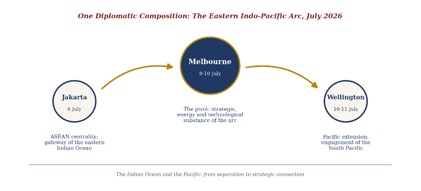
Figure 1: Strategic sequencing of the three-nation tour, with Melbourne as the pivot of the eastern Indo-Pacific arc. Source: author.
This article asks why the visit marks a qualitative transformation and how it reshapes the Indo-Pacific’s security architecture. The answer is a single sustained thesis: Melbourne 2026 consolidated a mature partnership that is now structurally self-reinforcing, because strategic trust, economic complementarity and societal connectivity have begun to compound one another rather than merely coexist. This settled understanding is what the article names the Melbourne Consensus, and it can be stated in one sentence: if the 2020 Comprehensive Strategic Partnership institutionalised India-Australia cooperation, Melbourne 2026 transformed that cooperation into a self-reinforcing strategic ecosystem.
The Consensus rests on five constitutive principles: trust institutionalised through standing mechanisms rather than political chemistry; security framed affirmatively as regional order-building, preserving strategic autonomy on both sides; economic complementarity converted deliberately into trusted supply chains for the fuels, minerals and technologies of the energy and intelligence transitions; societal connectivity treated as strategic infrastructure and financed accordingly; and a bilateral core radiating outwards through the region’s own institutions. The compounding claim binds the five together, and it is this circularity, tested across the sections below through interpretive analysis and process tracing of the primary documents, that distinguishes consolidation from mere convergence. The perspective throughout is Indian and constructivist, attentive to how repeated interaction and shared democratic identity have reconstituted mutual perception, with India appearing as agent rather than object: a civilisational state practising multi-alignment and speaking with growing authority as the leading voice of the Global South. Figure 2 visualises the architecture.
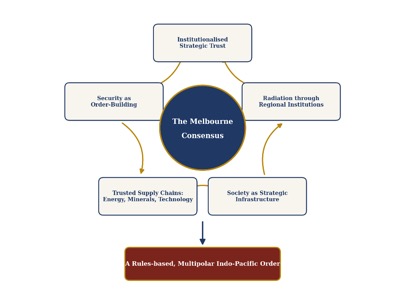
Figure 2: The compounding architecture of the Melbourne Consensus. Source: author.
From Distance to Convergence
The historical evolution is best understood as a passage from proximity without intimacy to intimacy grounded in proximity. Formal contact dates to 1944, when Australia opened its New Delhi mission before Indian independence, and Meg Gurry’s archival history dismantles the comfortable myth of simple Australian neglect, while Mayer and Jain locate as much of the era’s thinness in Indian indifference as in Australian inattention. The Cold War imposed a long estrangement, with Australia’s American alliance and India’s non-alignment on divergent tracks and the White Australia policy shadowing societal ties, punctuated by revealing exceptions such as the quiet defence cooperation explored after the 1962 India-China war. India’s 1998 nuclear tests produced a sharp chill, and the refusal to export uranium to a state outside the Non-Proliferation Treaty hardened into the relationship’s most symbolically charged irritant. The partnership of that era rested on the three Cs of Commonwealth, cricket and curry, a formula whose charm concealed strategic thinness, though the Commonwealth inheritance itself endures as living infrastructure rather than sentimental residue: common law lowers the transaction costs of every agreement, Westminster practice makes each side’s politics legible to the other, shared staff college traditions ease combined military operation, and English-medium education underwrites the student flows on which the modern relationship runs.
Five turning points then remade the relationship. The economic reforms of 1991 made India a market Australia could no longer ignore. The 2009 Joint Declaration on Security Cooperation supplied a first strategic charter. The Civil Nuclear Cooperation Agreement of 2014 dissolved the uranium impasse by accepting India as a responsible nuclear power, a recognition New Delhi had sought as a matter of principle. The virtual summit of 2020 elevated ties to a Comprehensive Strategic Partnership, established the 2+2 Ministerial Dialogue and concluded the Mutual Logistics Support Arrangement, converting declaration into machinery. The Economic Cooperation and Trade Agreement of 2022 lifted two-way trade beyond fifty billion dollars and opened the road to a Comprehensive Economic Cooperation Agreement. Mattoo and Singh describe this trajectory as a journey from divergence to convergence; the Indian reading adds that convergence was earned through Indian agency, as economic rise, doctrinal clarity and diplomatic confidence progressively changed the terms of engagement. Beneath the milestones ran a quieter revolution in maritime thinking. Both states long imagined the Indian Ocean as a moat; its intellectual reconception as a connector, developed through Raja Mohan’s account of India’s maritime turn and Medcalf’s remapping of the region as an Indo-Pacific whole, supplied the cognitive precondition for partnership, and Brewster’s observation that Australia’s western seaboard makes it an Indian Ocean power in fact if belatedly in self-understanding completes the picture. By July 2026 the question was no longer whether the two would cooperate, but how deeply, how fast and to what strategic end.
The Melbourne Architecture
The summit was arranged with intent, and the architecture of engagements repays reading as a map of priorities. Prime Minister Modi was received at Government House by the Governor of Victoria, Margaret Gardner, held one-on-one and delegation-level talks with Prime Minister Albanese, met the Leader of the Opposition, Angus Taylor, in a display of the relationship’s bipartisan foundation, addressed the Australia-India CEOs Forum and the Economic Roadmap business event, spoke to some thirty thousand members of the Indian community at Marvel Stadium, and joined his host at the Melbourne Cricket Ground to unveil the Sports Collaboration Roadmap. Four audiences were thus addressed in sequence, the state, the polity, the market and society, which is the engagement pattern of a partnership conceived as whole-of-nation rather than government-to-government. The ordering of the eighteen outcomes is equally revealing, for the hierarchy of deliverables discloses the hierarchy of priorities: defence and maritime security first, energy and civil nuclear cooperation second, critical technologies and supply chains third, then skills, science, education and the people-to-people domain. Two features of the architecture merit emphasis. The first is institutional density: the outcomes create standing mechanisms rather than one-off transactions, and standing mechanisms are how partnerships acquire habit, memory and resilience. The second is deliberate breadth, from uranium to para sports, a spectrum that embodies the comprehensive in Comprehensive Strategic Partnership. Table 1 sets out the principal instruments.
| Pillar | Instrument | Substance |
| Defence & Security | Joint Declaration on Defence and Security Cooperation (JDDSC) | Renews the 2009 Joint Declaration on Security; interoperability, capacity building, maritime domain, defence industry, cyber, counter-terrorism, HADR; unified approach through UNCLOS, ASEAN, PIF and IORA |
| Maritime Security | Maritime Security Collaboration Roadmap (MSCR) | Information sharing, capability development and operational coordination across the shared ocean |
| Maritime Security | MoU: Indian Coast Guard and Australian Maritime Border Command | Maritime law enforcement, domain awareness and maritime border protection |
| Energy & Nuclear | Administrative Arrangement, Civil Nuclear Cooperation Agreement | Operationalises the 2015 agreement; enables Australian uranium supply to India under IAEA safeguards |
| Energy & Nuclear | Joint Statement on Energy Security | Reaffirms mutual commitment to energy security amid geopolitical tensions |
| Technology & Supply Chains | Partnership for Cyber, Critical Technologies and Supply Chains (PACTS) | Builds on the 2020 Framework Arrangement; resilient supply chains, critical technologies, cyber security, digital resilience |
| Technology & Supply Chains | MoU under the Australia-Canada-India Technology and Innovation (ACITI) Partnership | Trilateral cooperation in emerging technologies and innovation |
| Resources & Science | MoU: Geoscience Australia and Geological Survey of India | Advanced exploration methodologies, capacity building and modernisation of GSI infrastructure |
| Resources & Skills | MoU: MSDE and TAFE Western Australia | Centre of Excellence in Mining and Mining Equipment, Technology and Services (METS) |
| Skills & Standards | LoI: NCVET and Australian Skills Quality Authority | Regulatory alignment of vocational training, co-developed occupational standards |
| Education | Letter of Approval: Victoria University; Letter of Intent: Flinders University | Campuses in Gurugram and Bengaluru; a two-way knowledge corridor |
| Science & Research | MoU: CSIR and University of Melbourne | Collaborative drug-target research, trainee programmes, faculty exchange |
| Culture & Sport | SRFTI-Griffith Film School MoU; India-Australia Sports Collaboration Roadmap | Cinema co-production; high-performance centres, Olympic and Commonwealth Games experience sharing, para sports priority |
| Civilisational Diplomacy | Voluntary return of antiquities from Tamil Nadu | Stone Nandi, trident of Goddess Bhadrakali, six-headed sculpture of Lord Kartikeya |
Table 1: Principal instruments of the Third India-Australia Annual Summit, Melbourne, July 2026. Source: Ministry of External Affairs, List of Outcomes (2026).
The instruments are usefully sorted into three tiers of maturity, for readers deserve to know what is executable, what is executory and what remains aspirational. Operationalised: the uranium Administrative Arrangement gives legal effect to an existing treaty, the Victoria University approval authorises a campus, and the antiquities were physically returned. Signed frameworks awaiting execution: the Joint Declaration, the maritime roadmap, PACTS, ACITI and the research and skills memoranda create machinery whose value depends on use. Future negotiations: CECA, uranium supply contracts and named minerals ventures constitute the agenda the summit set rather than settled. This gradient is a feature rather than a flaw, for a partnership that always retains unfinished business has institutionalised its own momentum, yet it disciplines the analysis that follows: the Melbourne Consensus is judged here on architecture, and its ultimate verdict will be delivered by implementation.
The Strategic Spine: Defence and the Maritime Commons
The centrepiece was the Joint Declaration on Defence and Security Cooperation, superseding the 2009 framework and encoding the qualitative elevation that Prime Minister Albanese captured in calling India a top-tier security partner. It institutionalises an Annual Defence Ministers’ Dialogue, deepens interoperability and exercise tempo under the Mutual Logistics Support Arrangement, and identifies maritime domain awareness, counter-terrorism, humanitarian assistance and defence industrial collaboration as priority vectors, while a quieter provision, the placement of an Indian military instructor at the Australian Defence College from 2028-29, embeds trust at the formative level where professional cultures are transmitted. The Maritime Security Collaboration Roadmap and the Coast Guard arrangement with the Maritime Border Command give the Declaration operational content, extending cooperation into the constabulary domain where most day-to-day maritime order is actually produced. Read together with Malabar and the Quad’s maritime domain awareness partnership, these instruments mean that two navies anchored at opposite ends of the same ocean are constructing a shared operational picture of the commons: capability aggregation in the service of strategic autonomy, in which options widen while obligations remain sovereign.
Geography gives this cooperation its physical grammar. The Indian Ocean is an enclosed strategic space whose commerce funnels through a handful of chokepoints: Malacca and its southern alternatives at Sunda and Lombok in the east, Hormuz and the Bab-el-Mandeb at the western gates. Between them lie the assets that make India and Australia natural custodians of the ocean’s eastern approaches: India’s Andaman and Nicobar Islands, home to its only integrated theatre command, sit astride Malacca’s western exit; Australia’s Cocos (Keeling) Islands, their airfield upgraded for maritime patrol aircraft, watch Sunda and Lombok from the south; Diego Garcia anchors the centre. The two partners jointly command the observation points of the ocean’s eastern half, and surveillance cooperation between the Andamans and Cocos, long discussed among strategists, now possesses the scaffolding to become routine. Geography, patiently converted into shared awareness, is how a favourable maritime order is built without a shot being fired.
Atoms, Minerals and Algorithms
The visit’s most historically resonant breakthrough was the finalisation of the Administrative Arrangement under the Civil Nuclear Cooperation Agreement, clearing the path for Australian uranium exports to India for exclusively peaceful purposes under International Atomic Energy Agency safeguards and closing the last chapter of the post-1998 estrangement. The material logic is compelling: Australia holds roughly one-third of the world’s known uranium resources, while India targets one hundred gigawatts of nuclear capacity by 2047 to feed baseload demand surging with industrialisation and the growth of data centres and artificial intelligence infrastructure. The symbolism equals the substance, for Canberra now treats New Delhi as a full partner in the most sensitive of strategic technologies, though candour requires noting that commercial quantities and contracts remain to be concluded. The companion Joint Statement on Energy Security binds uranium into a lattice spanning liquefied natural gas, green hydrogen and solar supply chains, and it is here that the partnership’s western horizon appears as an organic extension of its energy logic. India draws most of its crude from the Gulf, sustains a nine-million-strong diaspora there and has built an Indo-Gulf strategic arc of growing consequence through the India-Middle East-Europe Economic Corridor; Australia, a leading LNG exporter, shares a direct stake in the arteries running from Hormuz through the Arabian Sea and the Red Sea, whose recent disruptions transmitted instantly into freight rates and energy prices in both economies. The energy compact is therefore, by implication, a whole-of-ocean security document.
Critical minerals have become instruments of geoeconomic power in their own right. Lithium, cobalt, nickel, graphite and the rare earths are the currencies of the energy transition and the digital economy, present in every battery, wind turbine, missile seeker and data centre, and control over their processing confers leverage that a decade of export controls has demonstrated repeatedly. The structural facts favour the compact concluded at Melbourne: Australia is the world’s largest lithium producer and the most consequential rare earths source outside China, while India brings surging demand from electric mobility and defence electronics, a state enterprise chartered to secure overseas mineral assets, and declared ambition to build the midstream processing the democratic world lacks. The Geoscience Australia agreement with the Geological Survey of India modernises the upstream end, the mining Centre of Excellence with Western Australia builds the skills layer, and the leaders’ commitment to long-term offtake arrangements points toward the mine-to-market ventures that must follow. Cooperation advanced at the level of frameworks, and the first flagship project remains to be named; yet frameworks are how democracies move, and the derisking imperative both economies have internalised, Australia through economic coercion and India through its 2020 border crisis, supplies the will that converts frameworks into flows.
The technological pillar completes the triad. PACTS, the new Partnership for Cyber, Critical Technologies and Supply Chains, extends the 2020 framework into artificial intelligence, quantum technologies, semiconductors and digital resilience, with the trilateral ACITI arrangement adding a minilateral layer with Canada. The complementarities are precise: India brings the world’s largest pool of AI and semiconductor design talent, a compute build-out of extraordinary scale and a proven model of population-scale digital public infrastructure; Australia brings research depth in quantum computing and responsible AI through its Group of Eight universities, and the hardened threat awareness of an economy that has faced sustained state-linked cyber intrusion. The governance dimension matters most from an Indian perspective: the rules of the intelligent age are being written now, and two democracies co-authoring standards in international forums can ensure those rules encode openness, accountability and the developmental priorities of the Global South.
Why 2026, Why Australia
Melbourne unfolded within the most contested security environment the Indo-Pacific has known since 1945: intensifying United States-China rivalry, assertiveness in the South China Sea and across the Taiwan Strait, an expanding Chinese naval presence in the Indian Ocean and competitive courtship of the Pacific Islands. The summit acknowledged this candidly, with Foreign Secretary Vikram Misri confirming that Australia had conveyed concern over China’s intercontinental ballistic missile launch into the South Pacific, yet both capitals framed the partnership affirmatively, as construction of a favourable order rather than containment of any power, consistent with India’s strategic autonomy and Australia’s preference for a region in which no country dominates and none is dominated. The wider chronology sharpened the imperative: the Russia-Ukraine war rewired energy markets, the Red Sea disruptions exposed chokepoint fragility, and export controls, the semiconductor contest and the AI race turned geoeconomics into the principal theatre of rivalry, making capability aggregation among trusted democracies an imperative rather than an option.
Australia’s own recalibration supplied the second driver, and an Indian analysis gains by registering it in Australian terms. The Defence Strategic Review of 2023 and the National Defence Strategy of 2024 reoriented policy around denial, the northern approaches and partnerships beyond the American alliance, emerging from a domestic debate about sovereign capability, about the balance between AUKUS commitments and regional diplomacy, and about how a trading nation secures itself when its largest customer is its principal source of anxiety. AUKUS itself sharpens rather than crowds out the Indian partnership: a defence programme that concentrates vast resources and dependence in one alliance increases the premium Canberra places on capable regional partners who diversify its options, and India is the largest such partner on offer. Within that debate India’s stock has risen steadily: the Lowy Institute Poll records growing public trust even as Pandalai’s paradox, trusted more but understood less, persists, and the diaspora’s arrival in Australian electoral geography gives the warmth political weight. Canberra’s economic statecraft moved in parallel, with the coercion experience converting diversification into a programme and the Future Made in Australia agenda’s bets on green manufacturing dovetailing with India’s production-linked incentives. The bipartisan consensus displayed through the meeting with the Leader of the Opposition rests on settled Australian judgements about Australian interests, the firmest foundation a partner can ask for. India arrived with its own clarified calculus, from the China-Pakistan nexus and the lessons of Operation Sindoor in 2025 to a maritime horizon on which sea-lane security has become inseparable from development; ripeness was mutual, and the annual summit supplied the harvest festival at which six years of matured negotiations could be gathered at once.
Comparison discloses distinctiveness. Among India’s partnerships, Japan pioneered the Indo-Pacific grammar yet differs as a manufacturing complement under pacifist constraints; the United States commands unmatched scale yet carries asymmetry and domestic volatility that strategic autonomy must perpetually manage, a realism Madan’s history of that triangle counsels; France offers sovereign-minded convergence with a strategic centre of gravity elsewhere. Australia alone combines abundant uranium, lithium and rare earths, world-class universities, an Indian Ocean coastline, Quad membership, a flourishing diaspora and an uncomplicated historical ledger, engaging India as a fellow regional resident rather than a distant patron. The mirror holds through Canberra’s ledger: China delivered prosperity and then coercion, the American alliance concentrates risk in a single patron, Japan supplies sophistication without continental scale. India offers what no other partner can, a market of civilisational scale on Australia’s own ocean and a hedge that diversifies without antagonising. This is a partnership of structural need, with sentiment arriving through cricket, diaspora and democratic habit as reinforcement rather than foundation. The same distinctiveness holds at the level of the summit itself: set beside Prime Minister Modi’s landmark engagements in Washington, Tokyo, Paris and Abu Dhabi, Melbourne is singular in combining a sensitive-technology breakthrough, a defence charter, a supply chain compact and a mass societal event within a single visit to a fellow resident of India’s own ocean, which is why it, alone among them, has generated a consensus worth naming.
Asymmetries and the Implementation Test
A rigorous assessment must weigh what Melbourne deferred. CECA remained unconcluded, the uranium arrangement awaits contracts, and minerals cooperation advanced through frameworks rather than named projects. The consistent asymmetry is that strategic convergence has outpaced commercial liberalisation, a familiar condition in democratic dyads where governments move faster than markets, yet one carrying risk: a partnership whose strategic superstructure grows faster than its economic base can become top-heavy, sustained by threat perception rather than thickening self-interest. Two further asymmetries deserve registration. The knowledge deficit that Pandalai diagnoses, trust without commensurate understanding, is durable in fair weather and brittle in foul, which is why the education corridor, the film school agreement and the research memoranda are strategically consequential rather than ornamental: they manufacture the mutual comprehension on which crisis resilience depends. And the asymmetry of scale between the two economies requires architecture in which each side holds standing and voice, which the reciprocal institutions created at Melbourne, from regulatory alignment bodies to two-way campuses, deliberately provide.
The implementation test itself will be governed by five practical constraints, each paired with a designed remedy: Australia’s three-year electoral cycle, insured against by the bipartisan foundation; India’s implementation capacity across ministries and states, addressed by the new regulatory bodies; Chinese counter-moves, which the record suggests consolidate rather than divide the partners; budgetary competition on both sides, which argues for the economies of co-production and mutual sustainment; and the bureaucratic pace of defence-industrial and trade negotiation. Naming these constraints is an act of confidence rather than doubt: a consensus that has priced its own frictions is far likelier to survive them. The balance sheet, honestly drawn, shows a partnership whose deficits are identified, priced and already being financed, the signature of maturity rather than its absence.
Complementarity and the Living Bridge
The economic logic rests on one of the cleanest complementarities in the contemporary international economy: Australia is a resource, energy and education power with a small domestic market; India is a continental market, a digital power and a rising manufacturing state with vast resource and skills requirements. ECTA has demonstrated the gains, lifting two-way trade past fifty billion Australian dollars and making India Australia’s fifth-largest trading partner, and the investment relationship is thickening on both sides of the ledger, with Indian investment in Australia now exceeding forty-five billion dollars and Australian investment in India approaching twenty-seven billion. The CEOs Forum and Economic Roadmap at Melbourne prioritised clean energy, minerals, education, agribusiness and tourism as the superhighways ahead, and the leaders explicitly paired Make in India with the Future Made in Australia agenda as complementary industrial strategies building the capacity each other’s supply chains require.
Capital is the quietest and potentially largest of these highways. Australia’s superannuation pool, approaching four trillion dollars and structurally hungry for long-duration infrastructure assets, meets India’s pipeline of ports, transmission and renewables hungry for patient capital, and the direction of travel was made concrete at Melbourne when AustralianSuper announced a further five hundred million dollar commitment to India’s National Investment and Infrastructure Fund, with Prime Minister Albanese undertaking to lead a business delegation to India for Australia Week in December 2026. Australia’s universities belong in this account as national assets in their own right, with Group of Eight depth in quantum science, biotechnology and responsible AI that the CSIR-Melbourne agreement begins to weld to Indian scale, a template that joint laboratories should replicate; India’s digital public infrastructure, from the Unified Payments Interface outwards, offers a fintech partnership model no other advanced-economy pairing replicates; and green hydrogen joins Australian sunlight to Indian electrolyser manufacturing. The pending CECA should be read against this widening canvas: trade agreements between large democracies mature slowly because they engage real constituencies whose concerns deserve patient negotiation, and the leader-level reaffirmation keeps political will aligned with negotiating machinery. The political economy of the relationship is best conceived as a diversified, compounding portfolio rather than a single pending agreement.
Approximately one million Australians of Indian origin, the country’s fastest-growing large community, constitute what Prime Minister Albanese has memorably called a living bridge, functioning simultaneously as constituency, conduit and credential. The Marvel Stadium reception displayed that bridge’s weight, and Prime Minister Modi’s image of Australian milk meeting Indian tea, everyday commodities blending into a shared cup, distilled the relationship’s sociology: integration without erasure. Melbourne converted much of this soft power from sentiment into structure. The Sports Collaboration Roadmap, unveiled by the two Prime Ministers at the Melbourne Cricket Ground itself, institutionalises the cricketing idiom while extending it to high-performance centres and a deliberate para sports priority, and it acquires a natural horizon in India’s hosting of the Commonwealth Games in 2030 and Australia’s hosting of the Olympic Games in 2032, back-to-back showcases that will keep sporting cooperation at the front of both publics’ imagination. The Satyajit Ray Film and Television Institute’s agreement with the Griffith Film School carries cooperation into the creative economy where narratives about each society are manufactured; the education corridor now runs in both directions, with more than one hundred and twenty thousand Indian students in Australia and Australian campuses opening in Gurugram and Bengaluru; and the voluntary return of the Tamil Nadu antiquities, the stone Nandi, the trident of Goddess Bhadrakali and the six-headed Kartikeya, affirmed a civilisational courtesy that India’s cultural diplomacy has made a hallmark of its statecraft. Attraction endures best when it is reciprocal, quotidian and embodied in people, and the Melbourne instruments are engineered on exactly that insight.
The Quad, the Region and Three Futures
The consolidation strengthens, and is strengthened by, the Quad, within which the India-Australia leg was long the softest edge; that description no longer holds. A hardened second diagonal raises the floor of what the grouping can deliver regardless of political weather in Washington or Tokyo, and the Quad’s limits, a coalition of the willing with differently calibrated China policies, are from an Indian standpoint also virtues, accommodating strategic autonomy while generating collective signalling and public goods. The Melbourne documents were deliberate in their wider courtesies, affirming ASEAN centrality and naming IORA and the Pacific Islands Forum as venues of unified approach, so that the bilateral core radiates through the region’s own institutions. To Southeast Asia and the Pacific the summit signalled that regional stewardship rests on multiple, redundant partnerships; to the Global South, that partnerships of equality offer an alternative to dependency; and to Beijing, without polemic, that coercion accelerates the very coalitions it seeks to deter.
Three futures bound the space to 2035 and 2047. In the consolidation scenario, the most probable, CECA concludes, uranium and minerals move from arrangement to contract, defence co-production begins, and by 2035 the dyad functions as the organising partnership of the eastern Indian Ocean with trade beyond one hundred billion dollars; by 2047, the centenary of independence and the horizon of Viksit Bharat, it stands as a load-bearing pillar of a multipolar Indo-Pacific. The status quo scenario is soberer, with CECA drifting and the partnership plateauing as a security-heavy relationship vulnerable to top-heaviness, still valuable yet shorn of compounding. The disruption scenario contemplates genuine shocks, a Taiwan contingency, American retrenchment, a China-India accommodation, protectionist turns. The instructive finding is that the Melbourne architecture is designed for resilience across all three: its instruments are bilateral rather than derivative of any third party, its economic logic is independent of any particular threat, and its societal foundations are indifferent to strategic weather. Disruption would slow the partnership; on the evidence of its construction, it would no longer unmake it.
An Agenda for Action
Eight time-bound recommendations follow, each tied to India’s Viksit Bharat 2047 vision and Australia’s 2035-2040 planning horizons.
1. Conclude CECA by 2027, pair it with an updated investment framework, and adopt a joint target of one hundred billion dollars in trade by 2030.
2. Launch at least two named mine-to-market critical minerals ventures by 2028, with Indian equity in Australian processing and coordinated stockpiling aligned with Quad partners.
3. Convert the uranium arrangement into long-term commercial contracts by 2028, embedded in India’s one hundred gigawatt programme, with a parallel track on small modular reactors.
4. Begin defence co-production this decade in undersea domain awareness and autonomous maritime systems, with mutual sustainment allowing each navy to repair and resupply in the other’s yards by the early 2030s.
5. Give PACTS a lighthouse project by 2027 in trusted artificial intelligence or quantum communications, and co-author AI governance standards in international forums from a democratic Indo-Pacific perspective.
6. Double the knowledge corridor by 2030 through reciprocal Indian institutional presence in Australia, joint doctoral programmes and a bilateral research fund of commensurate ambition.
7. Institutionalise regional outreach by 2030 through standing trilaterals with Indonesia and France and co-financed blue economy programmes with Pacific Islands Forum and IORA members.
8. Endow the societal base now, scaling the sports roadmap, the film agreement and diaspora institutions into permanently funded structures, on the recognition that societal connectivity is the partnership’s ultimate insurance policy.
Conclusion
What fundamentally changed at Melbourne is best stated plainly. A relationship that for seventy years required justification now requires only management; the burden of proof has shifted from those who advocate partnership to any who would neglect it. The five principles of the Melbourne Consensus can now be verified against the record: trust has been institutionalised through the Joint Declaration and the summit rhythm; security has been framed as order-building through the maritime instruments; complementarity has been converted into trusted supply chains through the uranium arrangement, PACTS and the minerals compact; society has been treated as strategic infrastructure through the campuses, the cinema agreement, the sports roadmap and the returned antiquities; and the bilateral core radiates outwards through the Quad, IORA, the Pacific Islands Forum and a respected ASEAN. The deeper answer to why the partnership is now structurally irreversible lies in the compounding that binds these principles: strategic trust generates economic opportunity, economic exchange generates societal familiarity, and societal familiarity generates the political permission for further strategic ambition. A relationship organised as a virtuous cycle has no single point of failure, and that, more than any individual instrument, is the achievement the Melbourne Consensus names.
Over the next two decades the partnership will shape the Indo-Pacific by anchoring a distributed, democratic maritime order across the Indian Ocean, by constructing trusted corridors for the minerals, fuels and technologies of the energy and intelligence transitions, and by demonstrating to a region weary of binary choices that strategic autonomy and deep partnership are complements rather than rivals. The horizons of the two national projects now converge: the Melbourne instruments mature precisely across Australia’s 2035-2040 defence and economic planning window and along the road to Viksit Bharat in 2047, so that each state’s domestic ambition is now partly underwritten by the other’s success. A wider claim completes the argument. The twenty-first century will be shaped in growing measure by the convergence of these two Indo-Pacific democracies, anchored in geography, reinforced by shared values, empowered by technological complementarity and sustained by strategic autonomy on both sides; the Melbourne Consensus therefore stands as an emerging template through which democratic powers can secure stability, prosperity and resilience in a contested international order, on terms of equality and without the surrender of sovereign judgement. The cricketing metaphor supplies the fitting verdict: the partnership has played its One-Day phase with focus, shown Twenty20 decisiveness in seizing the moment, and settled into the long innings of a Test match. India approaches this future from confidence, as a civilisational state and the voice of the Global South; Australia as a creative middle power that has recognised where the century’s centre of gravity lies. The Indian Ocean that once separated them now carries their combined purpose. The long innings has begun, the light is good, and both partners intend to bat through.
Views: 1087

Dr. Maheep
Dr. Maheep is Director, Indian Perspective on Global Affairs (IPGA), and a leading analyst of India’s foreign policy and South Asian geopolitics. He earned his PhD in Arab and Islamic Studies. With more than a decade of teaching and research experience in International Relations and Global Politics, he contributes regularly on issues shaping national and global affairs.