


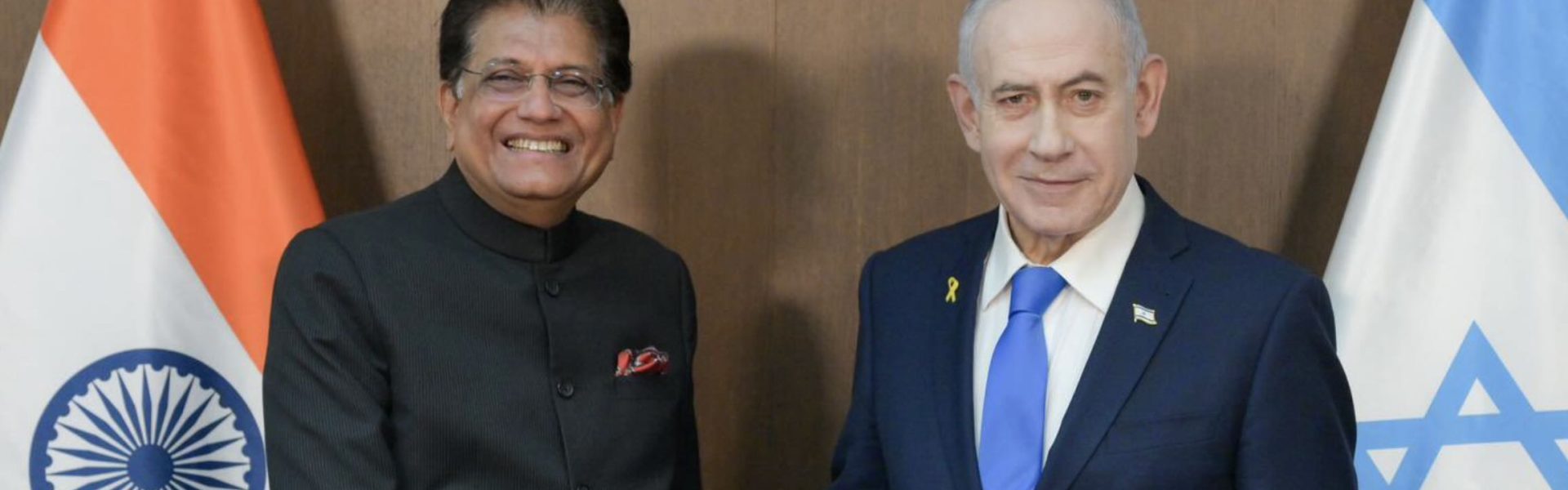







NEW DELHI/TEL AVIV: In a year when West Asia is marked by hostage negotiations, drone warfare and relentless diplomatic brinkmanship, a quieter but far more consequential transformation is shaping the India–Israel relationship. It is not a loud proclamation of alliance but a conscious alignment of interests and strategic purpose — a shift that defines 2025 as a critical juncture in the evolution of this partnership. For India, a civilisational democracy with rising Global South agency, Israel now functions as a partner that strengthens self-reliance in security and expands access to innovation-based economic growth. For Israel, India offers scale, resilience, and a reliable anchor in the changing power dynamics of the Indo-Pacific and Eastern Mediterranean. Both countries now occupy a geopolitical position that links South Asian stability with Mediterranean connectivity and Indo-Pacific geoeconomics, where these spheres increasingly reinforce one another — a role neither wielded so decisively even a decade ago.
The milestones of this year underscore the strategic consolidation underway. The 8 September Bilateral Investment Treaty — Israel’s first under India’s recalibrated investment-policy model that marks durable trust in India’s regulatory direction. Agricultural cooperation has been strategically redirected toward climate-resilient cultivation and advanced water management, integrating Israeli innovation into India’s food-security priorities. And the 21 November commencement of Free Trade Agreement negotiations in Tel Aviv positions the relationship at the forefront of digital trade, agritech, fintech and entrepreneurial collaboration. Collectively, these frameworks deepen not only economic integration but also the principle of shared risk-taking and mutually strengthened prosperity.
Defence collaboration remains the binding force. The early-November defence-technology MoU — deepening joint R&D and co-production — embodies a structural shift from arms transfers to collaborative defence innovation. In an age where asymmetric threats and autonomous weaponry define conflict patterns, India and Israel recognise that a credible deterrent requires technological agility and operational synergy. As Prof. P. R. Kumaraswamy has pointed out, India’s policy toward Israel has steadily evolved “from pragmatic rapprochement to institutionalised strategic cooperation,” reflecting a maturation guided by national interest rather than ideological hesitation. The integration of Israeli systems into India’s defence-industrial modernisation reinforces this evolution and demonstrates how complementary strengths now translate into shared strategic advantage.
In the deepening ties of the India–Israel strategic partnership, marked by the landmark Memorandum of Understanding signed on 4 November 2025 to bolster defence collaboration in technology, training and counter-terrorism, real-world crises have vividly illustrated the depth of this alliance. Israel’s unequivocal backing of the 7 May 2025 precision strikes on terrorist infrastructure in Pakistan (following the Pahalgam attack) underscored shared commitments to combating cross-border terrorism; Israeli officials lauded the operation as a “rightful and measured response” during high-level talks days later. Complementing this, “Operation Sindhu” in June 2025 exemplified seamless crisis-response coordination amid Israel–Iran tensions, as India evacuated over 4,400 Indian nationals from conflict zones in Israel and Iran through 19 special flights, leveraging Israeli intelligence and logistical support for safe passages from Tel Aviv while preserving diplomatic balance. These operations not only operationalised mutual trust under duress but also highlighted the escalating stakes of interdependence—deeper engagement amplifies vulnerabilities, yet fortifies resilience against shared threats in an increasingly volatile region.
The economic and technological agenda complements the security realm. Trade is approaching the USD 11 billion threshold and is poised for significant expansion once tariff schedules and services liberalisation take effect under the FTA. Labour mobility — especially of skilled workers — continues to build societal-level connections and remittance-supported families. Meanwhile, the climate agenda offers a new frontier of convergence, where India’s leadership heading into COP30 pairs naturally with Israeli expertise in water sustainability and desert agriculture. The emerging IMEC connectivity corridor, linking Mumbai to Haifa via Gulf hubs, underscores that this relationship is also about rewriting the geoeconomic landscape of the Indo-Mediterranean sphere.
The diplomatic dimension is equally important — and arguably the most remarkable expression of India’s foreign-policy confidence. India’s approach does not abandon other regional players; rather, it reinforces them. New Delhi continues political and energy engagement with the UAE, Saudi Arabia and Qatar, sustains connectivity diplomacy with Egypt and Jordan, and maintains calibrated channels with Tehran, even as it advocates humanitarian relief and peaceful resolution in Gaza. This is multi-alignment without contradiction — a form of statecraft that treats strategic diversification as a source of influence rather than a sign of indecision. India strengthens defence and technology bonds with Israel without narrowing its broader regional aperture, building credibility as a responsible actor capable of dialogue across divides. For Israel, cultivating a deep relationship with the world’s largest democracy enhances legitimacy in Asia and expands its diplomatic imagination at a time when exclusive reliance on Western security architectures can no longer guarantee long-term resilience.
As cooperation deepens, responsibility expands commensurately — in both strategic scope and ethical weight. New Delhi and Jerusalem must ensure that defence and intelligence collaboration does not overshadow the humanitarian, ethical and developmental dimensions that give this partnership democratic legitimacy and societal resilience. Safeguarding the dignity and rights of Indian workers contributing to Israel’s economy must remain a central priority for both governments. Joint initiatives in cyber security, data governance and AI-driven surveillance systems must embed rigorous accountability to prevent misuse while strengthening mutual trust in sensitive domains. Academic, cultural and scientific exchanges can widen societal literacy and reduce susceptibility to misperceptions at home and across the region. At the same time, clear and proactive strategic communication is essential to protect the relationship from disinformation and adversarial narratives in an increasingly contested information environment. These measures do not slow momentum; they anchor and future-proof it, ensuring that the India–Israel partnership matures not only as powerful and innovative but also as principled, responsible and widely supported.
The cumulative effect is the rise of a partnership that reframes the logic of global engagement — positioning interdependence as a catalyst of sovereignty, not its constraint. This marks a departure from traditional alliance frameworks toward smart-power diplomacy: calibrated, multi-dimensional, and anchored in development outcomes for citizens. It blends the power of deterrence with the legitimacy of economic progress; aligns technology with empowerment rather than dependence; and recognises that national ambition grows more resilient when embedded in trusted and strategically complementary partnerships.
Looking forward, the true test will be whether the structural gains of 2025 can develop into a resilient and socially rooted partnership by the early 2030s. Strategic cooperation must deepen alongside people-to-people linkages; innovation-driven trade must expand while ensuring labour welfare; connectivity must grow without generating vulnerability; and regional engagement must be broadened without misinterpretation. If New Delhi and Jerusalem continue to pursue these objectives with discipline, they will shape not only bilateral outcomes but also broader regional equilibrium — stabilising parts of West Asia, enhancing South Asian deterrence, and strengthening the world’s democratic innovation economy.
In the final analysis, the emerging India–Israel equation is not merely a story of bilateral success — it is a living blueprint for how agile, self-assured states can thrive in a fragmented world. If New Delhi and Jerusalem sustain momentum, calibrate balance with principle, and preserve ethical credibility, they will stand as reference points for nations seeking independence without isolation and interdependence without vulnerability. Their cooperation shows that sovereignty is reinforced — not diminished — when states collaborate on innovation, security and human development. It signals that leadership in the twenty-first century will belong not only to superpowers, but to those who solve real problems through trust, technology and tenacity. What India and Israel are shaping is thus more than a partnership: it is a quiet transformation in the practice of power itself — diplomacy that broadens agency, strategy that advances societal well-being, and statecraft that looks outward with confidence rather than backward with fear. In the decades to come, this may be remembered as a moment when two democracies chose to lead by design — and in doing so, offered the world a future rooted in shared purpose and resilient, responsible and visionary cooperation.
Views: 1353

Dr. Maheep
Dr. Maheep is Director, Indian Perspective on Global Affairs (IPGA), and a leading analyst of India’s foreign policy and South Asian geopolitics. He earned his PhD in Arab and Islamic Studies. With more than a decade of teaching and research experience in International Relations and Global Politics, he contributes regularly on issues shaping national and global affairs.


