






From Nokia to Northern Lights: India–Finland and the Rise of a Democratic Innovation Partnership
For millions of Indians who first encountered the digital revolution at the turn of the millennium, the word Finland evoked a simple yet transformative memory: Nokia. The Finnish telecommunications giant quietly embedded itself in everyday Indian life, placing a mobile phone in millions of hands and catalysing the country’s first great wave of digital connectivity. Long before geopolitical discourse caught up, that technological bridge symbolised an unexpected affinity between two societies that prize innovation, education, and democratic pluralism.
Two decades later, that modest technological connection has matured into a far more consequential strategic convergence. The state visit of President Alexander Stubb to India in March 2026—culminating in the elevation of bilateral ties to a Strategic Partnership in Digitalisation and Sustainability—marks a decisive moment in the evolution of India–Finland relations. Coinciding with his keynote address at the Raisina Dialogue, the visit consolidated a forward-looking partnership between a rising Indo-Pacific power and one of the most technologically sophisticated societies of the Nordic world.
Understanding this partnership requires situating it within the wider transformation of global politics. As technological rivalry intensifies, climate challenges deepen, and supply chains reorganise across geopolitical lines, states increasingly seek partners capable of combining technological innovation with a shared commitment to democratic governance. In this emerging landscape, India and Finland increasingly recognise one another as partners in shaping the governance of technology, sustainable development, and multilateral cooperation—two democracies whose complementary strengths provide a natural foundation for deeper strategic collaboration.
Finland in the Nordic Constellation and India’s Arctic Vision
Situated in Northern Europe between Sweden and Russia and bordering the Baltic Sea, Finland occupies a distinctive geopolitical space within the Nordic constellation. With a population of approximately 5.62 million, Finland’s international influence derives not from demographic scale but from technological sophistication, institutional stability, and diplomatic pragmatism. Within the broader Nordic framework—comprising Finland, Sweden, Norway, Denmark, and Iceland—these countries collectively form one of the highest Human Development Index clusters globally, consistently leading in education, digital governance, and social trust.
Finland’s geopolitical significance has deepened markedly in recent years. For more than seven decades following the Second World War, Finland practised strategic neutrality—often described as Finlandisation—carefully balancing Western democratic values with Soviet strategic sensitivities. Russia’s full-scale invasion of Ukraine in February 2022 fundamentally altered this equilibrium, prompting Finland’s accession to NATO in April 2023. With a 1,340-kilometre border with Russia—the longest land frontier in the European Union—Finland now occupies a frontline role in the evolving security geometry of the Nordic–Baltic region. For India, whose own strategic relationship with Moscow remains a complex inheritance of Cold War-era Non-Alignment and contemporary defence dependencies, Finland’s decisive strategic transformation provides an instructive reference point on the recalibration of foreign policy in an era of renewed great-power competition.
For India, engagement with Finland acquires an additional and increasingly significant dimension through the Arctic. India’s Arctic Policy (2022), titled India and the Arctic: Building a Partnership for Sustainable Development, represents the country’s first comprehensive national framework for engagement with the polar north, structured around six pillars: scientific research; climate and environmental protection; economic and human development; transportation and connectivity; governance and international cooperation; and national capacity building. Collectively, these pillars reflect India’s approach to the Arctic as a domain of science-led diplomacy and rules-based governance rather than resource competition—a positioning that contrasts with China’s more commercially assertive self-designation as a “near-Arctic state.”
As an Arctic state and founding member of the Arctic Council, Finland possesses extensive expertise in polar meteorology, glaciology, cryosphere research, sustainable Arctic infrastructure, and cold-climate technologies. The India–Finland Arctic Dialogue of January 2026—held just weeks before President Stubb’s state visit—underscored this convergence by focusing on Himalayan–Arctic ecosystem linkages. Scientists increasingly recognise that accelerating glacial retreat in the Himalayan “Third Pole” and rapid Arctic warming are interconnected components of the global climate system. For India, whose monsoon patterns, river hydrology, agricultural productivity, and coastal vulnerabilities are shaped by polar climate dynamics, collaboration with Finland’s advanced polar research infrastructure represents a strategic scientific asset of the first order.
Finnish Gender Blueprint: A Role Model for Inclusive Growth
As the world observes International Women’s Day, Finland stands widely recognised as one of the most successful global models of gender equality and inclusive governance. In 1906, Finland became the first nation in the world to grant women both the right to vote and the right to stand for parliamentary election. This historic milestone inaugurated an institutional commitment to gender parity that has continued to shape every dimension of Finnish political, economic, and social life.
Today women hold approximately 46 percent of seats in the Finnish Parliament, and female leadership has become a defining feature of Finnish governance. Finland has produced President Tarja Halonen (2000–2012) and multiple female prime ministers, including Sanna Marin, whose 2019 coalition—in which all five governing parties were headed by women—drew global attention as a singular expression of institutionalised gender parity. Female labour-force participation stands at around 77 percent, substantially above the EU average. Women constitute a strong presence in Finland’s research and innovation sectors, supported by initiatives such as Women in Tech Finland, which advances female participation in artificial intelligence, digital innovation, and advanced manufacturing. Over 60 percent of Finnish diplomats are women, reflecting a systematic mainstreaming of gender equality across foreign policy practice.
The World Economic Forum’s Global Gender Gap Report 2025 ranks India 131st out of 146 countries—a figure that reflects the scale of the opportunity as much as the scale of the challenge. India’s constitutional architecture—particularly Articles 14 and 15, which guarantee equality and prohibit discrimination on the basis of sex—provides a strong normative foundation. The Finnish experience illustrates how long-term institutional frameworks, encompassing universal childcare, active labour-market policies, equal-pay enforcement, and educational parity, can translate such constitutional commitments into sustained societal outcomes.
The Migration and Mobility Partnership signed during President Stubb’s visit creates structured pathways for Indian students, researchers, and technology professionals—including women scientists—to engage with Finland’s advanced innovation ecosystem. When Indian women scientists work alongside Finnish counterparts in Arctic research laboratories or 6G development centres, they carry back not merely technical knowledge but experiential proof that structural equality is simultaneously achievable and economically productive. On International Women’s Day 2026, the India–Finland strategic partnership carries symbolism that transcends technology agreements: it is, in microcosm, a dialogue between two democracies at different stages of the same journey, committed to a shared destination.
Seven Decades of Quiet Diplomacy: The Historical Substratum
Diplomatic relations between India and Finland were formally established in 1949, shortly after Indian independence. For much of the Cold War period, interactions remained cordial yet modest. India, as the leading voice of the Non-Aligned Movement, maintained strategic autonomy amid superpower rivalry; Finland, situated on the Soviet frontier, pursued its own carefully calibrated neutrality. Despite differing geopolitical circumstances, both cultivated a diplomatic culture valuing pragmatic engagement, multilateralism, and the architecture of international law.
The relationship acquired renewed institutional momentum through the 12th Foreign Office Consultations held in New Delhi in November 2023, led by India’s Secretary (West) Sanjay Verma and Finland’s Permanent State Secretary Jukka Salovaara. The consultations addressed cooperation in digital technologies, sustainability, Arctic governance, and UNSC reform, while preparing to commemorate the 75th anniversary of diplomatic relations in 2024. The first-ever virtual summit between Prime Minister Narendra Modi and Finnish leadership on 16 March 2021 marked a qualitative acceleration in bilateral ambition, followed by Modi’s participation in the India–Nordic Summits in Stockholm (2018) and Copenhagen (2022).
The institutional architecture of the partnership was assembled methodically. The Joint Declaration of Intent on Digitalisation (2019), the MoU on Defence Production and Research and Development (2020), and the MoU on Environmental Cooperation (2020) each added structural capacity—laying, brick by brick, the foundations upon which the 2026 Strategic Partnership was ultimately built. Bilateral merchandise trade has expanded to approximately USD 1.39–1.52 billion, with services trade estimated at USD 1.95 billion in 2024. During April–December FY 2025–26, bilateral trade recorded 19 percent year-on-year growth, with Indian exports rising by 11 percent and Finnish exports to India increasing by 24 percent, narrowing the trade deficit to an estimated USD 300–400 million.
President Stubb in India: Raisina Dialogue and the Architecture of Partnership
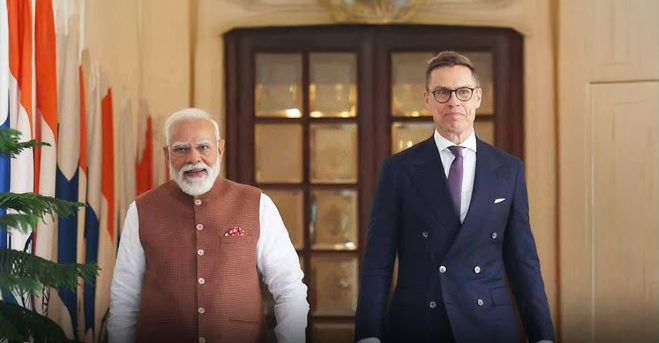
President Alexander Stubb—philosopher-statesman, marathon runner, and lifelong Europeanist—arrived in New Delhi on 4 March 2026 leading a delegation of senior officials, business executives, and technology leaders. The bilateral summit at Hyderabad House engaged the full spectrum of shared interests: democratic governance, international law, multilateral institution reform, and the imperative of dialogue-based resolution of the conflicts in Ukraine and West Asia. Both leaders reaffirmed their shared commitment to eradicating terrorism in all forms and expressed support for UNSC reform, on which Finland has consistently expressed understanding of India’s long-standing aspirations.
As Chief Guest at the Raisina Dialogue 2026—Asia’s foremost geopolitical conference—Stubb delivered a keynote that ranged across the fracturing international order, the emergence of a multipolar world, and the indispensability of India as a co-architect of whatever governance architecture would succeed the current period of institutional turbulence. He was unambiguous in his view that the world required more multilateralism, not less—a conviction grounded in Finland’s own existential experience of small-state survival in a great-power neighbourhood and its historic transition from Finlandisation to full NATO membership. His dialogue with External Affairs Minister Dr S. Jaishankar illuminated the growing convergence between Indian and Nordic perspectives on the governance of a post-Western multipolar order.
The formal outcomes, published by the Press Information Bureau on 5 March 2026, were extensive. At their centre was the elevation of India–Finland relations to a Strategic Partnership in Digitalisation and Sustainability. A Joint Working Group on Digitalisation was established to advance cooperation in 5G, 6G, quantum communications, high-performance computing, and artificial intelligence. A Joint Task Force on 6G links the University of Oulu’s internationally recognised 6G Flagship programme with India’s Bharat 6G Alliance, creating a research-to-standards pipeline that positions both countries as contributors to, rather than recipients of, the architecture of next-generation telecommunications. The symbolism is striking: Nokia, which once introduced millions of Indians to mobile communication, now finds its technological legacy extended through collaborative efforts shaping the sixth-generation digital nervous system of the world.
The Indo-Finland Startup Corridor connects Helsinki’s globally celebrated Slush conference with India’s Startup Mahakumbh platform, linking venture capital networks, research institutions, and technology entrepreneurs across both countries. The agreement to co-host the World Circular Economy Forum 2026 in India—jointly with SITRA, Finland’s Innovation Fund and the global intellectual driver of circular economy thinking—signals India’s readiness to engage circular economy principles programmatically rather than rhetorically. The Migration and Mobility Partnership Agreement creates structured pathways for professionals, students, and researchers, recognising that Finland’s world-class innovation ecosystem demands international talent at scale and that India’s vast pool of technology and research professionals represents an extraordinarily well-matched supply.
On sustainability, the renewal of the MoU on Environmental Cooperation expands collaboration in bioenergy, waste-to-energy technologies, green hydrogen, energy storage, and wind and solar power—sectors where Finnish technological precision complements India’s Net Zero commitment and its National Green Hydrogen Mission targeting one million metric tonnes of production by 2030. Finland’s own carbon-neutrality target of 2035 and India’s net-zero commitment by 2070 establish a shared temporal horizon for sustainability convergence.
Joint Research Calls between India’s Department of Science and Technology and Business Finland focusing on semiconductors, 6G, and energy systems institutionalise scientific collaboration at the most fundamental level: the allocation of public resources to shared discovery. An MoU on statistical cooperation and a standing Consular Dialogue mechanism complete an institutional architecture designed for structural depth and administrative durability.
The EU-FTA Catalyst: From USD 1.5 Billion to USD 3 Billion by 2030
The bilateral trade relationship between India and Finland has historically been characterised less by its scale than by its structural quality. The most transformative catalyst for its future expansion is the India–European Union Free Trade Agreement, concluded at the 16th India–EU Summit in New Delhi on 27 January 2026—Republic Day, a date of considerable symbolic resonance. The agreement establishes a new tariff and regulatory architecture across an economic space exceeding USD 30 trillion in combined GDP and nearly two billion people, eliminating or substantially reducing tariffs on 96.6–99.5 percent of traded goods.
For Finland, as a member of the European Union, the FTA facilitates greater access for Finnish clean-technology solutions, advanced machinery, and digital infrastructure, while opening EU markets to Indian pharmaceuticals, textiles, information technology services, and manufactured goods. As Dr Maheep notes in his analysis of the 2026 India–EU Summit, the agreement represents the “mother of all deals”, signalling a decisive phase in the consolidation of economic and technological cooperation between India and Europe. Within this evolving framework, the joint commitment to doubling bilateral India–Finland trade to approximately USD 3 billion by 2030 emerges not as a rhetorical aspiration but as a structurally grounded projection.
A significant precursor to this wider liberalisation architecture was the India–EFTA Trade and Economic Partnership Agreement (TEPA), which entered into force on 1 October 2025. As Dr Maheep’s analysis in The European Timesobserved, the EFTA agreement represents “a new strategic grammar of India’s economic diplomacy”—one that blends state-led development imperatives with global market integration while attracting high-value technological investment. The India–EU FTA represents the far more expansive continuation of this evolving economic strategy.
The India–Finland Business Summit and CEO interactions held in Mumbai on 7 March 2026, the concluding day of President Stubb’s visit, translated strategic partnership commitments into commercial pipelines across clean energy, digital infrastructure, healthcare innovation, and advanced manufacturing. The presence of a substantial Finnish business delegation signalled the confidence that Finnish industry invests in India’s expanding innovation ecosystem. President Stubb’s address at the University of Mumbai—one of Asia’s oldest academic institutions—added the intellectual dimension of knowledge exchange, research collaboration, and academic mobility to a visit that thus engaged the full depth of the bilateral relationship: governmental, commercial, academic, and civilisational.
Strategic Convergence in a Multipolar World
The elevation of India–Finland relations must also be understood within the wider transformation of the contemporary international order. At the G20 Summit in Johannesburg in 2025, Finland participated as part of the Nordic grouping, with President Alexander Stubb emphasising that global governance must integrate digital transformation, sustainable development, and humanitarian values within the architecture of economic cooperation. Finland’s collaboration with South Africa on the G20 Digital Economy Track reflected the Nordic conviction that digital inclusion and transparent governance are essential components of sustainable development—an approach that resonates strongly with India’s own G20 Presidency in 2023, which placed digital public infrastructure and the concerns of the Global South at the centre of the international agenda.
As Dr Maheep observes in his analysis of India–EU relations at the dawn of 2026, the present moment represents a phase of “strategic consolidation”, where technological partnerships, economic integration, and shared multilateral commitments increasingly shape the evolving architecture of India–Europe engagement.
Finland’s NATO membership and India’s policy of strategic autonomy represent distinct geopolitical orientations, yet both countries converge on a commitment to a rules-based international order capable of accommodating a multipolar world. Both advocate UNSC reform, the integration of climate concerns into global governance, and diplomatic resolution of international conflicts. Stubb’s expressed disquiet about the Trump administration’s territorial ambitions regarding Greenland, the strain on transatlantic collective defence arrangements, and the human costs of the Russia–Ukraine conflict found resonance in a New Delhi that has consistently championed dialogue over confrontation. These convergences are not incidental: they reflect the structural condition of two democracies that have learned, through different historical experiences that principled multilateralism is the indispensable architecture of peace.
Beyond institutional frameworks, the India–Finland partnership also carries a deeper civilisational dimension. Finland’s cultural concept of sisu—resilient determination in conditions of adversity—and India’s philosophical concept of dharma—the righteous pursuit of duty in the face of complexity—are distinct traditions that nonetheless converge around a common appreciation for principled perseverance. Such resonances underscore that this partnership is not only the product of economic complementarity or diplomatic pragmatism, but an expression of a broader intellectual dialogue between democratic societies navigating an increasingly turbulent global landscape.
The Long Arc: From Nokia’s Signal to the Northern Lights
When the Nokia ringtone first resonated on Indian mobile phones in the late 1990s, it quietly introduced a small Nordic nation into the everyday technological life of a rising India. When Prime Minister Narendra Modi and President Alexander Stubb elevated bilateral ties to a Strategic Partnership in Digitalisation and Sustainability in March 2026, they signalled a deeper recognition: that India and Finland now occupy complementary roles in shaping the technological, environmental, and institutional foundations of the twenty-first-century international order.
The evolution of this relationship traces a long and purposeful arc. From the modest diplomatic exchanges of the Cold War period to the institutionalised engagement of the 2020s; from Nokia’s first digital connection to contemporary collaboration in 6G telecommunications, quantum computing, circular economy frameworks, and Arctic–Himalayan climate research; and from sector-specific memoranda to a comprehensive strategic partnership—India–Finland relations have matured into a multidimensional framework linking innovation, sustainability, and global governance with remarkable structural depth.
The partnership also illuminates the importance of inclusive development. Finland’s century-long commitment to gender equality demonstrates how social inclusion strengthens economic vitality and institutional resilience. For India, which increasingly embraces the doctrine of women-led development, the Finnish experience offers a living proof of concept: that nations which invest in the full participation of women in political, economic, and intellectual life do not merely advance justice—they compound their own capacity for innovation, stability, and global influence.
From Nokia to the Northern Lights, this is an arc of expanding ambition and deepening trust—built not on geographic proximity but on the convergence of values, capabilities, and a shared conviction that the challenges of the twenty-first century are navigated most effectively through the disciplined architecture of collaboration. The Strategic Partnership announced in New Delhi in March 2026 is, by every structural indicator, built for that long arc. And in the luminous northern sky, those lights have only just begun to shine.
Views: 1403

Dr. Maheep
Dr. Maheep is Director, Indian Perspective on Global Affairs (IPGA), and a leading analyst of India’s foreign policy and South Asian geopolitics. He earned his PhD in Arab and Islamic Studies. With more than a decade of teaching and research experience in International Relations and Global Politics, he contributes regularly on issues shaping national and global affairs.