


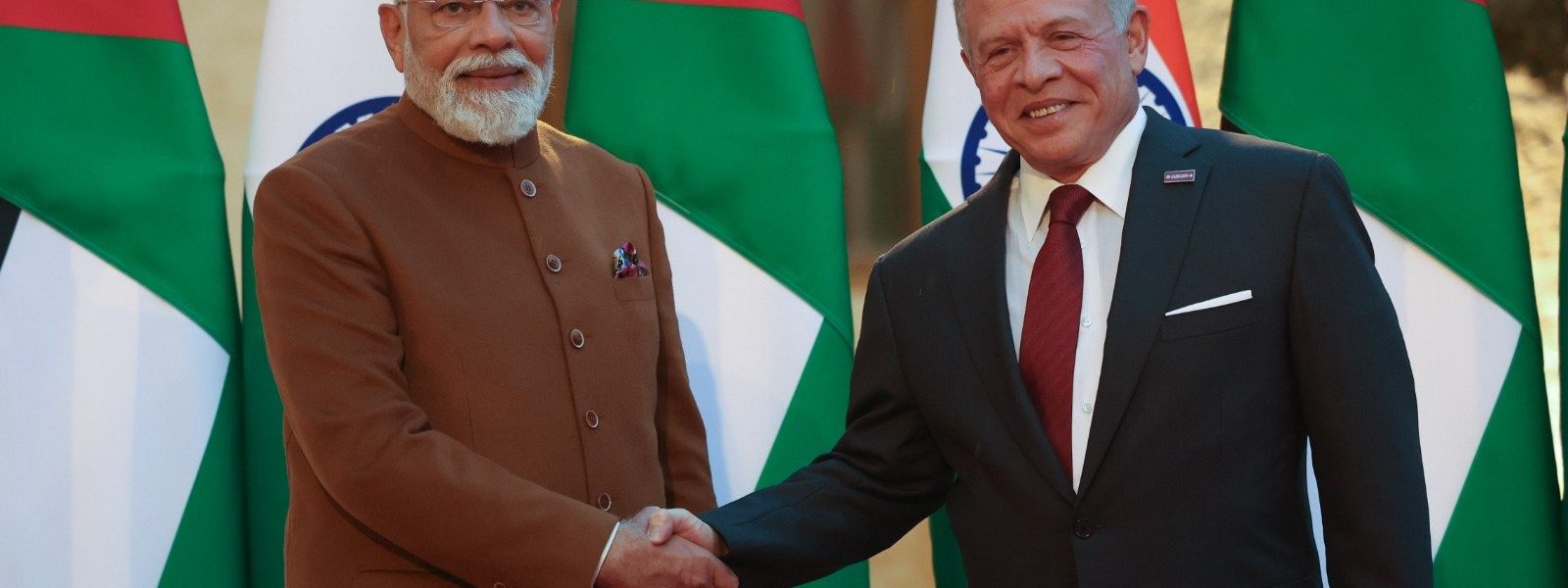







Seventy-five years after the establishment of diplomatic relations in 1950, the December 2025 visit of Indian Prime Minister Narendra Modi to the Hashemite Kingdom of Jordan marked a moment of strategic re-articulation, recalibrating India–Jordan relations within a shifting regional and global order. Unfolding at a juncture of profound historical and geopolitical resonance, the visit elevated a partnership long sustained by goodwill into one defined by strategic coherence, developmental purpose, and civilisational self-assurance rooted in continuity and ethical statecraft—reflecting the manner in which India approached West Asia at a time of systemic flux.
The anniversary thus offered India and Jordan an opportunity to consolidate this transformation by deepening institutional depth and strategic coherence. In Amman, India demonstrated a diplomatic grammar embedded in continuity, ethical rationality, and long-term stability—an approach increasingly characteristic of its global posture in a fragmented international order.
India–Jordan relations draw from a civilisational substrate that predates modern statehood. Long before formal diplomatic engagement, South Asia and the Levant were connected through ancient trade routes, pilgrimage networks, and intellectual exchange. The movement of spices, textiles, technologies, and ideas across the Indus–Mediterranean corridor grounded in India within the historical imagination of West Asia. From a constructivist perspective, such historical memory is not incidental; it shapes perceptions, expectations, and normative comfort. Prime Minister Modi’s invocation of these ancient linkages functioned as identity reinforcement rather than symbolism, situating contemporary cooperation within a longue durée of civilisational interaction.
The visit to the Jordan Museum alongside the Crown Prince lent tangible expression to this historical consciousness. It conveyed a diplomatic philosophy in which heritage and progress reinforce one another, captured succinctly in India’s idiom of Vikas bhi, Virasat bhi (progress without the erasure of heritage). Culture, in this setting, operated as strategic capital—socialising trust, reducing relational distance, and stabilising expectations in a region where legitimacy is deeply entwined with historical continuity.
The engagement between Prime Minister Modi and King Abdullah II reflected a convergence of leadership worldviews grounded in moderation, dialogue, and responsibility. Their interaction carried the ease of sustained mutual regard rather than episodic diplomacy. Jordan’s consistent alignment with India on counter-terrorism, multilateral reform, and regional stability reflects a normative convergence rather than transactional calculation. In turn, India recognises Jordan as a stabilising force in West Asia, whose diplomatic credibility rests on restraint, pragmatism, and principled engagement. From the standpoint of strategic culture, such alignment is decisive: enduring partnerships are sustained when states share underlying assumptions about order, legitimacy, and appropriate conduct.
India’s engagement with Jordan illuminates the maturation of its strategic culture in West Asia. Rather than privileging coercive leverage or alliance entanglements, India advances a model of diplomacy oriented toward equilibrium, predictability, and institutional durability. Stability is pursued through sustained presence, respect for sovereignty, and long-term cooperative frameworks rather than securitised postures. Throughout the visit, India’s commitment to non-intrusive diplomacy remained evident. Political dialogue emphasised autonomy, dialogue-driven solutions, and cooperative problem-solving, indicating a preference for institutionalised cooperation and norm reinforcement over power projection. Security discussions centred on shared responsibility and counter-terrorism cooperation rooted in legitimacy, reinforcing regional resilience without escalating strategic anxieties.
Viewed through the civilisational state framework, India’s diplomacy in Jordan reflects a synthesis of identity, ethics, and strategic rationality. India projected itself as a plural and continuous civilisation, confident in its historical depth and ethical traditions. This self-understanding resonates strongly in West Asia, where continuity and legitimacy remain central to political discourse. The emphasis on water security, renewable energy, healthcare, and digital infrastructure illustrated how development functions simultaneously as moral responsibility and strategic investment. For Jordan, confronting structural water scarcity and energy challenges, India’s technological cooperation offers solutions grounded in partnership and shared capacity rather than dependency.
Discussions on humanitarian assistance, including regional crises such as Gaza, further underscored India’s ethical realism. By supporting humanitarian corridors through Jordan and endorsing dialogue-based approaches, India reinforced its identity as a responsible global actor attentive to regional sensitivities while remaining anchored in pragmatic statecraft.
The economic dimension of the visit translated strategic vision into institutional substance. The signing of five Memoranda of Understanding and the articulation of an eight-point roadmap reflected a commitment to structured and forward-looking economic integration. India’s aspiration to expand bilateral trade to USD 5 billion by 2030 was framed within a broader developmental narrative rather than a narrow commercial calculus. By prioritising renewable energy, pharmaceuticals, digital governance, healthcare, start-ups, and agri-technology, India aligned economic cooperation with Jordan’s developmental trajectory and its own comparative advantages. This approach reflects a distinctly Indian political economy—one that privileges growth with resilience, innovation with inclusion, and markets embedded in social purpose. Trust, rather than leverage, emerges as the principal multiplier.
Jordan’s strategic geography further situates it as a potential node in emerging connectivity architectures, including the India–Middle East–Europe Economic Corridor (IMEC). India’s engagement thus extends beyond bilateralism into regional integration and geo-economic strategy. By strengthening ties with Amman, India enhances its capacity to participate constructively in West Asia’s evolving connectivity landscape, linking South Asia, the Gulf, the Levant, and Europe through trade, energy, and digital corridors. Jordan’s political stability and diplomatic credibility render it a natural partner in this endeavour.
Security cooperation between India and Jordan rests on a shared normative understanding of legitimacy and responsibility. Both states articulate counter-terrorism as a collective moral imperative, reinforcing international norms against extremism. Jordan’s unequivocal solidarity with India on terrorism deepens this alignment. From a constructivist lens, such shared norms stabilise expectations, reduce uncertainty, and facilitate sustained strategic coordination across security domains.
The renewal of the Cultural Exchange Programme for 2025–2029, alongside proposals for academic collaboration, tourism promotion, and diaspora engagement, underscores the centrality of societal linkages in India–Jordan relations. India’s soft power—manifested through culture, education, yoga, and civilisational appeal—functions as connective tissue sustaining bilateral ties beyond governmental cycles. These people-centric dimensions lend durability, legitimacy, and emotional resonance to the partnership.
Within India’s broader West Asia strategy, Jordan occupies a distinctive role—not as an energy supplier or military ally, but as a strategic stabiliser. Its moderation, diplomatic credibility, and connectivity complement India’s multipolar worldview and reinforce a regional approach that integrates security, development, culture, and connectivity into a coherent strategic framework.
The seventy-fifth anniversary of India–Jordan diplomatic relations, refracted through Prime Minister Modi’s engagement in Amman, crystallised a broader reorientation in India’s approach to West Asia—one defined by continuity, institutional depth, and ethical imagination. The visit illuminated a mode of diplomacy in which meaning, civilisational consciousness, and strategic foresight converge to offer a durable framework for partnership in an era of flux. In a region undergoing profound geopolitical and normative realignments, the India–Jordan relationship affirms how trust can be cultivated through development, dialogue, and shared historical awareness rather than through assertion alone. As West Asia navigates uncertainty and transformation, this partnership stands as an exemplar of how civilisations engage as states and states act as responsible civilisations. What emerged in Amman was therefore not a singular diplomatic moment but an enduring reference point—one that illuminates the future contours of India’s role in regional and global order, grounded in institutional depth, inclusive engagement, and a sustained commitment to shaping history with patience, prudence and purpose.
Views: 998

Dr. Maheep
Dr. Maheep is Director, Indian Perspective on Global Affairs (IPGA), and a leading analyst of India’s foreign policy and South Asian geopolitics. He earned his PhD in Arab and Islamic Studies. With more than a decade of teaching and research experience in International Relations and Global Politics, he contributes regularly on issues shaping national and global affairs.


