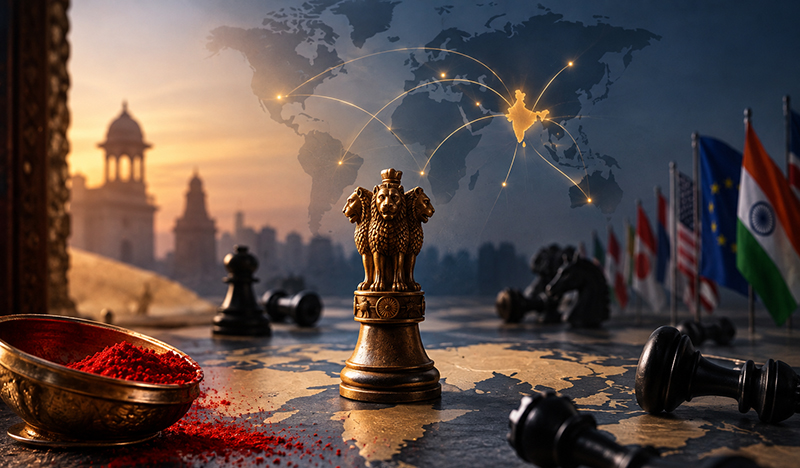







I was in Iran on a research visit when Operation Sindoor began. I had travelled there for fieldwork and an academic seminar, and on an evening given over to conversation among scholars, it was a Pakistani participant at the table who told me that fighting had broken out between our two countries. The news carried a weight that the study of these matters rarely prepares one for. I had spent years examining the calculations by which states pursue their interests. I now sat abroad, an Indian among foreign colleagues, absorbing the knowledge that my country had launched a retaliatory operation against Pakistan and turning over a question that felt suddenly personal. When the moment came, who would stand with India, and what would their standing be worth?
What formed in my mind over the days that followed was an impression of the asymmetry of company, and I offer it as that, an impression rather than a settled audit. Pakistan did not appear to face the crisis alone, and its principal partners did not conceal their alignment. China had supplied the aircraft, missiles and air-defence systems over many years, and its diplomatic voice moved quickly to Islamabad’s side; Turkey had supplied drones, and its sympathy was expressed in the open. India, by contrast, prosecuted its operation without a comparable public chorus, and no great power declared itself for New Delhi in the demonstrative manner that others aligned themselves with Rawalpindi. India was not friendless, and it was not without partners of consequence. Yet visibility is one thing and value another. Public endorsement, weapons supplied over decades and assistance rendered during combat are distinct forms of support, and diplomatic noise establishes none of them by itself. What unsettled me was how much louder Pakistan’s alignments sounded than India’s, and how little that volume revealed about what any of these friendships would deliver at the hour they were tested. That question became the starting point of a longer inquiry into what a partnership is actually worth when it must perform.
A Framework Arrives
Sixteen months later, on 3 September 2026, India’s Ministry of Defence released a document it called RAKSHA. Defence Minister Rajnath Singh unveiled it as a ten-year framework for the country’s global defence partnerships, organised around four pillars: strategic partnerships, the building of partner capacity, indigenous production and exports under the banner of self-reliance, and maritime security in an Indian Ocean where India casts itself as net security provider and first responder. The timing invited a tempting inference that should be resisted. The public record does not show that the May crisis produced RAKSHA, and honest analysis will not claim a paternity the evidence cannot support. Yet the crisis remains the sharpest lens through which to read the framework, because it posed in live fire the question RAKSHA exists to answer. Under what conditions can defence diplomacy give a nuclear-armed state, hemmed in by a difficult neighbourhood, the readiness and the reliable partnerships that let it act on its own terms when a crisis comes?
Autonomy Is a Conversion, Not a Possession
Strategic autonomy is often spoken of as though it were a stockpile, a quantity of ships and squadrons and missiles that a state accumulates until it is free. It is nothing of the kind. Autonomy is the capacity to make an independent choice at the moment a choice is forced, and that capacity is produced, not owned. It is the outcome of a conversion, in which diplomatic access becomes command over the systems a state fields, production becomes supply that does not fail under strain, and a partnership becomes a relationship that delivers when delivery is costly. A country may hold a formidable inventory and still be unable to use it, if the conversion has not been made.
Five things determine whether it has. The first is readiness, the plain condition of forces, munitions and trained crews standing available for immediate use. The second is technological control, the difference between operating a system and commanding it, between holding a platform and holding the right to sustain, repair and upgrade it without another government’s leave. The third is industrial endurance, the capacity to replace what a war consumes for as long as it lasts. The fourth is the reliability of partners, the likelihood that access and deliveries will materialise when a crisis raises their price. The fifth is diplomatic freedom under escalation, the room a state keeps to manage a confrontation and to end it on terms it can accept.
These do not add together. They interact, and the interaction obeys a threshold. A single severe dependence, in a domain with no substitute and a long replacement time, can render an otherwise powerful force unusable at the decisive moment. Propulsion is such a domain, and so are precision-guided munitions and the space-based services on which modern targeting depends. A dependence on a commodity many suppliers offer is manageable. A dependence on a sole source that can be switched off is a vulnerability no quantity of other strengths will offset. This is why the number of a state’s partners tells one so little, and why the depth of what each partnership actually delivers tells one nearly everything. The work of autonomy is the identification and the closing of the dependencies that cross the threshold.
The Stress Test
Operation Sindoor put each of these to the test under real pressure. India launched it in the early hours of 7 May 2025, striking sites associated with terrorist infrastructure in Pakistan and Pakistan-administered Kashmir after gunmen murdered twenty-six civilians at Pahalgam on 22 April. The exchanges ran four days and ceased on 10 May. The operation carried a distinction that loose commentary tends to blur. When Indian airpower struck Balakot in 2019, its target lay in Khyber Pakhtunkhwa, in Pakistan proper rather than the disputed sector, yet the strike was delivered across the Line of Control. In May 2025, Indian strikes crossed the settled international boundary itself and reached targets in the Pakistani heartland. The novelty of Sindoor lay less in the location of what it hit, since Balakot had already reached Pakistani soil, than in the boundary its weapons crossed to get there, and a precise account keeps target, boundary and flight path separate rather than collapsing them into one claim.
The more instructive part of the episode was what it revealed about support, and here precision is a duty. That China had equipped Pakistan over many years is not in dispute; roughly four in five of Pakistan’s major arms imports in the last five years came from China, and Pakistani forces flew Chinese J-10C fighters carrying PL-15 missiles, debris of which India recovered on its own soil. That Turkey supplied the drones used against Indian positions is likewise established, and diplomatic endorsement was given openly. Beyond this lie the contested claims, which must be held apart from the settled ones. Indian officials maintain that China realigned satellite coverage to feed Pakistan reconnaissance in something close to real time, and a senior Indian general described the conflict as a live laboratory in which Beijing tested its systems against Indian ones. Beijing described its contacts with Islamabad as routine consultation between allies. The distinction is not pedantry. Equipment supplied over years describes an ordinary client relationship. Real-time targeting, if it occurred, describes an operational partnership of a graver kind, and a serious reading of India’s predicament must weigh the graver possibility without asserting it as fact.
India, for its part, fought with a diverse arsenal, stand-off cruise missiles and layered air defences drawn from Russian, French, Israeli and domestic sources, and its endurance rested throughout on the reliability of those suppliers for the spares, sensors and munitions a longer campaign would have demanded. The demand never fully came. Consumption in war depends on its intensity, on the stocks a state begins with and on the weapons it expends, and a four-day exchange interrogates none of these as a protracted campaign would. India’s forces performed well and its escalation was controlled, and the outcome favoured New Delhi at the tactical level. The brevity of the confrontation, however, offers limited evidence about the country’s capacity to sustain a substantially longer one. The uncertainty I had felt at that dinner table was neither confirmed nor dispelled. It was deferred.
Technology, Endurance and the Shadow of the Bomb
Modern military power turns less on the possession of platforms than on the connective tissue that makes them usable: the surveillance that finds a target, the networks and space services that carry a firing solution, the electronic warfare that survives a contested spectrum, the drones and the defences against them that filled the skies over the subcontinent in May. India’s position across these domains is uneven, and its dependence sits most heavily in the one that has long defined the ceiling of its ambition, the jet engine.
Here the F414 engine is the hinge of the whole argument, because it shows the difference between access and control in a single case. General Electric and Hindustan Aeronautics have agreed to co-produce the engine in India for the Tejas fighter, an arrangement announced in outline in 2023 and elaborated since. Indian reporting places the share of manufacturing technology to be transferred at around four-fifths, a figure that describes licensed production rather than ownership. Three things must be held apart that enthusiasm tends to merge. The transfer of manufacturing technology lets India build the engine. The intellectual property, which the American firm retains in large part, governs who may alter and license the design. And sovereign design authority, the capacity to conceive and certify an engine of one’s own, is a further step no co-production arrangement confers. The deal is a genuine advance, and it speaks directly to the propulsion dependence that has constrained India’s air forces for a generation. Yet it proceeds under American licensing, the underlying property remains substantially in American hands, and the final contractual position is a matter to confirm against the parties’ own documents rather than to assume. This is access of a high order. It is not yet control, and the distance between the two is the distance RAKSHA must travel.
Endurance is the quieter half of the problem, and the war in Ukraine has taught it to everyone paying attention. Protracted high-intensity fighting consumes munitions at rates peacetime planning rarely imagines, and a supplier consumed by its own war becomes an unreliable source for anyone else. India draws around forty per cent of its major arms from Russia, whose wartime disruptions have already delayed Indian deliveries. A magazine that cannot be refilled is a magazine that empties, and the state depending on a distracted patron for refills is a state whose war has a clock running against it.
All of this unfolds beneath a nuclear ceiling, which changes every calculation. The presence of nuclear weapons on both sides opens a space for provocation below the threshold of full war, in which sub-conventional violence and calibrated strikes can occur precisely because neither side wishes to climb to the top of the ladder. India’s operation in May was fitted carefully into that space, designed to impose cost while staying beneath the level that would summon nuclear signalling. Preparedness in such an environment is not only the capacity to strike. It is the capacity to communicate in a crisis, to avoid the misperception that turns a limited exchange into an unlimited one, and to find the off-ramp that ends a confrontation on acceptable terms. A doctrine that builds only the means of striking, and neglects the means of talking and of stopping, prepares a state for the easy half of a nuclear crisis and abandons it in the hard half.
Three Conflicts, One Lesson
India’s own past and the world’s recent conflicts point, from different directions, at the same vulnerabilities. Kargil in 1999 was a war of surprise, in which an intelligence gap became a battlefield disadvantage that costly high-altitude fighting had to redeem, and its enduring lesson concerns the surveillance and reconnaissance that keep a state from being surprised again. Ukraine is a war of endurance, and its lesson concerns the industrial depth and the diversified supply that let a state keep fighting when the fighting does not stop. The Red Sea, where a modest actor has held some of the world’s most important shipping lanes at risk, is a war of chokepoints, and its lesson concerns the maritime presence and the capacity for first response on which the security of trade and energy depends.
Compressed together, these point to a single recurring truth. A force optimised for the last crisis may fail the next, because the crises differ in kind. An army built for a short, calibrated exchange may lack the depth for a long war of attrition, and a force built for endurance may want the responsiveness a rapid confrontation demands. India has just fought a brief, calibrated operation and drawn conclusions about its competence. The harder task is to prepare for the protracted conflict it has not fought, without losing the readiness for the short crisis it may face again.
The Pillars, Judged by What They Deliver
RAKSHA’s four pillars are best judged not by the language that announces them but by the capability they can be shown to produce. Take partnerships first. India has diversified its suppliers deliberately, drawing major arms from Russia, France and Israel in descending share, and diversification is a real gain, for it spares a state the coercion a single supplier can exert. It is also a burden, for a mixed arsenal multiplies the interfaces to manage and the repair rights to secure. The decisive matter is not how many partners India counts but how deep the access each grants, and above all whether India holds the rights to sustain and upgrade its systems without a supplier’s continuing consent. Where those rights are withheld, the platform remains capable on paper yet dependent in practice, since every overhaul, spare and modification must pass through another government’s approval.
Capacity-building, the second pillar, lives or dies by persistence. India’s widening web of defence attachés, exercises and training across the Indian Ocean and Southeast Asia builds trust cheaply and opens doors, but the effect depends on a partner’s own priorities, which India does not control, and on continuity, which demands resources year after year. The line between strategic depth and ceremony is drawn by whether India shows up reliably over a decade, not by the frequency of a photograph.
The third pillar, production and exports, is where a false alarm must be dismissed and a real one sounded. India’s defence exports reached a record of some 38,000 crore rupees in the last financial year, even as the country remained the world’s second-largest importer of major arms. This is not the contradiction it is often called. A state at an intermediate stage of industrial development can sell what it has learned to build and buy what it has not, and the coexistence proves nothing on its own. What matters is the composition beneath the totals, and there the questions are exacting. How much of the value is genuine domestic design rather than the assembly of foreign parts, and who holds the design authority, the intellectual property, the right to certify and to modify? A rupee figure of export authorisations and a volume measure of major weapons transferred are different instruments answering different questions, and neither alone settles whether India is closing the dependencies that constrain it. Sovereignty is not assembled on a domestic line from imported essentials. It is built where propulsion, sensors, semiconductors and software are commanded rather than sourced.
The maritime pillar, fourth, carries a revealing tension in its own vocabulary. India calls itself a net security provider in the Indian Ocean, yet its operational language and much of its expert commentary have drifted towards the more modest posture of a preferred security partner and first responder, an acknowledgement that the provider’s role outruns present capacity and that littoral states guard their sovereignty against arrangements implying dependence. RAKSHA’s public text keeps the more ambitious phrase even as practice has moved towards the humbler one, and the gap between them is itself a finding. The sea is where India’s usable influence is likely to grow fastest, because presence and assurance count for much there. But the growth demands a fleet whose expansion competes for money with the army that guards a contested land frontier, a problem of allocation rather than a settled impossibility. Its resolution will be visible in the naval share of successive defence budgets and in the pace of shipbuilding, and those figures, more than any declaration, will show how far the maritime ambition is genuinely funded.
The Modest Value of Coordination
What, then, is genuinely new in RAKSHA? On the evidence available, its disclosed pillars largely codify what India already does. The diversification of partners, the expansion of attachés and exercises, the drive for indigenous production and the vocabulary of maritime security all predate the document. The visible novelty is the ten-year horizon and the act of gathering these strands into one architecture, which is less than a revolution and more than nothing. A framework that aligns incentives across the diplomatic service, the armed forces and the defence industry, and sequences investment across them, can produce a coherence that scattered instruments do not. And because the full text functions as an internal document rather than a published one, judgment on its deeper institutional machinery is best reserved rather than asserted in either direction.
The real test is implementation, where India’s ambitions have historically thinned. Announced spending is not executed spending, installed capacity is not achieved output, and a diplomatic commitment is not a delivered capability. The proof of RAKSHA will be sought in delivery over ten years, not in the elegance of its launch.
The Freedom to Choose
The question that found me at a dinner table in Iran has an answer with a shape, if not yet a resolution. The freedom diplomacy secures for a state in crisis is bounded by the reliability of the support its preparedness rests upon, and that reliability is measured not in the number of a country’s friends but in the depth of the control it commands, the certainty of the replenishment it can count on, and the dependability of the partners who must choose, when the cost is high, whether to deliver. India learned in four days of May that its forces are capable and its friendships quieter than its adversary’s. It did not learn whether those friendships would hold through a longer trial, because the trial was mercifully brief.
Four priorities emerge from this analysis, and their order matters. The first is to convert access into control, to turn the technology India is granted into the technology it commands, beginning with the engine and the other domains where a decision in a foreign capital can still ground an Indian fighter. The second is to deepen production into endurance, so that a magazine can be refilled through a campaign rather than only before one. The third is to test partnerships against strain rather than to assume their loyalty, since the alignment loud in peacetime is not always present in conflict. The fourth is to use defence diplomacy for more than the accumulation of arms, to build the channels of communication and the off-ramps a nuclear neighbourhood makes indispensable. Deterrence rests on industrial depth, maritime assurance on a fleet that ambition alone will not build, dependable partnership on delivery under pressure, and the judgment to hold these in balance on a clear sense of what military strength is finally for.
RAKSHA supplies the architecture within which that freedom can be built, and its coordinating ambition is worth taking seriously. Coordination creates real value when it produces concrete goods: the repair and upgrade rights that let India sustain its systems, the replenishment that lets it fight beyond the opening days, the technological competence that turns licensed production into command of a design, and the crisis communication that keeps a confrontation from climbing beyond control. These are achievable outcomes rather than distant aspirations, and a ten-year horizon is a reasonable span in which to pursue them.
I returned from Iran with a scholar’s question sharpened into a citizen’s conviction. The conviction was never that India lacked strength. It was that strength, joined to control and endurance and dependable friends, becomes the power to secure the nation and the freedom to choose its own course, and that the joining is the whole of the work. India came to Operation Sindoor with capable forces and quieter friendships than its adversary paraded. It can come to the next test with something more durable, if the decade ahead is spent converting access into control, production into endurance, and partnership into reliability that has been proven rather than presumed. RAKSHA has named that work and set a horizon for it. The measure of the framework will be the capabilities it leaves behind, and the direction, at least, is set: towards an India that can act, when the moment demands, on terms that are genuinely its own.
Views: 1740

Dr. Maheep
Dr. Maheep is Director, Indian Perspective on Global Affairs (IPGA), and a leading analyst of India’s foreign policy and South Asian geopolitics. He earned his PhD in Arab and Islamic Studies. With more than a decade of teaching and research experience in International Relations and Global Politics, he contributes regularly on issues shaping national and global affairs.